Review
. 2013 Apr;38(4):184-94.
doi: 10.1016/j.tibs.2012.12.003. Epub 2013 Jan 17.

Enigmatic roles of Mcm10 in DNA replication

Affiliations
Review

Enigmatic roles of Mcm10 in DNA replication

Yee Mon Thu et al. Trends Biochem Sci. 2013 Apr.

Abstract

Minichromosome maintenance protein 10 (Mcm10) is required for DNA replication in all eukaryotes. Although the exact contribution of Mcm10 to genome replication remains heavily debated, early reports suggested that it promotes DNA unwinding and origin firing. These ideas have been solidified by recent studies that propose a role for Mcm10 in helicase activation. Whereas the molecular underpinnings of this activation step have yet to be revealed, structural data on Mcm10 provide further insight into a possible mechanism of action. The essential role in DNA replication initiation is not mutually exclusive with additional functions that Mcm10 may have as part of the elongation machinery. Here, we review the recent findings regarding the role of Mcm10 in DNA replication and discuss existing controversies.


Figures

Figure 1
Figure 1
Stepwise assembly of initiation and elongation complexes at eukaryotic replication origins. The events described here are primarily based on studies in budding yeast. Two models are shown that depict different times of Mcm10 recruitment to the origin. On the left, Mcm10 is recruited after the assembly of the CMG helicase [8]. On the right, Mcm10 is recruited before the activation of DDK [4]. (a) Formation of the pre-replication complex completes origin licensing after the minichromosome maintenance proteins 2-7 (Mcm2-7) are loaded onto DNA by a specialized loading machine comprised of ORC, Cdc6 and Cdt1 during late M/G1. The functional helicase, the Cdc45-Mcm2-7-GINS complex (CMG complex), is formed by the stepwise assembly of multiple factors. To initiate CMG formation, DDK phosphorylates Mcm2-7 subunits (red circles mark phophates) after which Sld3 and Cdc45 are recruited to the origin. S-CDK initiates formation of the pre-loading complex, comprised of Dpb11, GINS, Sld2 and Pol-ε. In addition, S-CDK phosphorylates both Sld2 and Sld3, leading to their association with Dpb11. This delivers GINS and Pol-ε to origins. GINS and Cdc45 now form a complex with Mcm2-7, resulting in the CMG helicase poised for origin unwinding. After activation of the CMG helicase, some factors such as Dpb11, Sld2, Sld3, DDK, S-CDK dissociate from the origin. (b) Mcm10 is recruited to the CMG complex and facilitates origin unwinding. Potential models describing how Mcm10 mediates origin unwinding are depicted in greater detail in Figure 2. Mcm10 either directly or indirectly recruits Pol-α to the replication fork in order to initiate DNA synthesis. (c) Proposed model of Mcm10 function during S-phase progression. Mcm10 coordinates Mcm2-7 and Pol-α during elongation through interaction with both proteins. When Mcm10 is di-ubiquitylated (yellow stars ‘Ub’), it releases Pol-α and binds to PCNA, possibly facilitating the recruitment of Pol-δ. Ctf4 cooperates with Mcm10 to load Pol-α onto DNA in higher eukaryotes, but it is not essential in budding yeast. Ctf4 is not included in steps (a) and (b) as its role during initiation remains unclear.
Figure 2
Figure 2
Hypothetical models of Mcm10 promoting origin unwinding. (a) Mcm10 may facilitate the extrusion of one DNA strand from the core of the CMG helicase at the origin and aid the 3’ to 5’ ssDNA translocase activity [23]. This chain of events leads to origin unwinding and replication initiation. In this model, Mcm10 plays an active role in origin unwinding by remodeling the helicase. (b) Alternatively, Mcm10 may stabilize the formation of ssDNA via its ssDNA-binding domain after origin melting by the active CMG complex, thereby facilitating the initiation step. In this model, Mcm10 plays an indirect role in origin unwinding. Note that the two models are not mutually exclusive. After initiation, the replisome promotes DNA synthesis and the requirement for Mcm10 during this steps remains unresolved. Mcm10 may be a stable component of the replisome (top) or may associate with the elongation apparatus only transiently (bottom).
Figure 3
Figure 3
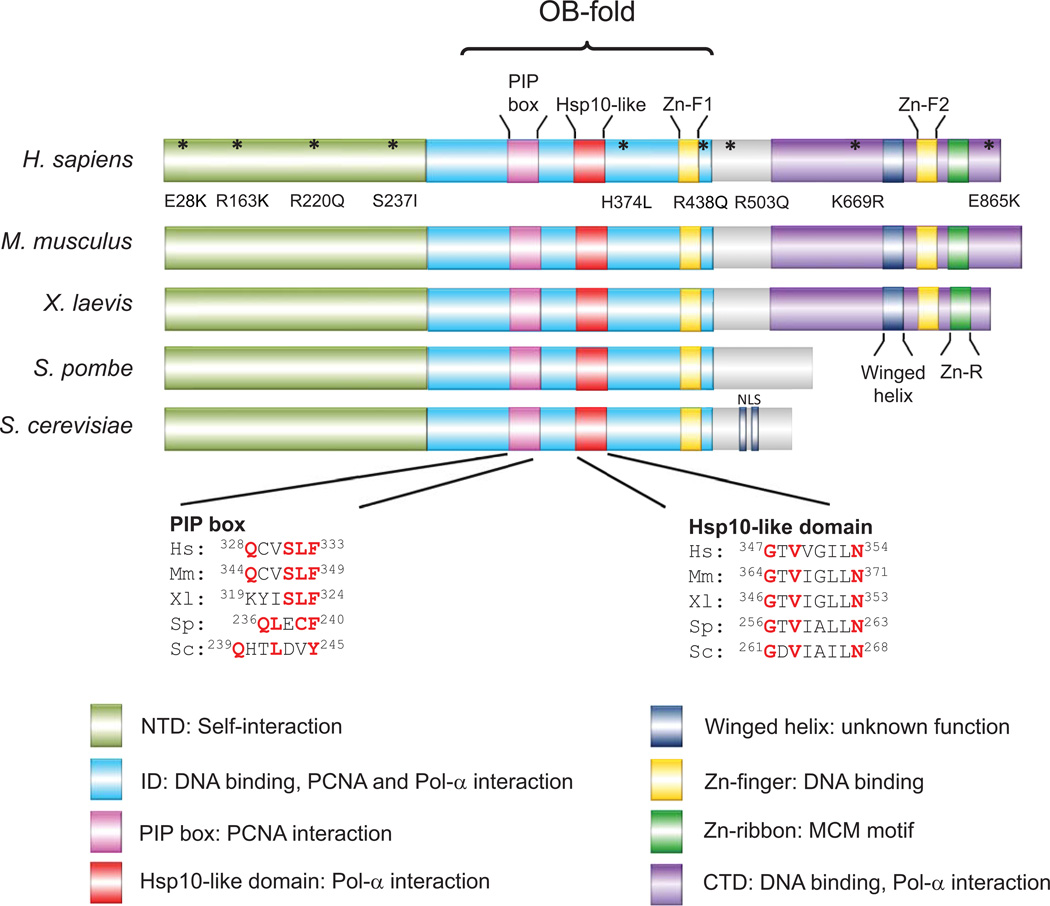
Functional domains of Mcm10 across species. The N-terminal domain (NTD), although not highly conserved, is responsible for self-interaction of Mcm10. The internal domain (ID) is the most highly conserved region of the protein. It comprises an oligonucleotide/oligosaccharide (OB)-fold, PCNA-interacting peptide (PIP) box and Hsp10-like domain, which mediate DNA-binding, PCNA interaction and Pol-α binding, respectively. The positions and sequence alignments of the PIP-box and Hsp10-like domain from different species are shown. The PIP box in all species (except S. cerevisiae) resembles the consensus sequence of the prokaryotic β-clamp binding site (QLsLF, s=small amino acid). The PIP box in S. cerevisiae matches the canonical PIP box (QXXM/I/LXXF/YF/Y, X=any amino acid). Both Zn-finger motifs facilitate DNA-binding: the first (Zn-F1) is conserved across species while the second (Zn-F2) is present in the C-terminal domain (CTD), a domain specific to metazoans. The asterisks in human Mcm10 indicate mutations identified in cancer cells (www.sanger.ac.uk); exact residues are shown underneath. Nuclear localization sequences (NLS) have only been identified in budding yeast. (Hs: Homo sapiens; Mm: Mus musculus; Xl: Xenopus laevis; Sp: Saccharomyces pombe; Sc: Saccharomyces cerevisiae)
Figure I
Figure I
Synthetic genetic interactions of mcm10. (a) Summary of genes that are synthetically lethal with mcm10 or cdc23 (the fission yeast mcm10 homolog), including various replication genes, double stranded break repair genes and checkpoint genes [, –69]. Red and blue colors indicate essential and nonessential genes, respectively. Underlined genes indicate physical interactions between the corresponding gene products and Mcm10 [6, 10, 22, 29, 33, 35, 39, 44, 67, 69, 77]. (b) Synthetic genetic array analysis identified genes that are synthetically sick (red line) or synthetically healthier (green line) with mcm10-1. The analysis was performed at 30°C with an array of non-essential single gene deletion mutants. The thickness of the lines indicates the relative intensity of the interaction.

References

    1. Bell SP, Dutta A. DNA replication in eukaryotic cells. Annu Rev Biochem. 2002;71:333–374. - PubMed
    1. Masai H, et al. Eukaryotic chromosome DNA replication: where, when, and how? Annu Rev Biochem. 2011;79:89–130. - PubMed
    1. Moyer SE, et al. Isolation of the Cdc45/Mcm2-7/GINS (CMG) complex, a candidate for the eukaryotic DNA replication fork helicase. Proc Natl Acad Sci U S A. 2006;103:10236–10241. - PMC - PubMed
    1. Wohlschlegel JA, et al. Xenopus Mcm10 binds to origins of DNA replication after Mcm2-7 and stimulates origin binding of Cdc45. Mol Cell. 2002;9:233–240. - PubMed
    1. Kanke M, et al. Mcm10 plays an essential role in origin DNA unwinding after loading of the CMG components. EMBO J. 2012;31:2182–2194. - PMC - PubMed

Publication types

MeSH terms

LinkOut - more resources