. 2013 Feb 7;92(2):238-44.
doi: 10.1016/j.ajhg.2012.11.021. Epub 2013 Jan 17.

Loss of function of glucocerebrosidase GBA2 is responsible for motor neuron defects in hereditary spastic paraplegia

Affiliations

Loss of function of glucocerebrosidase GBA2 is responsible for motor neuron defects in hereditary spastic paraplegia

Elodie Martin et al. Am J Hum Genet. .

Abstract

Spastic paraplegia 46 refers to a locus mapped to chromosome 9 that accounts for a complicated autosomal-recessive form of hereditary spastic paraplegia (HSP). With next-generation sequencing in three independent families, we identified four different mutations in GBA2 (three truncating variants and one missense variant), which were found to cosegregate with the disease and were absent in controls. GBA2 encodes a microsomal nonlysosomal glucosylceramidase that catalyzes the conversion of glucosylceramide to free glucose and ceramide and the hydrolysis of bile acid 3-O-glucosides. The missense variant was also found at the homozygous state in a simplex subject in whom no residual glucocerebrosidase activity of GBA2 could be evidenced in blood cells, opening the way to a possible measurement of this enzyme activity in clinical practice. The overall phenotype was a complex HSP with mental impairment, cataract, and hypogonadism in males associated with various degrees of corpus callosum and cerebellar atrophy on brain imaging. Antisense morpholino oligonucleotides targeting the zebrafish GBA2 orthologous gene led to abnormal motor behavior and axonal shortening/branching of motoneurons that were rescued by the human wild-type mRNA but not by applying the same mRNA containing the missense mutation. This study highlights the role of ceramide metabolism in HSP pathology.


Figures

Figure 1
Figure 1
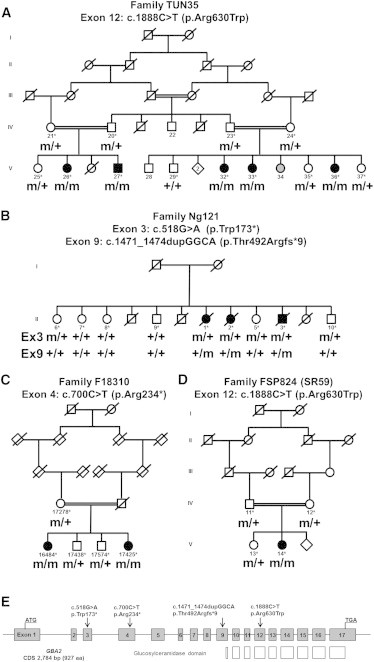
Mutations in GBA2 (A–D) Family trees and segregation analysis of the mutations identified in individuals of families TUN35 (A), Ng121 (B), F18310 (C), and FSP824 (D). The following symbols are used: squares for males, circles for females; filled symbols for affected individuals; gray symbols for subjects not clinically assessed; double line for consanguinity; m, mutation; +, wild-type; , sampled individuals. Sequencing chromatograms of mutations c.518G>A (p.Trp173), c.700C>T (p.Arg234), c.1888C>T (p.Arg630Trp), and c.1471_1474dupGGCA (p.Thr492Argfs9) are in Figure S1. (E) Graphic representation of the exon organization of GBA2 on chromosome 9 (gray boxes) and the location of the mutations (black arrows). The GBA2 transcript is 3,611 bp long (CDS 2,784 bp) and is composed of 17 exons that encode a 927 amino acid protein. White boxes show the exons encoding the glucosylceramidase domain.
Figure 2
Figure 2
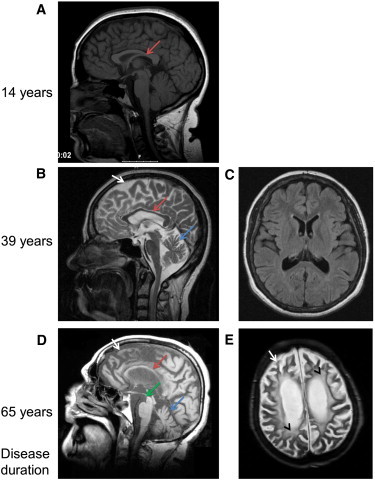
Brain Imaging in SPG46-Affected Individuals (A) Sagittal brain magnetic resonance imaging (MRI) in subject FSP824-V.14 after 14 years of disease duration, showing a very slight thinning of the corpus callosum (red arrow). (B and C) Sagittal and transversal flair MRI of individual F18310-V.16484 after 39 years of disease duration. The atrophy of the corpus callosum (B, red arrow) and of the cerebellar (B, blue arrow) and cerebral (B, white arrow) cortex are evident in the absence of relevant white matter disease (C). (D and E) Sagittal T1- and transversal axial T2-weighted MRI images of subject Ng121-II.2 after 65 years of disease duration, showing severe atrophy of her cerebellum (D, blue arrow) and cerebrum (white arrows) with mesencephalon atrophy (D, hummingbird/colibri sign, green arrow) and pronounced white matter lesions (E, black arrowhead).
Figure 3
Figure 3
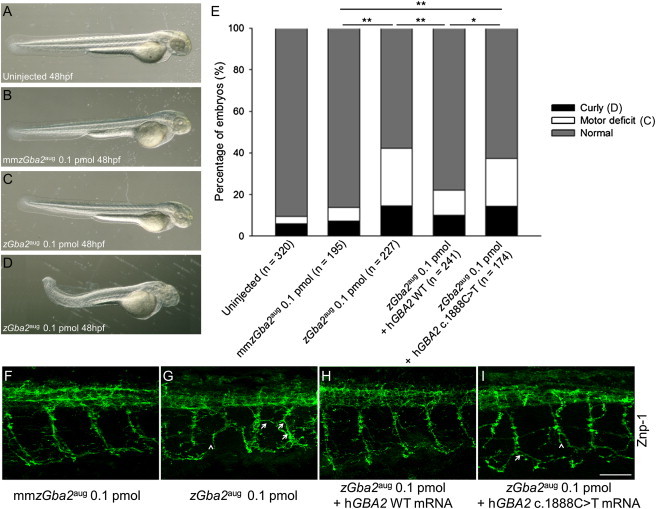
zGba2 Inactivation Induces Morphological Phenotypes and Abnormal Motoneuronal Outgrowth in Zebrafish Larvae (A–D) Whereas 48 hpf embryos injected with 0.1 pmol of the control AMO mmzGba2aug (B) were phenotypically indistinguishable from noninjected controls (A), injection of 0.1 pmol zGba2aug (D) impaired embryonic development of the caudal region, with some morphants showing shortened and/or twisted tails. Most of the injected morphants were normal looking even when they showed abnormal locomotion (C). Magnification ×44. (E) Classification of morphant phenotypes observed after injection of AMOs with or without mRNA. The numbers of noninjected controls and different zGba2 morphants are indicated in parentheses. p < 0.002, ∗∗p < 0.001. (F–I) Noninjected and zGba2 morphants were analyzed for Znp-1 staining in spinal neurons. In contrast to noninjected larvae and to morphants injected with mmzGba2 (F) or zGba2aug + hGBA2 WT mRNA (H), morphants injected with the zGba2aug AMO in presence (I) or absence (G) of the mutated c.1888C>T RNA showed dramatically impaired axonal outgrowth leading to truncated axons (arrowheads). Axon trajectories are disturbed; ectopic and aberrant motor axon branches can be seen (arrows). Scale bar represents 50 μm.

References

    1. Harding A.E. Classification of the hereditary ataxias and paraplegias. Lancet. 1983;1:1151–1155. - PubMed
    1. Schüle R., Schöls L. Genetics of hereditary spastic paraplegias. Semin. Neurol. 2011;31:484–493. - PubMed
    1. Finsterer J., Löscher W., Quasthoff S., Wanschitz J., Auer-Grumbach M., Stevanin G. Hereditary spastic paraplegias with autosomal dominant, recessive, X-linked, or maternal trait of inheritance. J. Neurol. Sci. 2012;318:1–18. - PubMed
    1. Boukhris A., Feki I., Elleuch N., Miladi M.I., Boland-Augé A., Truchetto J., Mundwiller E., Jezequel N., Zelenika D., Mhiri C. A new locus (SPG46) maps to 9p21.2-q21.12 in a Tunisian family with a complicated autosomal recessive hereditary spastic paraplegia with mental impairment and thin corpus callosum. Neurogenetics. 2010;11:441–448. - PubMed
    1. Li H., Durbin R. Fast and accurate short read alignment with Burrows-Wheeler transform. Bioinformatics. 2009;25:1754–1760. - PMC - PubMed

Publication types

MeSH terms