


Review
doi: 10.1016/j.smim.2012.12.001.
Epub 2013 Jan 18.
The immune system's involvement in obesity-driven type 2 diabetes
Affiliations
- PMID: 23333525
- PMCID: PMC3582811
- DOI: 10.1016/j.smim.2012.12.001
Item in Clipboard
Review
The immune system's involvement in obesity-driven type 2 diabetes
Semin Immunol.
2012 Dec.
Abstract
Type 2 diabetes is now a worldwide epidemic, strongly correlated with an elevated incidence of obesity. Obesity-associated adipose tissue inflammation is a major cause of the decreased insulin sensitivity seen in type 2 diabetes. Recent studies have shed light on the cross-talk between the immune system and organismal metabolism. This review discusses the connection between inflammation in adipose tissue and systemic insulin resistance, focusing on the roles of innate and adaptive immune cell subsets in the pathogenesis of this metabolic disease.
Copyright © 2012 Elsevier Ltd. All rights reserved.
Figures
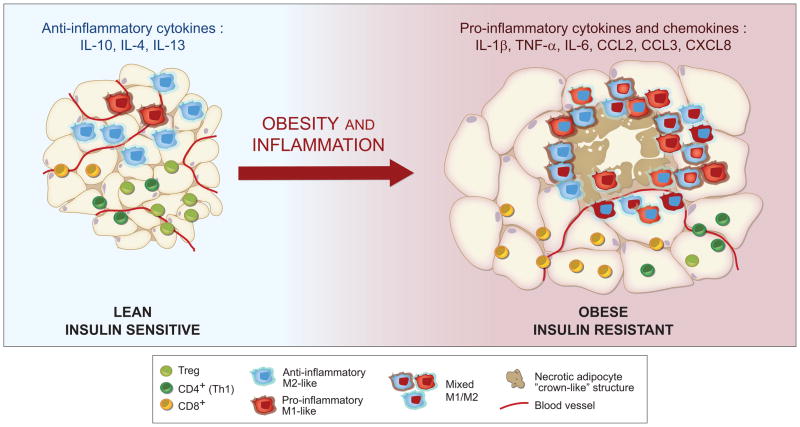
Lean adipose tissue has elevated fractions of anti-inflammatory M2-like ATMs and Tregs, the local environment is dominated by anti-inflammatory cytokines (IL-10, IL-4, IL-13). Long-term nutrient excess leads to apoptotic and necrotic death of adipocytes, as well as decreased vascularity. Upon obesity, the adipose tissue has a mixed M1/M2 phenotype of ATMs, more CD8+ T cells than CD4+ Th1 cells, and fewer Tregs. The effector cells promote chronic inflammation through the production of pro-inflammatory cytokines and chemokines (IL-1β, TNF-α, IL-6, CCL2, CCL3, CXCL8). Graphics by Catherine Laplace.
References
Publication types
MeSH terms
Grants and funding
LinkOut - more resources
Full Text Sources
Other Literature Sources
Medical
