


Hysterectomy surgery trends: a more accurate depiction of the last decade?
- PMID: 23333543
- PMCID: PMC3610857
- DOI: 10.1016/j.ajog.2013.01.022
Hysterectomy surgery trends: a more accurate depiction of the last decade?
Abstract
Objective: The objective of the study was to describe trends in hysterectomy route at a large tertiary center.
Study design: We reviewed all hysterectomies performed at Magee-Womens Hospital from 2000 to 2010. This database was chosen over larger national surveys because it has been tracking laparoscopic procedures since 2000, well before laparoscopic hysterectomy International Classification of Diseases, ninth revision (ICD-9) procedure codes were developed.
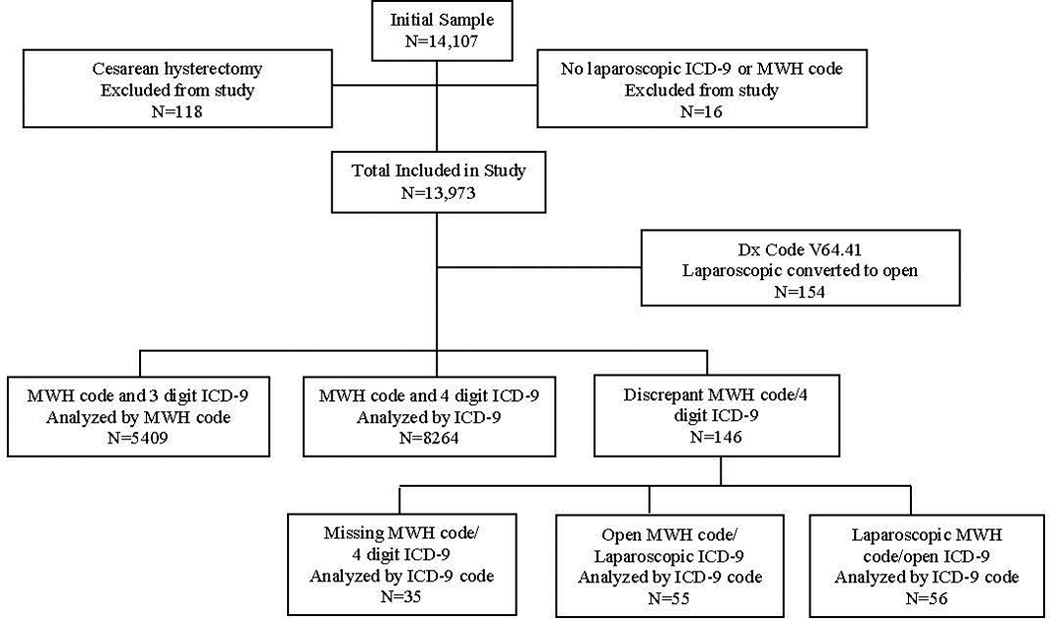
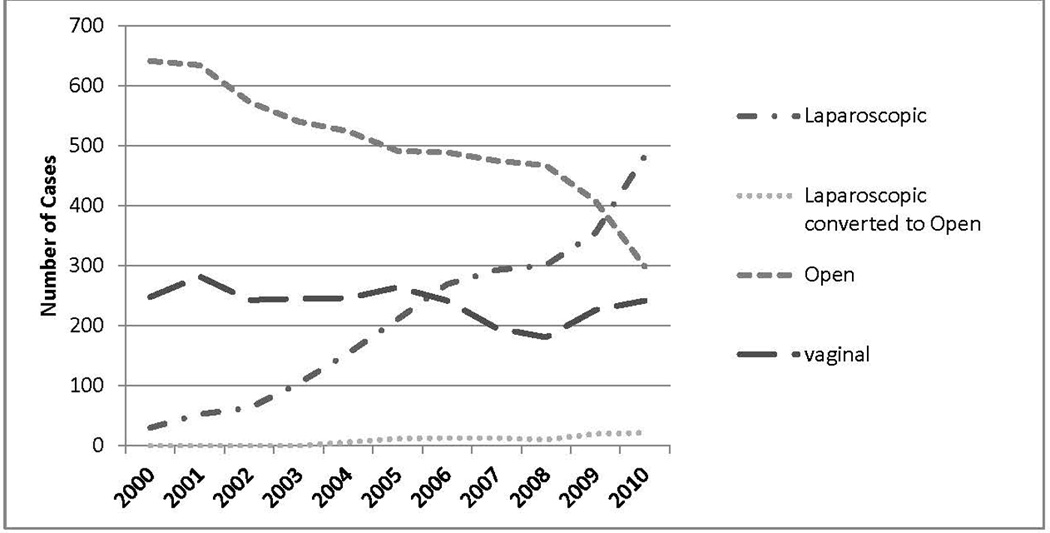
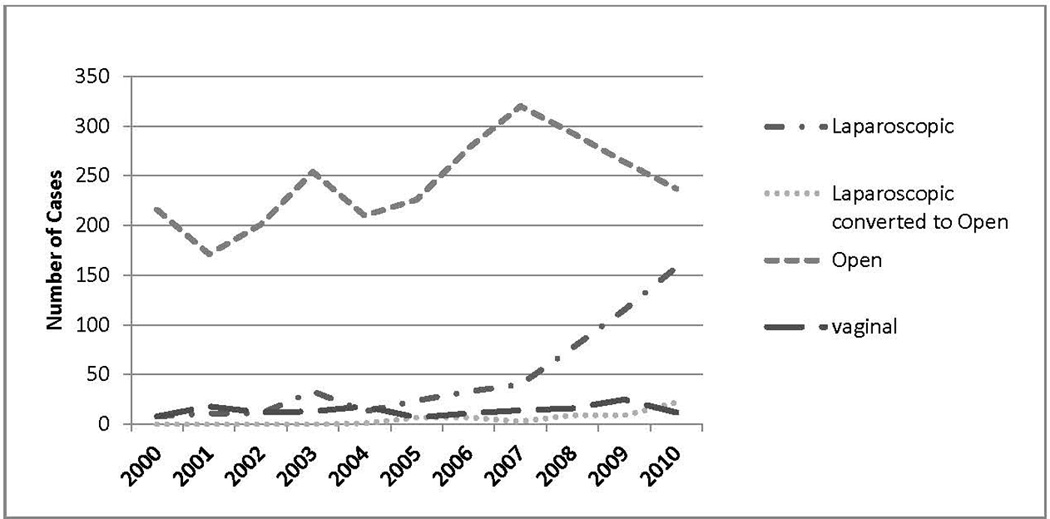
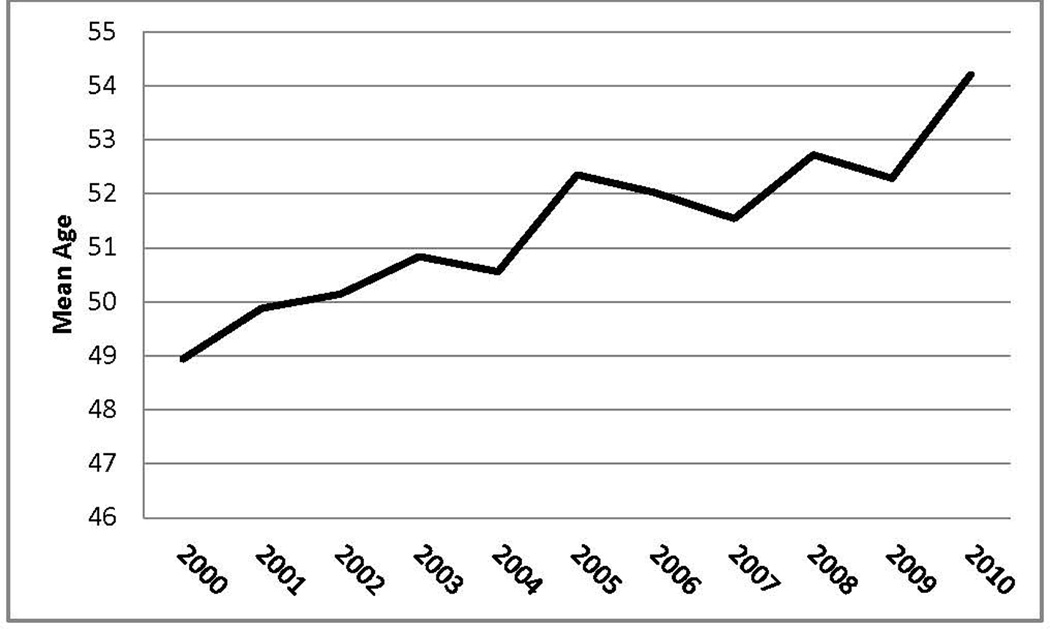
Results: There were 13,973 patients included who underwent hysterectomy at Magee-Womens Hospital. In 2000, 3.3% were laparoscopic (LH), 74.5% abdominal (AH), and 22.2% vaginal hysterectomy (VH). By 2010, LH represented 43.5%, AH 36.3%, VH 17.2%, and 3.0% laparoscopic converted to open (LH→AH). Hysterectomies performed for gynecological malignancy represented 24.4% of cases. The average length of stay for benign LH and VH, 1.0 ± 1.0 and 1.6 ± 1.0 days respectively, was significantly shorter than the average 3.1 ± 2.3 day stay associated with AH (P < .001). The average patient age was 46.9 ± 10.9 years for LH, 51.5 ± 12.1 years for AH, and 51.7 ± 14.1 years for VH, and over the study period there was a significant trend of increasing patient age (b1 = 0.517, 0.583, and 0.513, respectively [P < .001 for all]).
Conclusion: The percentage of LH increased over the last decade and by 2010 had surpassed AH. The 43.4% LH rate in 2010 is much higher than previously reported in national surveys. This likely is due to an increase in the number of laparoscopic procedures being performed over the last few years as well as the ability of our study to capture LH prior to development of appropriate ICD-9 procedure codes. Our unique ability to determine hysterectomy route, which predates appropriate coding, may provide a more accurate characterization of hysterectomy trends.
Copyright © 2013 Mosby, Inc. All rights reserved.
Conflict of interest statement
Disclosures: The authors report no conflict of interest.
Figures
References
-
- CDC website. National Center for Health Statistics. Number of all-listed procedures for discharges from short-stay hospitals: United States, 2010. 2013 Jan; http://www.cdc.gov/nchs/data/nhds/10Detaileddiagnosesprocedures/2010det1...,
-
- Reich H, DeCaprio J, McGlynn F. Laparoscopic hysterectomy. J Gynecol Surg. 1989;5:213.
-
- Nieboer TE, Johnson N, Lethaby A, Tavender E, Curr L, Garry R, van Voorst S, Mol MWJ, Kluivers KB. Surgical approach to hysterectomy for benign gynaecological disease. Cochrane Database of Systematic Reviews. 2009;(Issue 3) Art. No.CD003677. - PubMed
-
- Farquhar CM, Steiner CA. Hysterectomy rates in the United Sstates 1990–1997. Obstet Gynecol. 2002;22:229–234. - PubMed
Publication types
MeSH terms
Grants and funding
LinkOut - more resources
Full Text Sources
Other Literature Sources
Medical
