. 2013 Mar;122(1-2):121-34.
doi: 10.1007/s00412-013-0396-y. Epub 2013 Jan 20.

An Eco1-independent sister chromatid cohesion establishment pathway in S. cerevisiae

Affiliations

An Eco1-independent sister chromatid cohesion establishment pathway in S. cerevisiae

Vanessa Borges et al. Chromosoma. 2013 Mar.

Abstract

Cohesion between sister chromatids, mediated by the chromosomal cohesin complex, is a prerequisite for their alignment on the spindle apparatus and segregation in mitosis. Budding yeast cohesin first associates with chromosomes in G1. Then, during DNA replication in S-phase, the replication fork-associated acetyltransferase Eco1 acetylates the cohesin subunit Smc3 to make cohesin's DNA binding resistant to destabilization by the Wapl protein. Whether stabilization of cohesin molecules that happen to link sister chromatids is sufficient to build sister chromatid cohesion, or whether additional reactions are required to establish these links, is not known. In addition to Eco1, several other factors contribute to cohesion establishment, including Ctf4, Ctf18, Tof1, Csm3, Chl1 and Mrc1, but little is known about their roles. Here, we show that each of these factors facilitates cohesin acetylation. Moreover, the absence of Ctf4 and Chl1, but not of the other factors, causes a synthetic growth defect in cells lacking Eco1. Distinct from acetylation defects, sister chromatid cohesion in ctf4Δ and chl1Δ cells is not improved by removing Wapl. Unlike previously thought, we do not find evidence for a role of Ctf4 and Chl1 in Okazaki fragment processing, or of Okazaki fragment processing in sister chromatid cohesion. Thus, Ctf4 and Chl1 delineate an additional acetylation-independent pathway that might hold important clues as to the mechanism of sister chromatid cohesion establishment.


Figures

Fig. 1
Fig. 1
Cohesion establishment factors contribute to Smc3 acetylation. a Cells of the indicated genotypes were synchronized in G1 by α-factor treatment and released into nocodazole-imposed mitotic arrest. FACS analysis of the DNA content was used to monitor cell cycle progression. The Smc3 acetylation status was analyzed by Western blotting using an α-acetyl-Smc3 antibody. Total Smc3 levels served as the loading control and were detected using an antibody against its C-terminally fused Pk epitope. b The acetyl-Smc3 signal and loading control were quantified in three independent experiments and the mean and standard deviation of the normalized Smc3 acetylation levels are depicted. c Eco1 levels are comparable between wild type and cohesion establishment factor deficient cells. Cultures were synchronized in G1 using α-factor and released in hydroxyurea (HU)-containing medium. Eco1 protein levels were compared between the indicated strains by Western blotting against its HA epitope tag. Swi6 served as the loading control
Fig. 2
Fig. 2
Cohesin acetylation levels and cohesion defect do not strictly correlate. a Smc3-Pk was immunopurified from extracts of the indicated cells, progressing through a synchronous cell cycle following α-factor block and release into nocodazole-imposed mitotic arrest at 23 °C. The Smc3 acetylation status was analyzed by Western blotting. FACS analysis of the DNA content was used to monitor cell cycle progression. b Cells of the indicated genotypes were synchronized in G1 using α-factor and released into nocodazole-imposed mitotic arrest at 23 °C. Sister chromatid cohesion at the GFP-marked URA3 locus was analyzed
Fig. 3
Fig. 3
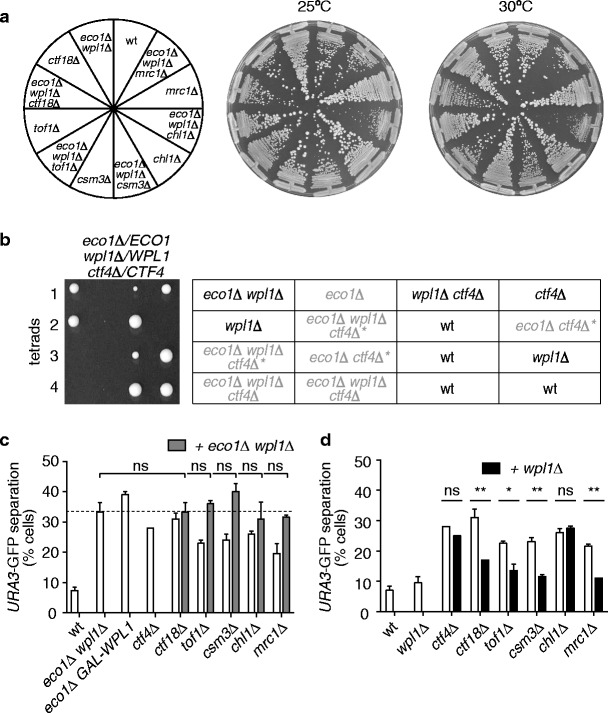
Ctf4 and Chl1 define a subset of Eco1-independent cohesion establishment factors. a chl1Δ deletion, but not other cohesion establishment factor deletions, causes a synthetic growth defect in the eco1Δ wpl1Δ background. Strains of the indicated genotypes were streaked on YPD medium and incubated at the indicated temperatures for 2–3 days. b Ctf4 is essential in the eco1Δ wpl1Δ background. A ctf4Δ/CTF4 eco1Δ/ECO1 wpl1Δ/WPL1 heterozygous diploid was sporulated, and the genotype of the viable spores in each tetrad was determined. Inferred genotypes of unviable spores are in gray. Asterisks (*) denote pairs of spores with either of the two indicated genotypes. c Search for additive cohesion defects in a eco1Δ wpl1Δ strain. Strains of the indicated genotypes were synchronized in G1 by α-factor block and released into nocodazole-imposed mitotic arrest. Sister chromatid cohesion at the GFP-marked URA3 locus was analyzed in 100 cells. The mean and standard deviation from three experiments are indicated. A dashed line marks the cohesion defect of the eco1Δ wpl1Δ strain. A binomial test showed that the cohesion defect differences of strains containing additional establishment factor deletions were not statistically significant (ns). d Rescue of the cohesion defect in most cohesion establishment factor mutants, but not ctf4Δ and chl1Δ, by wpl1Δ deletion. Strains of the indicated genotypes were synchronized in G1 by α-factor block and released into nocodazole-imposed mitotic arrest. Sister chromatid cohesion was analyzed as in c. The significance of the sister chromatid cohesion rescue by wpl1Δ deletion was analyzed using a binomial test (*p < 0.05; **p < 0.005; ns, not significant)
Fig. 4
Fig. 4
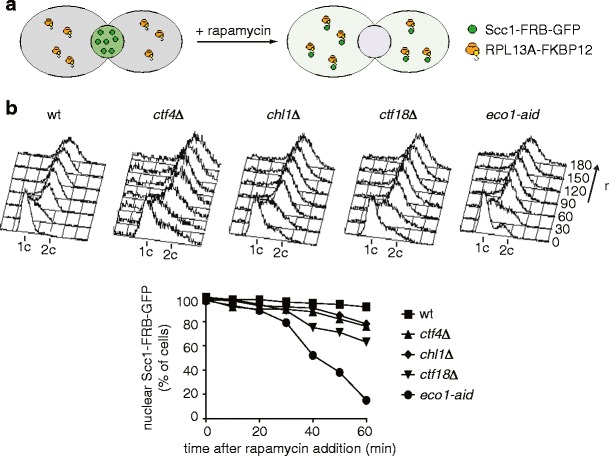
Effect of cohesion establishment mutants on cohesin stability on chromosomes. a Schematic of the anchor-away experiment to measure the persistence of nuclear Scc1-GFP enrichment as readout for cohesin stability on chromosomes. b Strains of the indicated genotypes were synchronized in G1 by α-factor block. 500 μM auxin was added to the growth medium to degrade Eco1-aid before release into nocodazole-imposed mitotic arrest. Next, 1 μM rapamycin was added (+r) and samples taken in 10-min intervals (compare Lopez-Serra et al. 2013). FACS analysis of DNA content is shown to monitor cell cycle progression. The fraction of cells with visible nuclear Scc1-GFP retention is indicated
Fig. 5
Fig. 5
Relationship between Ctf4, Chl1 and cohesin. a No additive cohesion defects when combining ctf4Δ and chl1Δ deletions. Strains of the indicated genotypes were synchronized in G1 by α-factor block and released into nocodazole-imposed mitotic arrest. Sister chromatid cohesion at the GFP-marked URA3 locus was analyzed. b Ctf4 and Chl1 are not part of a stable protein complex. Epitope-tagged Chl1 or Pol1 were immunoprecipitated using an α-Pk antibody and coprecipitation of Ctf4 was analyzed by immunoblotting. Whole cell extracts (WCE) and immunoprecipitates (IP) are shown. c chl1Δ deletion reduces cohesin association with chromosomes. Wild type and chl1Δ cells were arrested in mitosis by nocodazole treatment. Cells were processed for chromatin immunoprecipitation against the Pk epitope-tagged cohesin subunit Scc1. Chromatin immunoprecipitates were analyzed by quantitative PCR at three cohesin binding sites at convergent intergenic regions on chromosome arms and three centromeres. Mean and standard deviation of three repeats of the experiment are shown. d Cells of the indicated genotypes were synchronized in G1 by α-factor treatment and released into either HU or nocodazole (NOC)-containing media. Aliquots of the cultures were taken before synchronization (cycling cells [cyc]). Whole cell extracts (WE) were separated into supernatant (SU) and chromatin (CP) fractions, and Scc1-Pk was detected by immunoblotting. Tubulin and Hmo1 served as loading controls for the supernatant and chromatin fractions, respectively
Fig. 6
Fig. 6
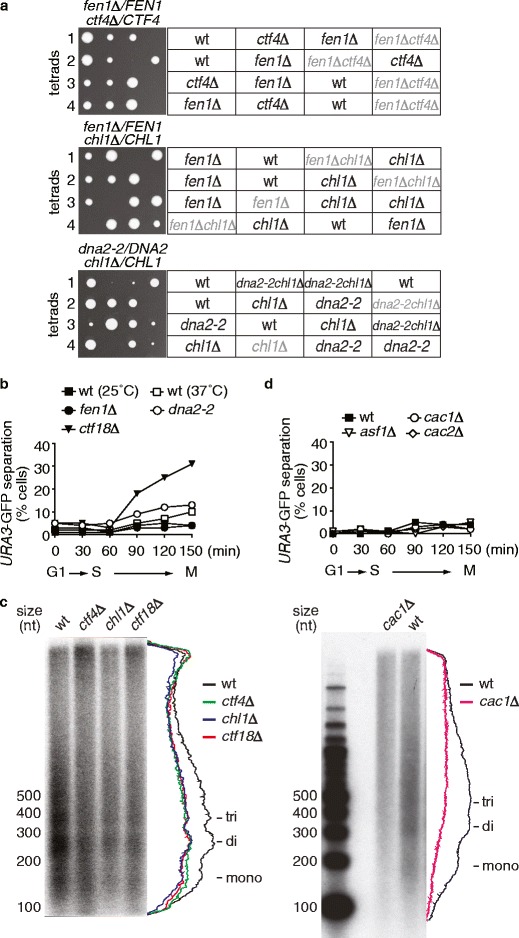
Relationship of Ctf4, Chl1 and Okazaki fragment processing. a Synthetic lethality of chl1Δ and ctf4Δ with fen1Δ and poor growth of chl1Δ in combination with the dna2-2 allele. Heterozygous diploid strains of the indicated genotypes were sporulated and the genotype of the viable spores in each tetrad was determined. Inferred genotypes of unviable spores are in gray. b Budding yeast cells lacking Fen1, or carrying the dna2-2 allele, show intact sister chromatid cohesion. Strains of the indicated genotypes were synchronized in G1 by α-factor block and released into nocodazole-imposed mitotic arrest. Sister chromatid cohesion at the GFP-marked URA3 locus was analyzed. fen1Δ and ctf18Δ cells, for comparison, were grown at 25 °C, dna2-2 cells were released from G1 at 37 °C. A wild type control at each temperature is included. c Unchanged Okazaki fragment length distribution in cells lacking Ctf4, Chl1 or Ctf18. DNA ligase I was inactivated in the indicated strain backgrounds and the Okazaki fragment length distribution analyzed as described (Smith and Whitehouse 2012). An intensity scan of each lane is included and the position of mono-, di-, and trinucleosome sized fragments is indicated. For comparison, cac1Δ cells were analyzed, in which Okazaki fragments are longer. d Increased Okazaki fragment length, observed in cells with compromised replication-coupled chromatin assembly, does not cause a sister chromatid cohesion defect. Strains of the indicated genotypes were synchronized in G1 by α-factor block and released into nocodazole-imposed mitotic arrest at 25 °C. Sister chromatid cohesion at the GFP-marked URA3 locus was analyzed

References

    1. Alcasabas AA, Osborn AJ, Bachant J, Hu F, Werler PJH, Bousset K, Furuya K, Diffley JF, Carr AM, Elledge SJ. Mrc1 transduces signals of DNA replication stress to activate Rad53. Nat Cell Biol. 2001;3:958–965. doi: 10.1038/ncb1101-958. - DOI - PubMed
    1. Bando M, Katou Y, Komata M, Tanaka H, Itoh T, Sutani T, Shirahige K. Csm3, Tof1, and Mrc1 form a heterotrimeric mediator complex that associates with DNA replication forks. J Biol Chem. 2009;284:34355–34365. doi: 10.1074/jbc.M109.065730. - DOI - PMC - PubMed
    1. Ben-Shahar TR, Heeger S, Lehane C, East P, Flynn H, Skehel M, Uhlmann F. Eco1-dependent cohesin acetylation during establishment of sister chromatid cohesion. Science. 2008;321:563–566. doi: 10.1126/science.1157774. - DOI - PubMed
    1. Bermudez VP, Maniwa Y, Tappin I, Ozato K, Yokomori K, Hurwitz J. The alternative Ctf18–Dcc1–Ctf8-replication factor C complex required for sister chromatid cohesion loads proliferating cell nuclear antigen onto DNA. Proc Natl Acad Sci USA. 2003;100:10237–10242. doi: 10.1073/pnas.1434308100. - DOI - PMC - PubMed
    1. Bernard P, Schmidt CK, Vaur S, Dheur S, Drogat J, Genier S, Ekwall K, Uhlmann F, Javerzat JF. Cell-cycle regulation of cohesin stability along fission yeast chromosomes. EMBO J. 2008;27:111–121. doi: 10.1038/sj.emboj.7601955. - DOI - PMC - PubMed

Publication types

MeSH terms

LinkOut - more resources