


Brief report: difficulty in understanding social acting (but not false beliefs) mediates the link between autistic traits and ingroup relationships
- PMID: 23334807
- PMCID: PMC4215940
- DOI: 10.1007/s10803-013-1757-3
Brief report: difficulty in understanding social acting (but not false beliefs) mediates the link between autistic traits and ingroup relationships
Abstract
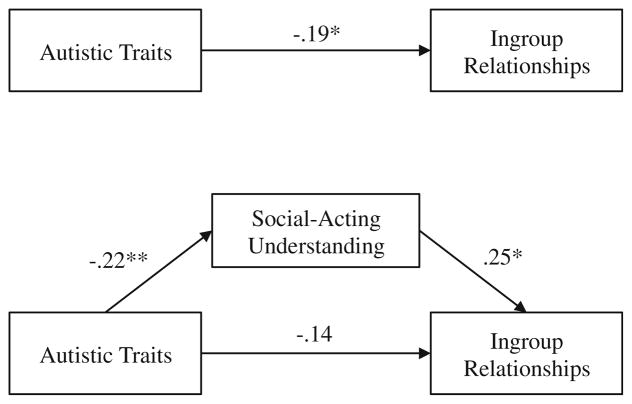
Why do individuals with more autistic traits experience social difficulties? Here we examined the hypothesis that these difficulties stem in part from a challenge in understanding social acting, the prosocial pretense that adults routinely produce to maintain positive relationships with their ingroup. In Study 1, we developed a self-administered test of social-acting understanding: participants read stories in which a character engaged in social acting and rated the appropriateness of the character's response. Adults who scored 26 or higher on the Autism Spectrum Quotient (AQ) questionnaire gave significantly lower ratings than comparison participants (AQ < 26). Study 2 found that difficulty in understanding social acting, but not false beliefs, mediated the link between autistic traits and perceived ingroup relationships.
Figures
References
-
- Badenes LV, Estevan RAC, Bacete FJG. Theory of mind and peer rejection at school. Social Development. 2000;9:271–283.
-
- Baillargeon R, He Z, Setoh P, Scott R, Sloane S, Yang DY-J. False-belief understanding and why it matters: The social-acting hypothesis. To appear. In: Banaji MR, Gelman S, editors. Navigating the social world: What infants, children, and other species can teach us. New York: Oxford University Press; (in press-a)
-
- Baillargeon R, Scott RM, He Z, Sloane S, Setoh P, Jin K, Bian L. Psychological and sociomoral reasoning in infancy. In: Shaver P, Mikulincer M, Borgida E, Bargh J, editors. APA handbook of personality and social psychology: Vol.1. Attitudes and social cognition. Washington, DC: APA; (in press-b)
-
- Banerjee R, Watling D, Caputi M. Peer relations and the understanding of faux pas: Longitudinal evidence for bidirectional associations. Child Development. 2011;82(6):1887–1905. - PubMed
-
- Baron-Cohen S, O’Riordan M, Stone V, Jones R, Plaisted K. Recognition of faux pas by normally developing children and children with Asperger syndrome or high-functioning autism. Journal of Autism and Developmental Disorders. 1999;29:407–418. - PubMed
Publication types
MeSH terms
Grants and funding
LinkOut - more resources
Full Text Sources
Other Literature Sources
Medical
