Review
. 2013 Mar 15;288(11):7430-7437.
doi: 10.1074/jbc.R112.444158. Epub 2013 Jan 18.

Discoidin domain receptors: unique receptor tyrosine kinases in collagen-mediated signaling

Affiliations
Review

Discoidin domain receptors: unique receptor tyrosine kinases in collagen-mediated signaling

Hsueh-Liang Fu et al. J Biol Chem. .

Abstract

The discoidin domain receptors (DDRs) are receptor tyrosine kinases that recognize collagens as their ligands. DDRs display unique structural features and distinctive activation kinetics, which set them apart from other members of the kinase superfamily. DDRs regulate cell-collagen interactions in normal and pathological conditions and thus are emerging as major sensors of collagen matrices and potential novel therapeutic targets. New structural and biological information has shed light on the molecular mechanisms that regulate DDR signaling, turnover, and function. This minireview provides an overview of these areas of DDR research with the goal of fostering further investigation of these intriguing and unique receptors.


Figures
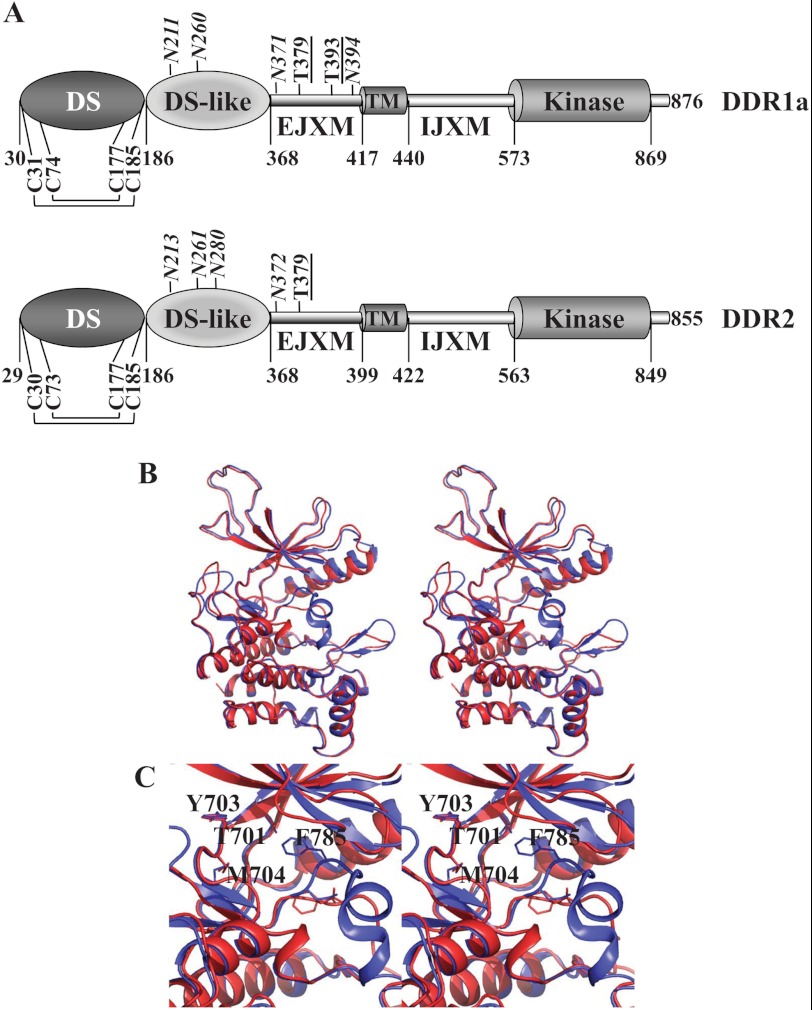
FIGURE 1.
FIGURE 1.
A, domain structure of DDRs. Only cysteine residues involved in intramolecular disulfide bond formation are shown. Predicted N-glycosylation (italic) and O-glycosylation (underlined) sites are indicated. B, ribbon representation of the modeled DFG-in (red) and DFG-out (blue) conformations of the DDR1a KD shown in stereo. C, close-up stereoview of the catalytic pocket with several key residues in stick representation.
FIGURE 2.
FIGURE 2.
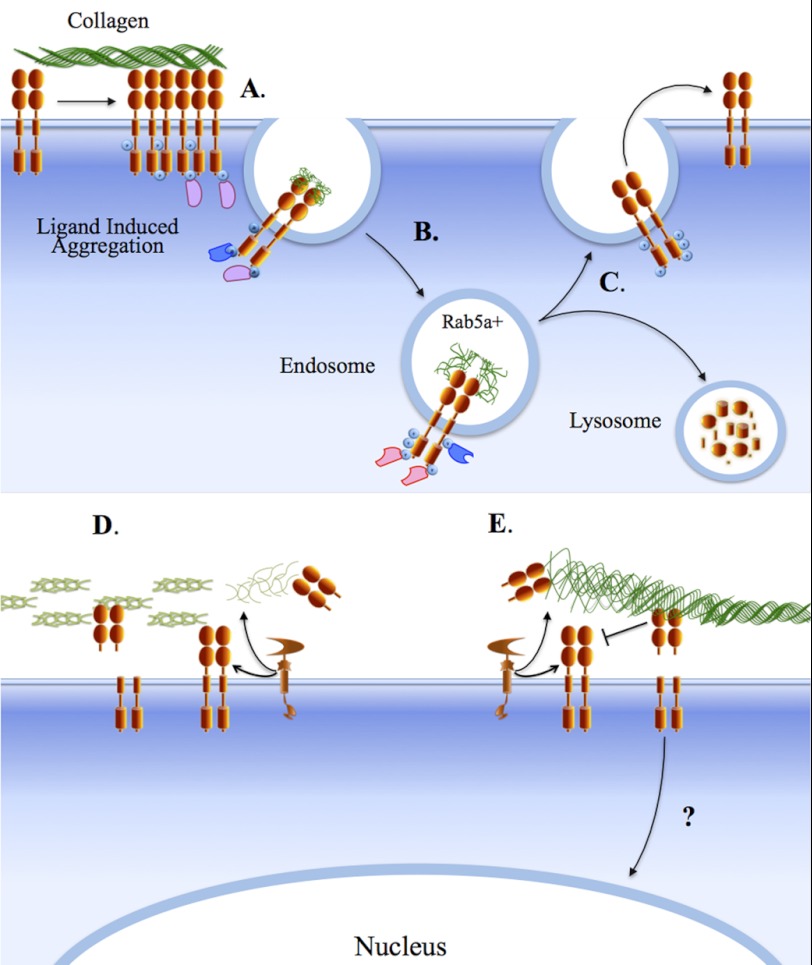
DDR1 endocytosis and shedding. Activation of DDR1 dimers by collagen induces receptor aggregation (A) and triggers endocytosis of the receptor-ligand complex into Rab5-positive endosomes (B), which can lead to lysosomal degradation or recycling of the receptor to the cell surface (C). The presence of the NPXY motif within the IJXM region of the DDR1b and DDR1c isoforms may confer on these receptors a unique endocytic trafficking route by mediating association with specific adaptor/scaffold proteins (pink and blue shapes). Within the endosomal compartment, DDR1 may display continued signaling. DDR1 is cleaved by metalloproteinases, including MT-MMPs and ADAMs, at the cell surface, releasing the ectodomain and generating a C-terminal fragment (D and E). Together with the full-length receptor, the released DDR1 ectodomain can play a role in regulation of collagen fibrillogenesis (D) and or block ligand binding (E). The action of MT-MMPs on collagen may also regulate DDR1 signaling by altering the integrity of the collagen matrix (D and E). The C-terminal fragment of DDR1 may translocate to the nucleus (E). At present, there is no information on DDR2 internalization and shedding.
FIGURE 3.
FIGURE 3.
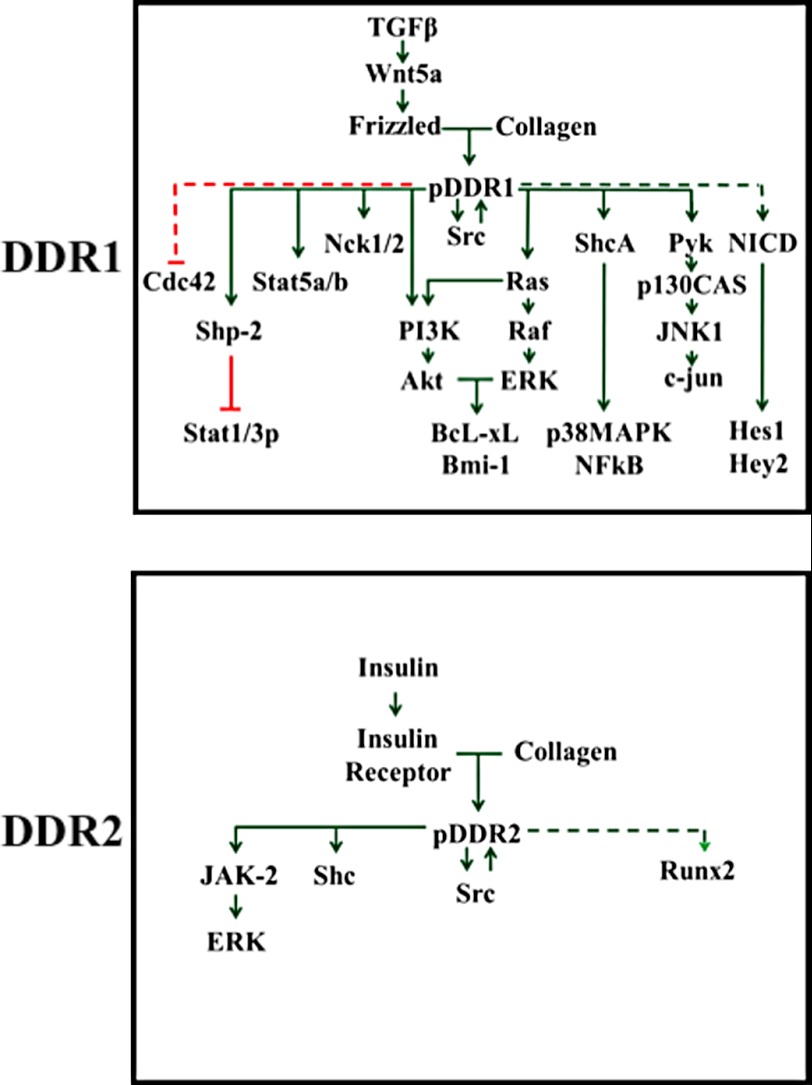
DDR signaling. The wiring diagram depicts signaling effectors of DDR activated in response to collagen. Solid and dashed green arrows indicate direct and indirect positive signaling effectors upstream and downstream of phosphorylated DDRs (pDDR), respectively. Red lines indicate direct (solid) and indirect (dashed) negative effects of phosphorylated DDRs on signaling effectors.

References

    1. Johnson J. D., Edman J. C., Rutter W. J. (1993) A receptor tyrosine kinase found in breast carcinoma cells has an extracellular discoidin I-like domain. Proc. Natl. Acad. Sci. U.S.A. 90, 5677–5681 - PMC - PubMed
    1. Di Marco E., Cutuli N., Guerra L., Cancedda R., De Luca M. (1993) Molecular cloning of trkE, a novel trk-related putative tyrosine kinase receptor isolated from normal human keratinocytes and widely expressed by normal human tissues. J. Biol. Chem. 268, 24290–24295 - PubMed
    1. Zerlin M., Julius M. A., Goldfarb M. (1993) NEP: a novel receptor-like tyrosine kinase expressed in proliferating neuroepithelia. Oncogene 8, 2731–2739 - PubMed
    1. Perez J. L., Jing S. Q., Wong T. W. (1996) Identification of two isoforms of the Cak receptor kinase that are coexpressed in breast tumor cell lines. Oncogene 12, 1469–1477 - PubMed
    1. Laval S., Butler R., Shelling A. N., Hanby A. M., Poulsom R., Ganesan T. S. (1994) Isolation and characterization of an epithelial-specific receptor tyrosine kinase from an ovarian cancer cell line. Cell Growth Differ. 5, 1173–1183 - PubMed

Publication types