


Freezing of gait in Parkinson's disease: disturbances in automaticity and control
- PMID: 23335895
- PMCID: PMC3541536
- DOI: 10.3389/fnhum.2012.00356
Freezing of gait in Parkinson's disease: disturbances in automaticity and control
Abstract
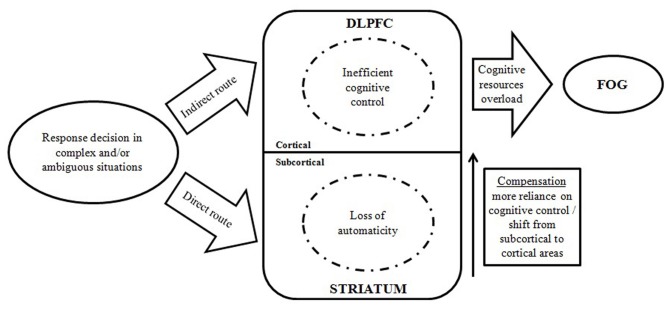
Recent studies emphasize a key role of controlled operations, such as set-shifting and inhibition, in the occurrence of freezing of gait (FOG) in Parkinson's disease (PD). However, FOG can also be characterized as a de-automatization disorder, showing impairments in both the execution and acquisition of automaticity. The observed deficits in automaticity and executive functioning indicate that both processes are malfunctioning in freezers. Therefore, to explain FOG from a cognitive-based perspective, we present a model describing the pathways involved in automatic and controlled processes prior to a FOG episode. Crucially, we focus on disturbances in automaticity and control, regulated by the frontostriatal circuitry. In complex situations, non-freezing PD patients may compensate for deficits in automaticity by switching to increased cognitive control. However, as both automatic and controlled processes are more severely impaired in freezers, this hampers cognitive compensation in FOG, resulting in a potential breakdown. Future directions for cognitive rehabilitation are proposed, based on the cognitive model we put forward.
Keywords: Parkinson's disease; automaticity; cognitive control; executive dysfunction; freezing of gait.
Figures
References
LinkOut - more resources
Full Text Sources
Other Literature Sources
