


doi: 10.1021/mz300585q.
Epub 2012 Dec 14.
Bioorthogonal Click Chemistry: An Indispensable Tool to Create Multifaceted Cell Culture Scaffolds
Affiliations
- PMID: 23336091
- PMCID: PMC3547663
- DOI: 10.1021/mz300585q
Item in Clipboard
Bioorthogonal Click Chemistry: An Indispensable Tool to Create Multifaceted Cell Culture Scaffolds
ACS Macro Lett.
.
Free PMC article
Abstract
Over the past decade, bioorthogonal click chemistry has led the field of biomaterial science into a new era of diversity and complexity by its extremely selective, versatile, and biocompatible nature. In this viewpoint, we seek to emphasize recent endeavors of exploiting this versatile chemistry toward the development of poly(ethylene glycol) hydrogels as cell culture scaffolds. In these cell-laden materials, the orthogonality of these reactions has played an effective role in allowing the creation of diverse biochemical patterns in complex biological environments that provide new found opportunities for researchers to delineate and control cellular phenotypes more precisely than ever.
Figures
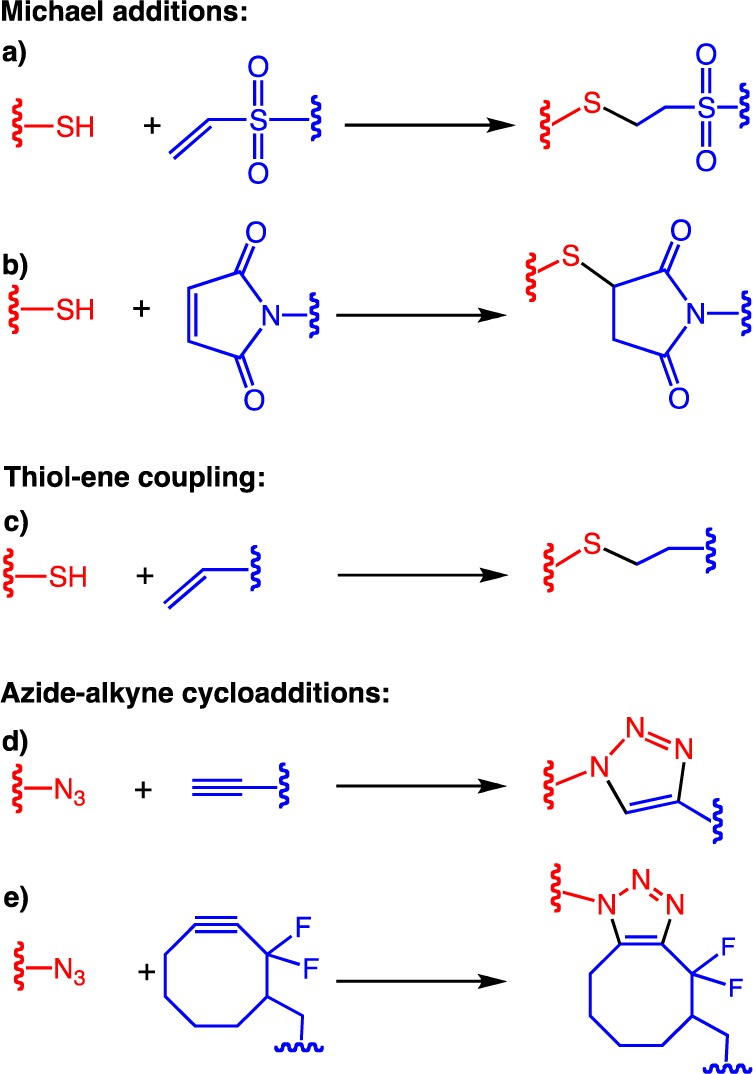
Examples
of various click reactions that are commonly used in bioconjugation
or hydrogel cross-linking: (a) copper-catalyzed Huisgen cycloaddition,
(b) strain-promoted azide–alkyne cycloaddition (SPAAC), (c)
base-catalyzed thiol-vinyl sulfone, (d) base-catalyzed thiol-maleimide
Michael addition, (e) photoinitiated thiol–ene photocoupling.
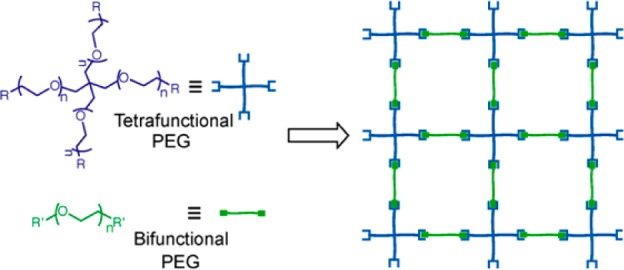
(left)
Structures of multiarm and linear PEG precursors and (right)
schematic of an idealistic step-growth hydrogel. The molecular weight
of the precursors, their functionality, and their stoichiometric ratio
can all influence the final network cross-linking density and ultimate
material properties, including equilibrium water content, elasticity,
and diffusion coefficients.

Schematic
of a Michael addition driven step-growth hydrogel formed
using thiol-reactive 4-arm PEG tetravinyl sulfone, cysteine-flanked
MMP degradable peptides (↓ shows cleavage site), and simultaneous
tethering of cysteine containing RGDS peptides.
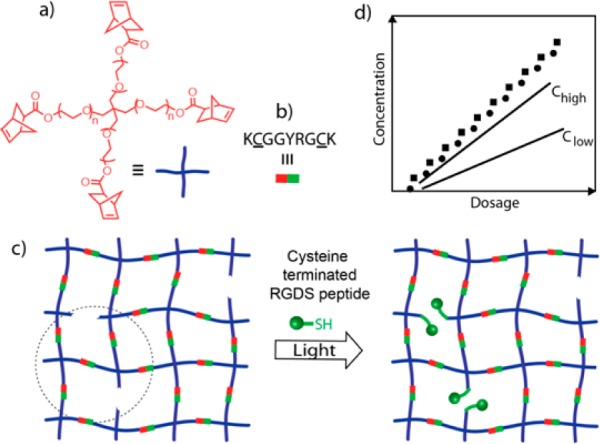
Thiol–ene hydrogel chemistry: (a) structure
of 4-arm PEG
tetranorbornene; (b) dicysteine-terminated chymotrypsin cleavable
peptide; (c) schematic of spatial photopatterning throughout hydrogel
networks created via thiol–ene by off-stoichiometrically reacting
hydrogel precursors; (d) predictable relationship between photopatterning
concentration and dosage of exposed light (● = constant intensity,
varied exposure; ■ = constant exposure, varied intensity).
The graph qualitatively shows that the extent of photopatterning can
be varied by the alteration of light dosage, which in turn can be
varied by exposure time/intensity. The graph also depicts the effect
of photoinitiator concentration (Clow–Chigh) on photopatterning.
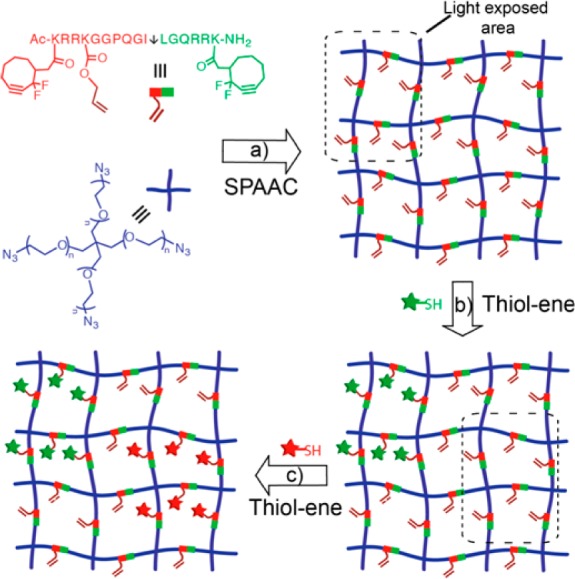
Sequential click approach for dynamically
tuning extracellular
microenvironments: (a) step-growth network formation via SPAAC that
enables thiol–ene photopatterning without altering the original
network structure by employing 4-arm PEG tetra azide and dicyclooctyne
MMP cleavable (↓ shows cleavage site) peptide; (b) spatial
thiol–ene photopatterning of a first biochemical unit; (c)
patterning of a second biochemical unit at a different time point
and location.
References
-
- Griffin B. A.; Adams S. R.; Tsien R. Y. Science 1998, 281, 269–272. - PubMed
-
- Nimmo C. M.; Shoichet M. S. Bioconjugate Chem. 2011, 22, 2199–2209. - PubMed
-
- Golas P. L.; Matyjaszewski K. Chem. Soc. Rev. 2010, 39, 1338–1354. - PubMed
-
- Lowe A. B.; Hoyle C. E.; Bowman C. N. J. Mater. Chem. 2010, 20, 4745–4750.
Grants and funding
LinkOut - more resources
Full Text Sources
Other Literature Sources
Miscellaneous
