. 2013 Jan 21:14:3.
doi: 10.1186/1471-2172-14-3.

Human CD3γ, but not CD3δ, haploinsufficiency differentially impairs γδ versus αβ surface TCR expression

Affiliations

Human CD3γ, but not CD3δ, haploinsufficiency differentially impairs γδ versus αβ surface TCR expression

Miguel Muñoz-Ruiz et al. BMC Immunol. .

Abstract

Background: The T cell antigen receptors (TCR) of αβ and γδ T lymphocytes are believed to assemble in a similar fashion in humans. Firstly, αβ or γδ TCR chains incorporate a CD3δε dimer, then a CD3γε dimer and finally a ζζ homodimer, resulting in TCR complexes with the same CD3 dimer stoichiometry. Partial reduction in the expression of the highly homologous CD3γ and CD3δ proteins would thus be expected to have a similar impact in the assembly and surface expression of both TCR isotypes. To test this hypothesis, we compared the surface TCR expression of primary αβ and γδ T cells from healthy donors carrying a single null or leaky mutation in CD3G (γ+/-) or CD3D (δ+/-, δ+/leaky) with that of normal controls.

Results: Although the partial reduction in the intracellular availability of CD3γ or CD3δ proteins was comparable as a consequence of the mutations, surface TCR expression measured with anti-CD3ε antibodies was significantly more decreased in γδ than in αβ T lymphocytes in CD3γ+/- individuals, whereas CD3δ+/- and CD3δ+/leaky donors showed a similar decrease of surface TCR in both T cell lineages. Therefore, surface γδ TCR expression was more dependent on available CD3γ than surface αβ TCR expression.

Conclusions: The results support the existence of differential structural constraints in the two human TCR isotypes regarding the incorporation of CD3γε and CD3δε dimers, as revealed by their discordant surface expression behaviour when confronted with reduced amounts of CD3γ, but not of the homologous CD3δ chain. A modified version of the prevailing TCR assembly model is proposed to accommodate these new data.


Figures
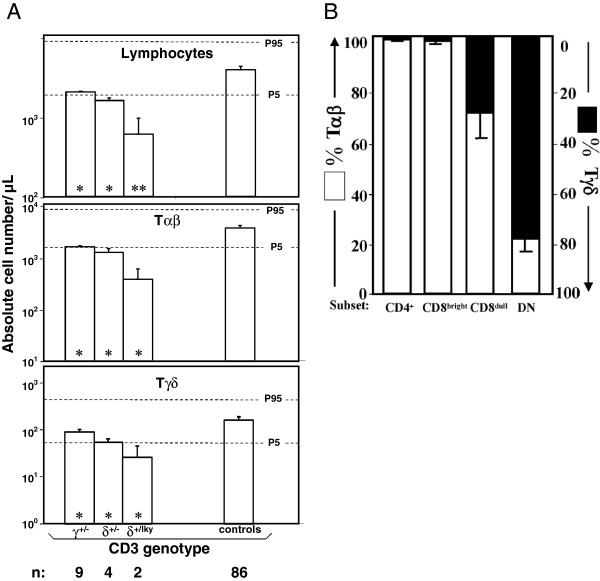
Figure 1
Figure 1
Peripheral αβ and γδ T lymphocyte numbers in human CD3G or CD3D haploinsufficiencies. (A) Peripheral blood cell counts from different γ+/−, δ+/− or δ+/leaky individuals are compared with the normal age-matched distribution as mean ± SEM against the P5/P95 normal range (horizontal dashed lines [6]). Asterisks in bars indicate significant differences as compared with controls. p < *0.05, **0.01 or ***0.001. (B) Proportion of αβ (BMA031+) and γδ (Immu510+) T cells (defined as CD3+) in different peripheral blood subsets (CD4+, CD8bright, CD8dull and DN) in healthy individuals. Data are mean ± SD (n = 6).
Figure 2
Figure 2
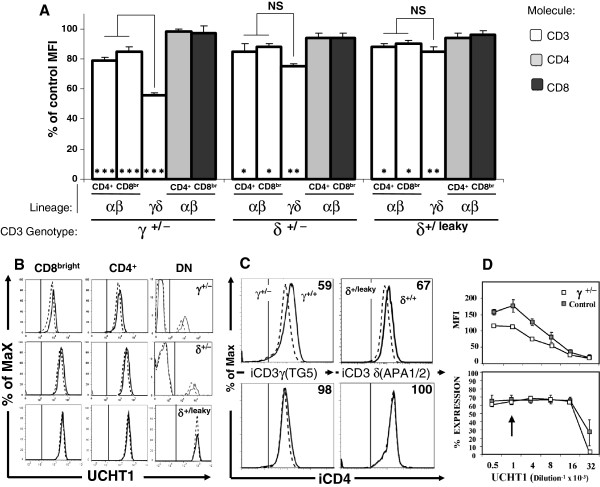
Reduced surface αβ and γδ TCR expression in CD3γ+/−, CD3δ+/− and CD3δ+/leaky individuals using UCHT-1. αβ T cells were defined as CD8bright and CD4+ in 9 γ +/−, 4 δ+/−, 2 δ+/leaky and 7 +/+ donors. Similar results were obtained with other anti-CD3 mAb (SK7, S4.1, F101.01, data not shown). (A) CD3 MFI ratios (X100) ± SEM relative to controls are shown for the indicated T cell lineages and genotypes. Asterisks in bars indicate significant differences as compared with controls, other comparisons as indicated. p as in Figure 1A. (B) Representative peripheral blood CD3 reactivity patterns of γ+/−, δ+/− or δ+/leaky T cells (dashed lines) as compared with +/+ controls (solid lines). The vertical line in each panel indicates the upper limit of background fluorescence using isotype-matched irrelevant mAb. (C) Intracellular stainings of γ+/− and δ+/leaky T cells (dashed lines) as compared with +/+ controls (solid lines). Vertical lines as in Figure 2B. The numbers in each histogram indicate MFI ratios (x100) relative to controls. (D) Comparative titration of CD3 (UCHT1) binding (MFI) to γ+/− peripheral blood T cells (n = 1) versus +/+ controls (n = 2, mean ± SD). The percentage of bound cells was determined in parallel to establish the endpoint dilution (1:16.000). The arrow indicates the working dilution in all other experiments. Similar results were obtained using other antibodies (F101.01 or BMA031).
Figure 3
Figure 3
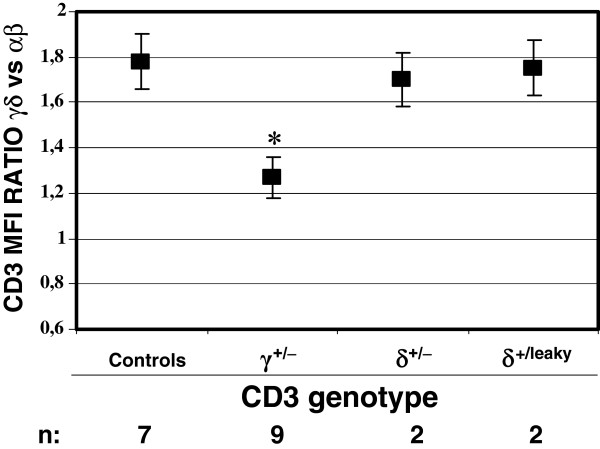
Discordant reduction of surface αβ and γδ TCR expression in CD3γ+/− vs CD3δ+/− or CD3δ+/leaky individuals. CD3 MFI ratios ± SEM of γδ versus αβ T cells for the indicated genotypes using UCHT-1. * indicates p < 0.05 as compared with other donors.
Figure 4
Figure 4
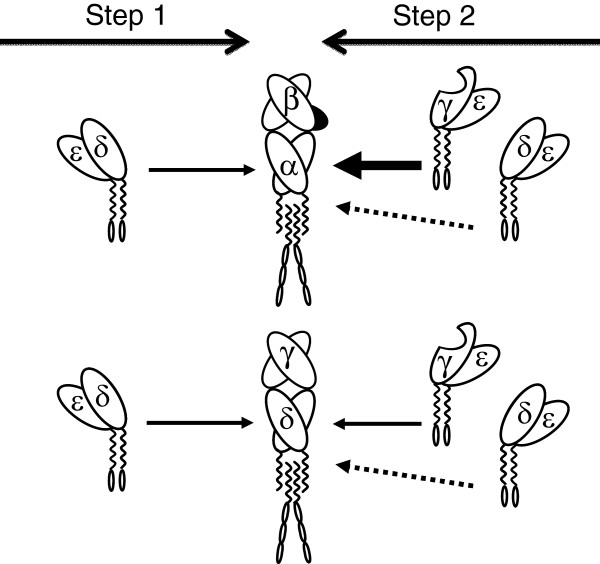
Simplified model for the effect of human CD3 haploinsufficiencies on TCR assembly and expression. Lack of a CD3γε-fitting structure in TCRγ, as opposed to TCRβ [13] (shown in black), and the resultant lower affinity of the former relative to the latter for the CD3γε dimer (represented by arrows), may explain the stronger impact of decreasing CD3γ (shown with a nick) but not CD3δ availability on surface γδ TCR expression as compared to that of the αβ TCR.

References

    1. Call ME, Pyrdol J, Wiedmann M, Wucherpfennig KW. The organizing principle in the formation of the T cell receptor-CD3 complex. Cell. 2002;111(7):967–79. doi: 10.1016/S0092-8674(02)01194-7. - DOI - PMC - PubMed
    1. Siegers GM, Swamy M, Fernández-Malavé E, Minguet S, Rathmann S, Guardo AC. et al.Different composition of the human and the mouse gammadelta T cell receptor explains different phenotypes of CD3gamma and CD3delta immunodeficiencies. J Exp Med. 2007;204(11):2537–44. doi: 10.1084/jem.20070782. - DOI - PMC - PubMed
    1. Thomassen EA, Dekking EH, Thompson A, Franken KL, Sanal O, Abrahams JP. et al.The impact of single amino acid substitutions in CD3gamma on the CD3epsilongamma interaction and T-cell receptor-CD3 complex formation. Hum Immunol. 2006;67(8):579–88. doi: 10.1016/j.humimm.2006.04.015. - DOI - PubMed
    1. Regueiro JR, López-Botet M, De Landazuri MO, Alcami J, Corell A, Martín Villa JM, Vicario JL, Arnaiz-Villena A. An in vivo functional immune system lacking polyclonal T-cell surface expression of the CD3/Ti(WT31) complex. Scand J Immunol. 1987;26(6):699–708. doi: 10.1111/j.1365-3083.1987.tb02306.x. - DOI - PubMed
    1. Perez-Aciego P. Caracterización clínica, inmunologica y molecular de una inmunodeficiencia familiar por defecto de expresión del receptor para antígeno del linfocito T, PhD thesis. 12 de Octubre Hospital, Madrid, Immunology Department. 1992.

Publication types

MeSH terms

Substances