. 2013 Jan 22:14:21.
doi: 10.1186/1471-2369-14-21.

Increased plasma sVCAM-1 is associated with severity in IgA nephropathy

Affiliations

Increased plasma sVCAM-1 is associated with severity in IgA nephropathy

Li Zhu et al. BMC Nephrol. .

Abstract

Background: A considerable proportion of IgAN patients present with histological vasculitic/crescentic lesions in glomeruli, indicating activation of vascular inflammation. Using sVCAM-1, a well-proven marker for endothelial injury under inflammatory processes, we investigated vascular injury and its association with clinical and pathological manifestations in IgAN patients.

Methods: In this study, 327 biopsy-proven IgAN patients and 55 healthy controls were enrolled. The Oxford classification and two variables, Active Crescentic Lesion Percentage (ACLP) and Chronic Glomerular Lesion Percentage (CGLP), were used for evaluating pathological lesions. Human Umbilical Vein Endothelial Cells were treated with 25-400 ug/ml IgA1. sVCAM-1 in plasma and culture supernatant were measured by ELISA.

Results: Plasma sVCAM-1 in IgAN patients was significantly higher than healthy controls. In patients with IgAN, plasma sVCAM-1 was significantly correlated with eGFR, 24h urine protein excretion, tubular atrophy/interstitial fibrosis lesion and ACLP, but not CGLP. Meanwhile, compared to healthy volunteers, IgA1 from IgAN patients showed a tendency to increase the HUVECs supernatant sVCAM-1 expression. And IgA1 induced the sVCAM-1 increasing from HUVECs in time- and dose-dependent manner.

Conclusions: We found increased plasma sVCAM-1 in IgAN patients and its association with severe clinical and pathological manifestations, which might be partly resulted from effect of IgA1 to endothelial cells.


Figures
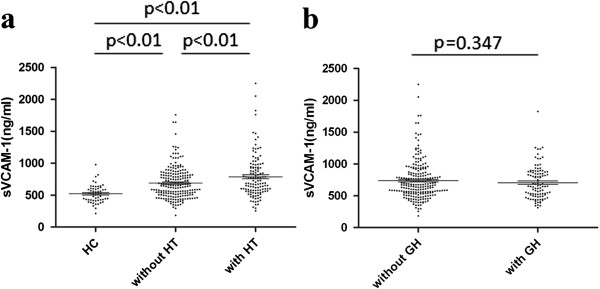
Figure 1
Figure 1
Scatter plot showing distribution of plasma sVCAM-1 levels of enrolled individuals according to with or without hypertension (HT), and with or without gross hematuria history (GH), respectively.a. Both group of IgAN patients, with or without hypertension, presented with higher plasma sVCAM-1 levels than healthy controls (without hypertension Vs healthy controls: 690.17±249.75 ng/ml Vs 520.23±137.51 ng/ml, p<0.01; with hypertension Vs healthy controls: 786.40±339.43 ng/ml Vs 520.23±137.51 ng/ml, p<0.01). IgAN patients with hypertension had significantly elevated plasma sVCAM-1 levels than those without (786.40±339.43 ng/ml Vs 690.17±249.75 ng/ml, p<0.01).b. Plasma levels of sVCAM-1 showed no difference between IgAN patients with or without gross hematuria history.
Figure 2
Figure 2
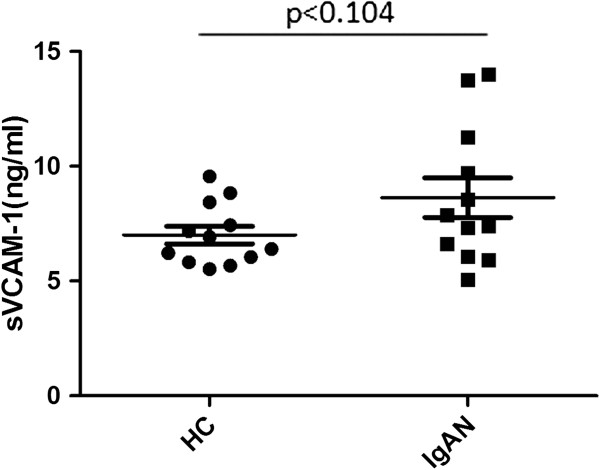
Scatter plot showing sVCAM-1 expressions in cultured HUVECs under IgA1 from IgAN patients and healthy volunteers. HUVECs were treated with 400 ug/ml IgA1 from healthy volunteers (HC) or IgAN patients (IgAN). Compared to IgA1 from healthy volunteers, IgA1 form IgAN patients showed a tendency to increase the HUVECs supernatant sVCAM-1 expression (8.63±2.98 ng/ml Vs 7.00±1.33 ng/ml, p=0.104).
Figure 3
Figure 3
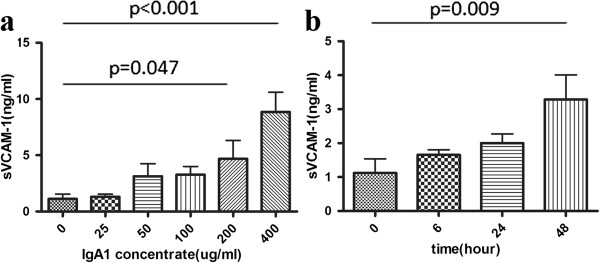
sVCAM-1 expressions in cultured HUVECs under different doses of IgA1 treatment for different time durations.a. HUVECs were treated with 25-400 ug/ml IgA1 for 48 hours. IgA1 induced the sVCAM-1 expression in cultured HUVECs supernatant in a dose-dependent manner. Significantly increased supernatant sVCAM-1 level could be detected at 200 ug/ml and 400 ug/ml IgA1 (p=0.047 for 200 ug/ml, p<0.001 for 400 ug/ml).b. HUVECs were treated with 200 ug/ml IgA1 for 6–48 hours. IgA1 induced the sVCAM-1 expression in cultured HUVECs supernatant in a time-dependent manner. The sVCAM-1 level in HUVECs supernatant significantly elevated upon 48 h treatment (p=0.009).

References

    1. D'Amico G. The commonest glomerulonephritis in the world: IgA nephropathy. Q J Med. 1987;64:709–727. - PubMed
    1. Barratt J, Feehally J. IgA nephropathy. J Am Soc Nephrol. 2005;16:2088–2097. doi: 10.1681/ASN.2005020134. - DOI - PubMed
    1. Chen Y, Tang Z, Yang G, Shen S, Yu Y, Zeng C, Chen H, Liu ZH, Li LS. Malignant hypertension in patients with idiopathic IgA nephropathy. Kidney Blood Press Res. 2005;28:251–258. doi: 10.1159/000090058. - DOI - PubMed
    1. Zhou F, Liu Y, Zou W, Zhang Y, Wang H. Malignant hypertension presenting with renal damage: a clinical and pathological analyses. Zhonghua Nei Ke Za Zhi. 2001;40:165–168. - PubMed
    1. Constans J, Conri C. Circulating markers of endothelial function in cardiovascular disease. Clin Chim Acta. 2006;368:33–47. doi: 10.1016/j.cca.2005.12.030. - DOI - PubMed

Publication types

Substances