


The fate of the messenger is pre-determined: a new model for regulation of gene expression
- PMID: 23337853
- PMCID: PMC3891481
- DOI: 10.1016/j.bbagrm.2013.01.004
The fate of the messenger is pre-determined: a new model for regulation of gene expression
Abstract
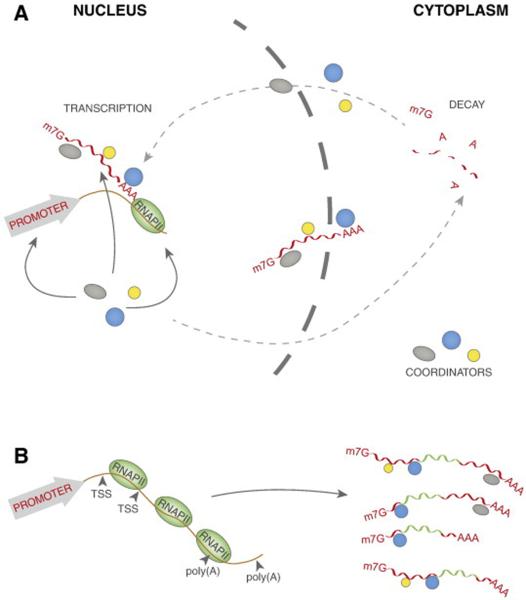
Recent years have seen a rise in publications demonstrating coupling between transcription and mRNA decay. This coupling most often accompanies cellular processes that involve transitions in gene expression patterns, for example during mitotic division and cellular differentiation and in response to cellular stress. Transcription can affect the mRNA fate by multiple mechanisms. The most novel finding is the process of co-transcriptional imprinting of mRNAs with proteins, which in turn regulate cytoplasmic mRNA stability. Transcription therefore is not only a catalyst of mRNA synthesis but also provides a platform that enables imprinting, which coordinates between transcription and mRNA decay. Here we present an overview of the literature, which provides the evidence of coupling between transcription and decay, review the mechanisms and regulators by which the two processes are coupled, discuss why such coupling is beneficial and present a new model for regulation of gene expression. This article is part of a Special Issue entitled: RNA Decay mechanisms.
Copyright © 2013. Published by Elsevier B.V.
Figures
References
-
- Bentley DL. Rules of engagement: co-transcriptional recruitment of pre-mRNA processing factors. Curr. Opin. Cell Biol. 2005;17:251–256. - PubMed
-
- Sandelin A, Carninci P, Lenhard B, Ponjavic J, Hayashizaki Y, Hume DA. Mammalian RNA polymerase II core promoters: insights from genome-wide studies. Nat. Rev. Genet. 2007;8:424–436. - PubMed
-
- Lutz CS, Moreira A. Alternative mRNA polyadenylation in eukaryotes: an effective regulator of gene expression, Wiley Interdiscip. Rev. RNA. 2011;2:22–31. - PubMed
-
- Choder M. Rpb4 and Rpb7: subunits of RNA polymerase II and beyond. Trends Biochem. Sci. 2004;29:674–681. - PubMed
Publication types
MeSH terms
Substances
Grants and funding
LinkOut - more resources
Full Text Sources
Other Literature Sources
Molecular Biology Databases
