. 2013 Feb;15(2):333-9.
doi: 10.1016/j.intimp.2013.01.006. Epub 2013 Jan 19.

Sorafenib induces autophagy and suppresses activation of human macrophage

Affiliations

Sorafenib induces autophagy and suppresses activation of human macrophage

Jiunn-Chang Lin et al. Int Immunopharmacol. 2013 Feb.

Erratum in

  • Int Immunopharmacol. 2013 May;16(1):123. Liu, Tsan-Pai [corrected to Liu, Tsang-Pai]

Abstract

Background: Sorafenib, a multi-kinase inhibitor approved for treatment of advanced renal cell carcinoma and other malignancies, has been shown as a modulator for dendritic cells. This study was designed to examine the effects of sorafenib on macrophages, the major ontogeny of innate immunity.

Materials and methods: Macrophages were derived from sorted CD14(+) monocytes of human peripheral blood mononuclear cells. Cell viability and surface antigens were examined by trypan blue analysis. Autophagy was characterized by light microscopy and transmission electron microscopy for morphology, Western blotting for microtubule associated light chain protein 3B (LC-3B) I lipidation, and acridine orange staining for acidic component vacuoles. Soluble factors contained in culture medium and serum were measured by ELISA.

Results: We found that sorafenib inhibited the viability of macrophages accompanied by morphological changes characteristic of autophagy. This autophagy-inducing effect was validated by LC3B-I lipidation and autophagosome accumulation. The surface antigen expression and the function of activated macrophages were inhibited by sorafenib, including the expression of co-stimulatory molecule CD80, phagocytosis, and the production of reactive oxygen species. The secretion of IL-10, but not IL-6, TNF-α nor TGF-β, was reduced by sorafenib.

Conclusion: Sorafenib, in addition to being a cancer targeted therapeutic agent, can induce autophagy and modulate the function of human macrophages.


Figures

Fig. 1
Fig. 1
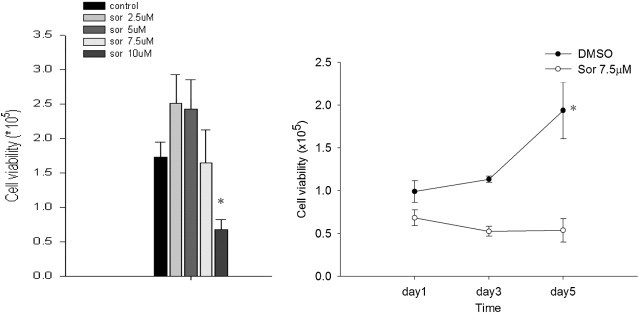
Effect of sorafenib on macrophage viability. After treatment with sorafenib (0, 2.5, 5.0, 7.5, and 10 μM), the monocyte-derived human macrophages were harvested on day 7 and the number of viable cells was counted using the trypan blue test. In the right panel, cells were treated with 7.5 mM sorafenib and harvested on days 1, 3, and 5 for the same test. Data from the three separate experiments were expressed as means ± SEMs. *p < 0.05 vs. DMSO control group.
Fig. 2
Fig. 2
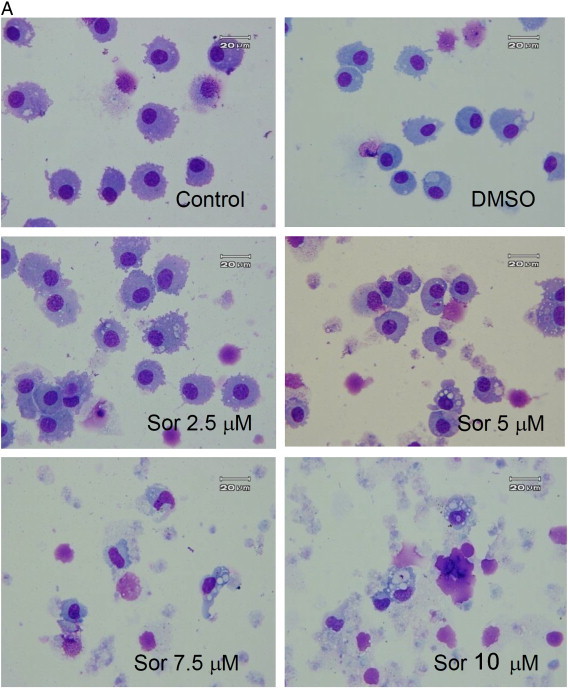
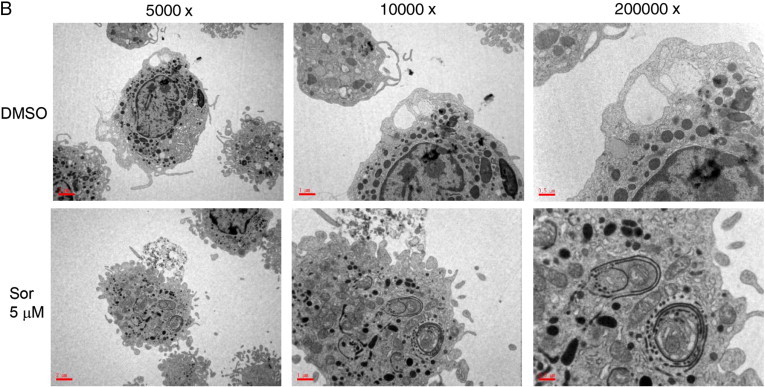
Morphological alteration of macrophages by sorafenib. (A) Morphology of macrophages, which were treated with 2.5, 5, 7.5, and 10 μM sorafenib (magnification 1000 ×). Macrophages were stained with Wright–Giemsa solution and observed under a light microscope. (B) Morphology of macrophages observed under transmitted electron microscopy. Macrophages were treated with 7.5 μM sorafenib for 4 days. Empty vacuoles with a monolayer membrane were observed in untreated cells. Numerous autophagic vacuoles with a typical double-layer membrane containing organelle remnants were noted.
Fig. 2
Fig. 2
Morphological alteration of macrophages by sorafenib. (A) Morphology of macrophages, which were treated with 2.5, 5, 7.5, and 10 μM sorafenib (magnification 1000 ×). Macrophages were stained with Wright–Giemsa solution and observed under a light microscope. (B) Morphology of macrophages observed under transmitted electron microscopy. Macrophages were treated with 7.5 μM sorafenib for 4 days. Empty vacuoles with a monolayer membrane were observed in untreated cells. Numerous autophagic vacuoles with a typical double-layer membrane containing organelle remnants were noted.
Fig. 3
Fig. 3
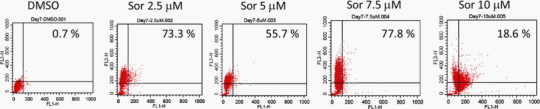
Acridine orange staining of acidic component of vacuoles. Representative flow cytometry data showed the acridine orange fluorescent intensities after treatment of sorafenib for 7 days. Similar results were obtained in three independent experiments.
Fig. 4
Fig. 4
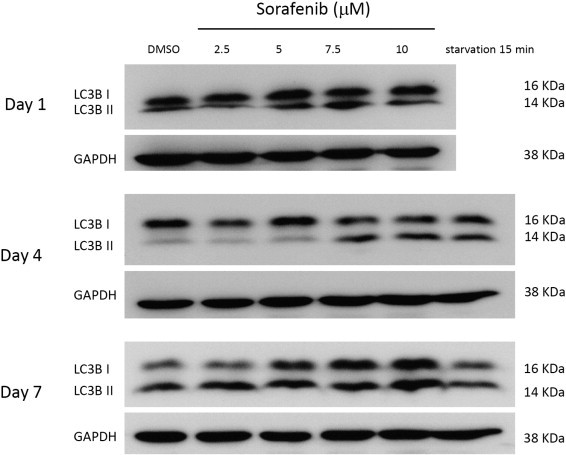
Lipidation of LC3-I in macrophages by immunoblotting. Macrophages were treated with sorafenib (0 to 10 μM for 1, 4, and 7 days) and serum starvation, and then subjected to immunoblot analysis using anti-LC-3B antibody and anti-GAPDH antibody.
Fig. 5
Fig. 5
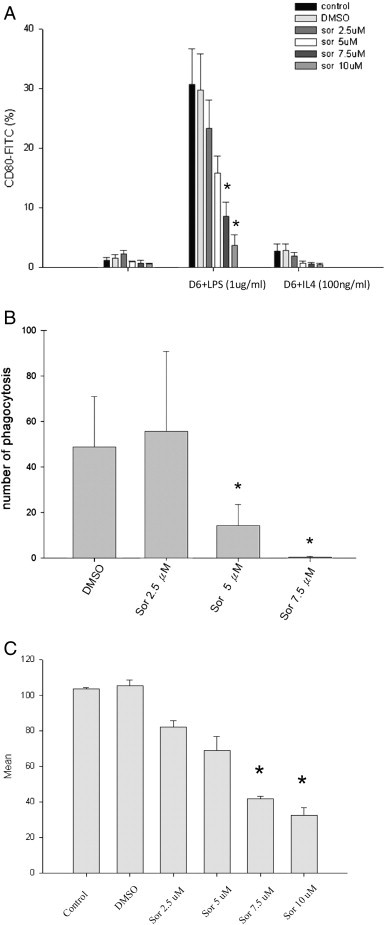
Expression of surface antigen CD80 and assessment of function in macrophages. (A) Expression of surface molecule CD80 on monocyte-derived macrophages. (B) Effect of sorafenib on phagocytosis. (C) Effect of sorafenib on LPS-induced production of reactive oxygen species. Data from three separate experiments were expressed as means ± SEMs. *p < 0.05 vs. DMSO control group.
Fig. 6
Fig. 6
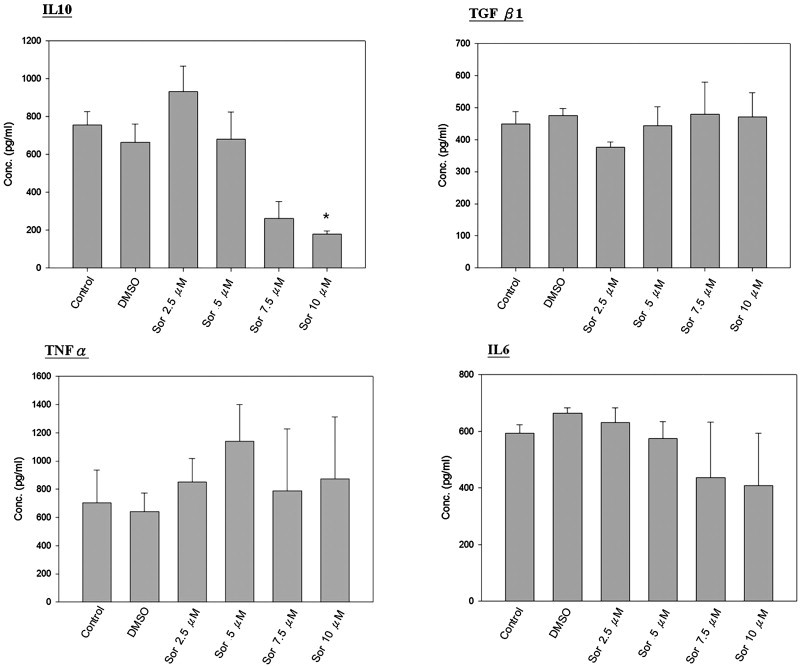
Production of cytokines by macrophages. The levels of IL-6, IL-10, TGF-β1 and TNF-α in the DC supernatant were measured using enzyme-linked immunosorbent assay (ELISA) (R&D Systems, HS120, D1000B) according to the manufacturer's instructions. *p < 0.05 vs. DMSO control group.

References

    1. Gordon S. Innate immune functions of macrophages in different tissue environments. J Innate Immun. 2012;4:409–410. - PMC - PubMed
    1. Wilhelm S.M., Carter C., Tang L., Wilkie D., McNabola A., Rong H. BAY 43-9006 exhibits broad spectrum oral antitumor activity and targets the RAF/MEK/ERK pathway and receptor tyrosine kinases involved in tumor progression and angiogenesis. Cancer Res. 2004;64:7099–7109. - PubMed
    1. Escudier B., Eisen T., Stadler W.M., Szczylik C., Oudard S., Siebels M. Sorafenib in advanced clear-cell renal-cell carcinoma. N Engl J Med. 2007;356:125–134. - PubMed
    1. Llovet J.M., Ricci S., Mazzaferro V., Hilgard P., Gane E., Blanc J.F. Sorafenib in advanced hepatocellular carcinoma. N Engl J Med. 2008;359:378–390. - PubMed
    1. Hsieh C.H., Jeng K.S., Lin C.C., Chen C.K., Liu C.Y., Lin C.P. Combination of sorafenib and intensity modulated radiotherapy for unresectable hepatocellular carcinoma. Clin Drug Investig. 2009;29:65–71. - PubMed

Publication types

MeSH terms