


Declining malaria parasite prevalence and trends of asymptomatic parasitaemia in a seasonal transmission setting in North-Western Burkina Faso between 2000 and 2009-2012
- PMID: 23339523
- PMCID: PMC3639197
- DOI: 10.1186/1475-2875-12-27
Declining malaria parasite prevalence and trends of asymptomatic parasitaemia in a seasonal transmission setting in North-Western Burkina Faso between 2000 and 2009-2012
Abstract
Background: Malaria transmission was reported to have declined in some East African countries. However, a comparable trend has not been confirmed for West Africa. This study aims to assess the dynamics of parasite prevalence and malaria species distribution over time in an area of highly seasonal transmission in Burkina Faso. The aim was also to compare frequency of asymptomatic parasitaemia between wet and dry season by parasite density status and age group.
Methods: During the years 2009-2012, six cross-sectional studies were performed in the rural village Bourasso in the Nouna Health District in north-west Burkina Faso. In subsequent rainy and dry seasons blood samples were collected to assess the parasite prevalence, species, density and clinical parameters. In total, 1,767 children and adults were examined and compared to a baseline collected in 2000.
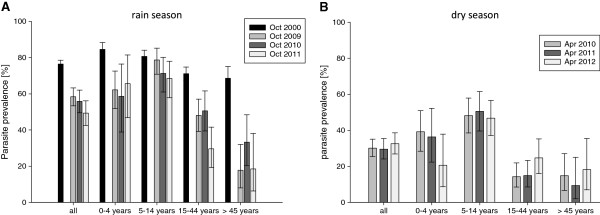
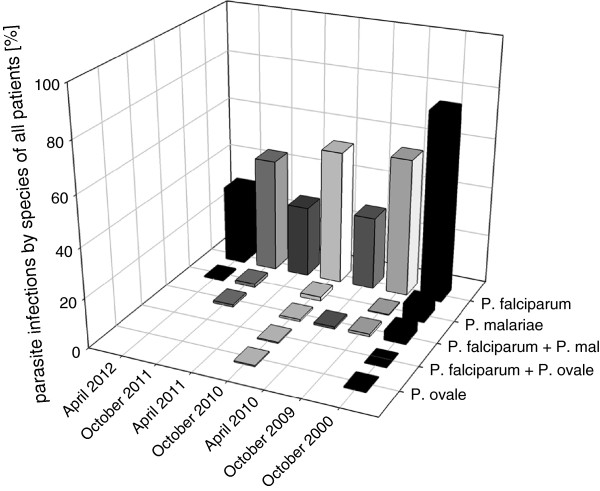
Results: The microscopical parasite prevalence (mainly P. falciparum) measured over the rainy seasons decreased significantly from 78.9% (2000) to 58.4%, 55.9% and 49.3%, respectively (2009-2011; p <0.001). The frequency of Plasmodium malariae infections (mono- and co-infections) decreased parallel to the overall parasite prevalence from 13.4% in 2000 to 2.1%, 4.1% and 4.7% in 2009-2011 (p <0.001). Comparing parasite-positive subjects from the rainy season versus dry season, the risk of fever was significantly reduced in the dry season adjusting for parasite density (grouped) and age group.
Conclusions: The results of this study suggest a decline of malaria transmission over the rainy seasons between 2000 and 2009-2011 in the region of Nouna, Burkina Faso. The decreased transmission intensity was associated with lower prevalence of P. malariae infections (both mono-infections and co-infections). Asymptomatic parasitaemia was more frequent in the dry season even adjusting for parasite density and age group in a multivariate regression. Possible reasons for this observation include the existence of less pathogenic Plasmodium falciparum genotypes prevailing in the dry season, or the effect of a reduced incidence density during the dry season.
Figures
References
-
- WHO. World Malaria Report 2011. Geneva: WHO press; 2011.
-
- Muller O, Becher H, van Zweeden AB, Ye Y, Diallo DA, Konate AT, Gbangou A, Kouyate B, Garenne M. Effect of zinc supplementation on malaria and other causes of morbidity in west African children: randomised double blind placebo controlled trial. BMJ. 2001;322:1567. doi: 10.1136/bmj.322.7302.1567. - DOI - PMC - PubMed
-
- Muller O, Traore C, Kouyate B, Ye Y, Frey C, Coulibaly B, Becher H. Effects of insecticide-treated bednets during early infancy in an African area of intense malaria transmission: a randomized controlled trial. Bull World Health Organ. 2006;84:120–126. doi: 10.2471/BLT.05.023150. - DOI - PMC - PubMed
-
- Louis VR, Bals J, Tiendrebeogo J, Bountogo M, Ramroth H, De Allegri M, Traore C, Beiersmann C, Coulibaly B, Yé M, Jahn A, Becher H, Müller O. Long-term effects of malaria prevention with insecticide-treated mosquito nets on morbidity and mortality in African children: randomised controlled trial. Trop Med Int Health. 2012;17:733–741. doi: 10.1111/j.1365-3156.2012.02990.x. - DOI - PubMed
Publication types
MeSH terms
LinkOut - more resources
Full Text Sources
Other Literature Sources
Medical
