


Regional metabolic liver function measured in patients with cirrhosis by 2-[¹⁸F]fluoro-2-deoxy-D-galactose PET/CT
- PMID: 23339954
- PMCID: PMC3660513
- DOI: 10.1016/j.jhep.2013.01.012
Regional metabolic liver function measured in patients with cirrhosis by 2-[¹⁸F]fluoro-2-deoxy-D-galactose PET/CT
Abstract
Background & aims: There is a clinical need for methods that can quantify regional hepatic function non-invasively in patients with cirrhosis. Here we validate the use of 2-[(18)F]fluoro-2-deoxy-d-galactose (FDGal) PET/CT for measuring regional metabolic function to this purpose, and apply the method to test the hypothesis of increased intrahepatic metabolic heterogeneity in cirrhosis.
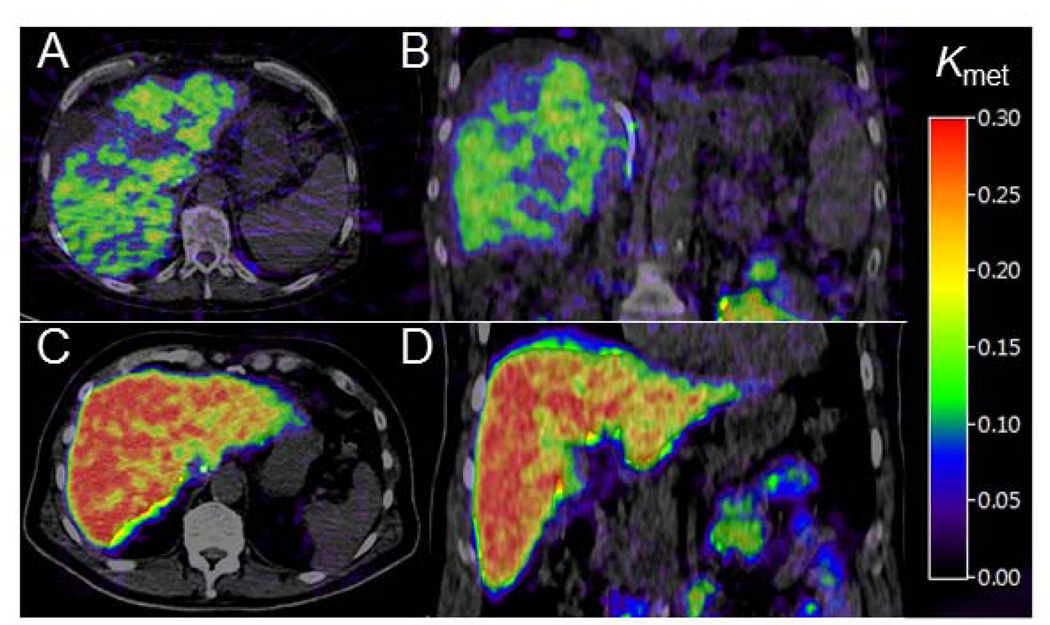
Methods: Nine cirrhotic patients underwent dynamic liver FDGal PET/CT with blood samples from a radial artery and a liver vein. Hepatic blood flow was measured by indocyanine green infusion/Fick's principle. From blood measurements, hepatic systemic clearance (Ksyst, Lblood/min) and hepatic intrinsic clearance (Vmax/Km, Lblood/min) of FDGal were calculated. From PET data, hepatic systemic clearance of FDGal in liver parenchyma (Kmet, mL blood/mL liver tissue/min) was calculated. Intrahepatic metabolic heterogeneity was evaluated in terms of coefficient-of-variation (CoV, %) using parametric images of Kmet.
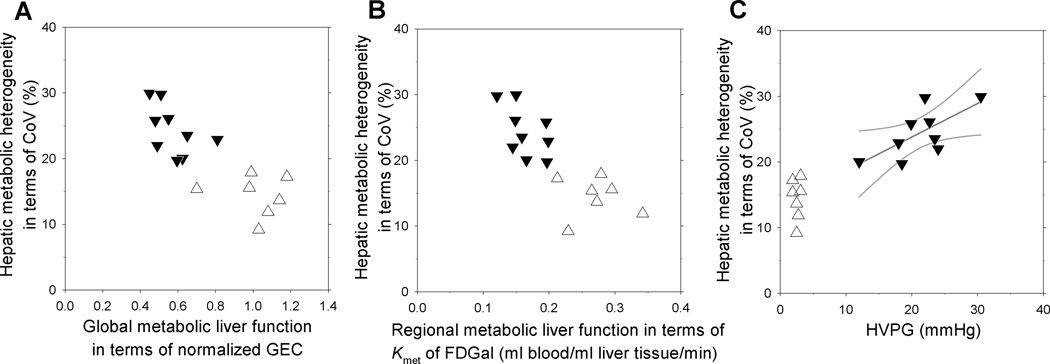
Results: Mean approximation of Ksyst to Vmax/Km was 86% which validates the use of FDGal as PET tracer of hepatic metabolic function. Mean Kmet was 0.157 mL blood/mL liver tissue/min, which was lower than 0.274 mL blood/mL liver tissue/min, previously found in healthy subjects (p<0.001), in accordance with decreased metabolic function in cirrhotic livers. Mean CoV for Kmet in liver tissue was 24.4% in patients and 14.4% in healthy subjects (p<0.0001). The degree of intrahepatic metabolic heterogeneity correlated positively with HVPG (p<0.05).
Conclusions: A 20-min dynamic FDGal PET/CT with arterial sampling provides an accurate measure of regional hepatic metabolic function in patients with cirrhosis. This is likely to have clinical implications for the assessment of patients with liver disease as well as treatment planning and monitoring.
Copyright © 2013 European Association for the Study of the Liver. Published by Elsevier B.V. All rights reserved.
Conflict of interest statement
Figures
References
-
- Pinzani M, Vizzutti F, Arena U, et al. Technology Insight: noninvasive assessment of liver fibrosis by biochemical scores and elastography. Nat Clin Pract Gastroenterol Hepatol. 2008;5:95–106. - PubMed
-
- de Graaf W, Bennink RJ, Veteläinen R, van Gulik TM. Nuclear imaging techniques for the assessment of hepatic function in liver surgery and transplantation. J Nucl Med. 2010;51:742–752. - PubMed
Publication types
MeSH terms
Substances
Grants and funding
LinkOut - more resources
Full Text Sources
Other Literature Sources
Medical
