


Novelty-induced emotional arousal modulates cannabinoid effects on recognition memory and adrenocortical activity
- PMID: 23340520
- PMCID: PMC3656371
- DOI: 10.1038/npp.2013.26
Novelty-induced emotional arousal modulates cannabinoid effects on recognition memory and adrenocortical activity
Erratum in
- Neuropsychopharmacology. 2013 Sep;7:124
Abstract
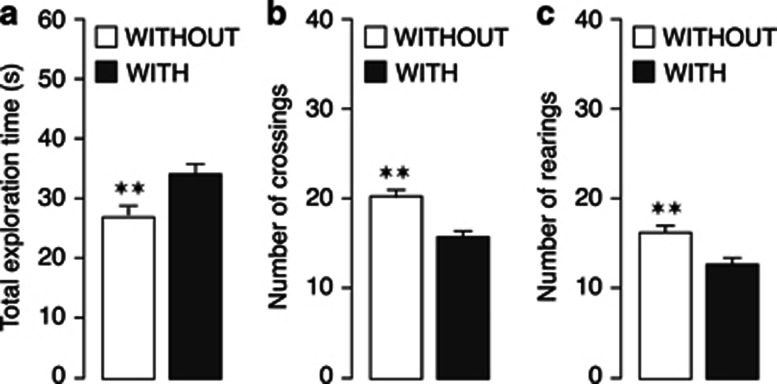
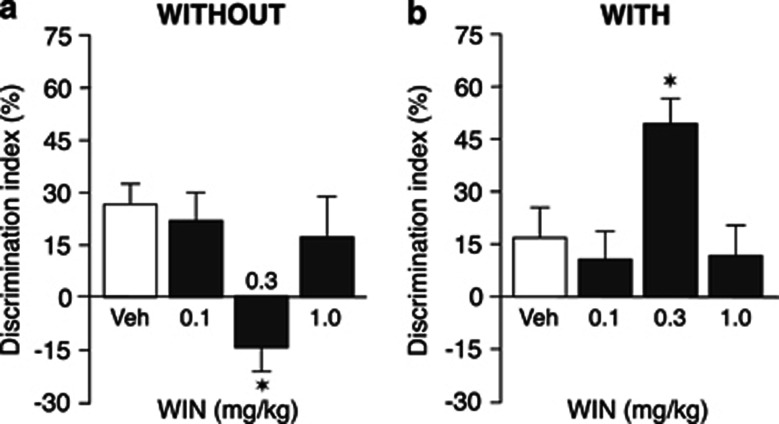
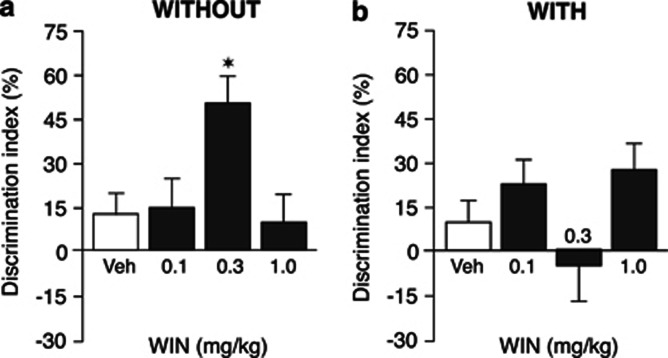
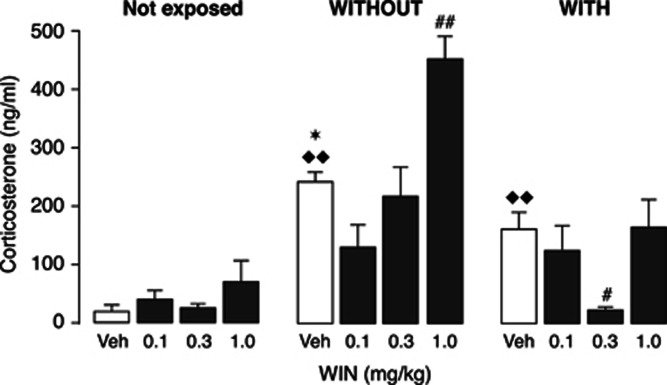
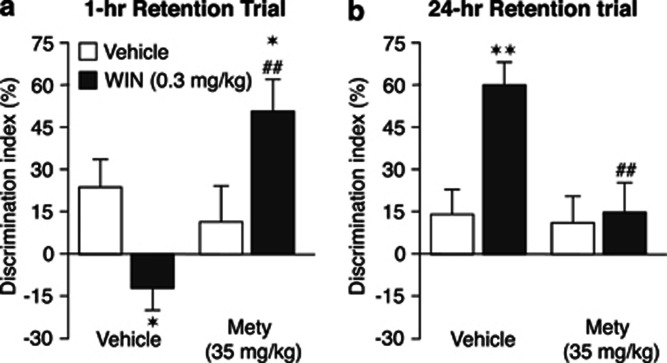
Although it is well established that cannabinoid drugs can influence cognitive performance, the findings-describing both enhancing and impairing effects-have been ambiguous. Here, we investigated the effects of posttraining systemic administration of the synthetic cannabinoid agonist WIN55,212-2 (0.1, 0.3, or 1.0 mg/kg) on short- and long-term retention of object recognition memory under two conditions that differed in their training-associated arousal level. In male Sprague-Dawley rats that were not previously habituated to the experimental context, WIN55,212-2 administered immediately after a 3-min training trial, biphasically impaired retention performance at a 1-h interval. In contrast, WIN55,212-2 enhanced 1-h retention of rats that had received extensive prior habituation to the experimental context. Interestingly, immediate posttraining administration of WIN55,212-2 to non-habituated rats, in doses that impaired 1-h retention, enhanced object recognition performance at a 24-h interval. Posttraining WIN55,212-2 administration to habituated rats did not significantly affect 24-h retention. In light of intimate interactions between cannabinoids and the hypothalamic-pituitary-adrenal axis, we further investigated whether cannabinoid administration might differently influence training-induced glucocorticoid activity in rats in these two habituation conditions. WIN55,212-2 administered after object recognition training elevated plasma corticosterone levels in non-habituated rats whereas it decreased corticosterone levels in habituated rats. Most importantly, following pretreatment with the corticosterone-synthesis inhibitor metyrapone, WIN55,212-2 effects on 1- and 24-h retention of non-habituated rats became similar to those seen in the low-aroused habituated animals, indicating that cannabinoid-induced regulation of adrenocortical activity contributes to the environmentally sensitive effects of systemically administered cannabinoids on short- and long-term retention of object recognition memory.
Figures
References
-
- Armario A. Activation of the hypothalamic-pituitary-adrenal axis by addictive drugs: different pathways, common outcome. Trends Pharmacol Sci. 2010;31:318–325. - PubMed
-
- Atsak P, Roozendaal B, Campolongo P. Role of the endocannabinoid system in regulating glucocorticoid effects on memory for emotional experiences. Neuroscience. 2012b;204:104–116. - PubMed
-
- Baek J, Zheng Y, Darlington CL, Smith PF. The CB1 receptor agonist, WIN 55,212-2, dose-dependently disrupts object recognition memory in adult rats. Neurosci Lett. 2009;464:71–73. - PubMed
-
- Barna I, Zelena D, Arszovszki AC, Ledent C. The role of endogenous cannabinoids in the hypothalamo-pituitary-adrenal axis regulation: in vivo and in vitro studies in CB1 receptor knockout mice. Life Sci. 2004;75:2959–2970. - PubMed
Publication types
MeSH terms
Substances
LinkOut - more resources
Full Text Sources
Other Literature Sources
