


Sex-specific clines support incipient speciation in a common European mammal
- PMID: 23340600
- PMCID: PMC3607112
- DOI: 10.1038/hdy.2012.124
Sex-specific clines support incipient speciation in a common European mammal
Abstract
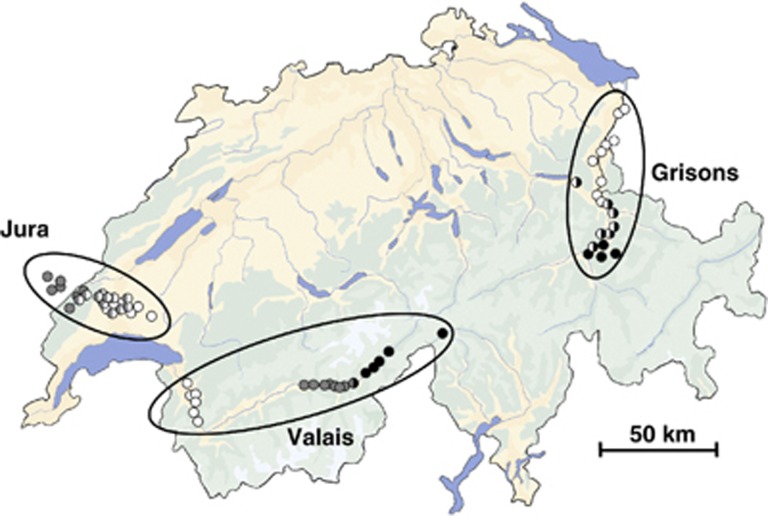
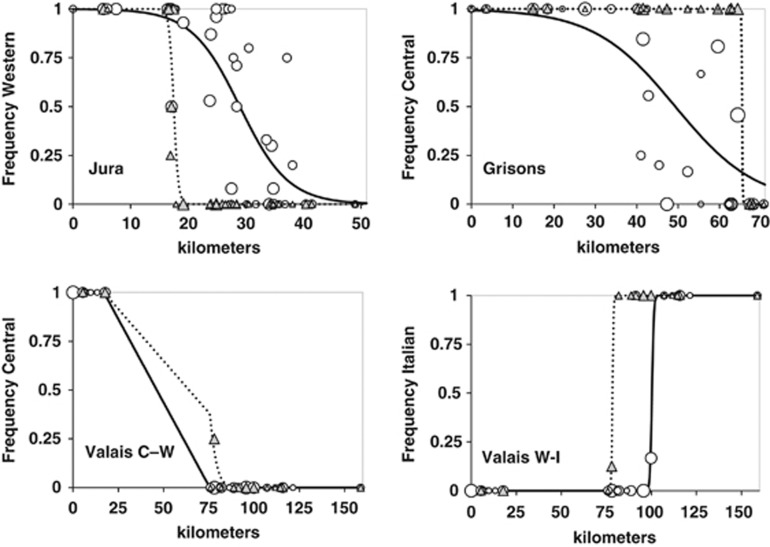
Hybrid zones provide excellent opportunities to study processes and mechanisms underlying reproductive isolation and speciation. Here we investigated sex-specific clines of molecular markers in hybrid zones of morphologically cryptic yet genetically highly-diverged evolutionary lineages of the European common vole (Microtus arvalis). We analyzed the position and width of four secondary contact zones along three independent transects in the region of the Alps using maternally (mitochondrial DNA) and paternally (Y-chromosome) inherited genetic markers. Given male-biased dispersal in the common vole, a selectively neutral secondary contact would show broader paternal marker clines than maternal ones. In a selective case, for example, involving a form of Haldane's rule, Y-chromosomal clines would not be expected to be broader than maternal markers because they are transmitted by the heterogametic sex and thus gene flow would be restricted. Consistent with the selective case, paternal clines were significantly narrower or at most equal in width to maternal clines in all contact zones. In addition, analyses using maximum likelihood cline-fitting detected a shift of paternal relative to maternal clines in three of four contact zones. These patterns suggest that processes at the contact zones in the common vole are not selectively neutral, and that partial reproductive isolation is already established between these evolutionary lineages. We conclude that hybrid zone movement, sexual selection and/or genetic incompatibilities are likely associated with an unusual unidirectional manifestation of Haldane's rule in this common European mammal.
Figures
References
-
- Baird SJE, Ribas A, Macholán M, Albrecht T, Piálek J, Goüy de Bellocq J. Where are the wormy mice? A reexamination of hybrid parasitism in the European House mouse hybrid zone. Evolution. 2012;66:2757–2772. - PubMed
-
- Barton NH, Baird SJE.2002. ANALYSE, Version 1.3: Freeware: available from http://helios.bto.edsac.uk/evolgen/Mac/Analyse .
-
- Barton NH, Hewitt GM. Analysis of hybrid zones. Annu Rev Ecol Syst. 1985;16:113–148.
-
- Barton NH, Hewitt GM. Adaptation, speciation and hybrid zones. Nature. 1989;341:497–503. - PubMed
-
- Bastos-Silveira C, Santos SM, Monarca R, Mathias ML, Heckel G. Deep mitochondrial introgression and hybridization between ecologically divergent vole species. Mol Ecol. 2012;21:5309–5323. - PubMed
Publication types
MeSH terms
Substances
LinkOut - more resources
Full Text Sources
Other Literature Sources
