Widespread splicing changes in human brain development and aging
- PMID: 23340839
- PMCID: PMC3564255
- DOI: 10.1038/msb.2012.67
Widespread splicing changes in human brain development and aging
Abstract
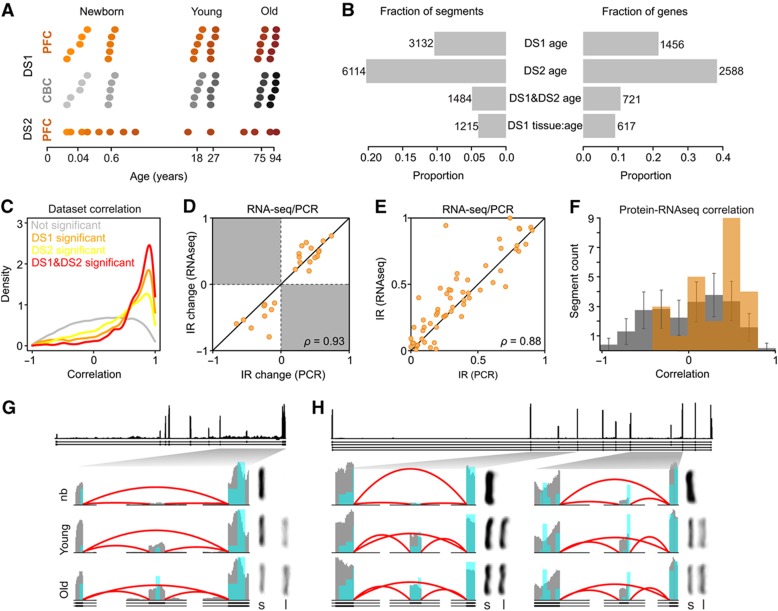
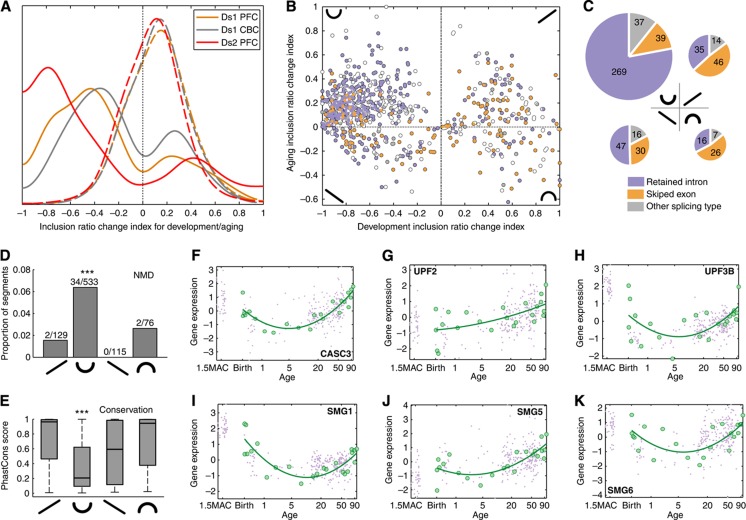
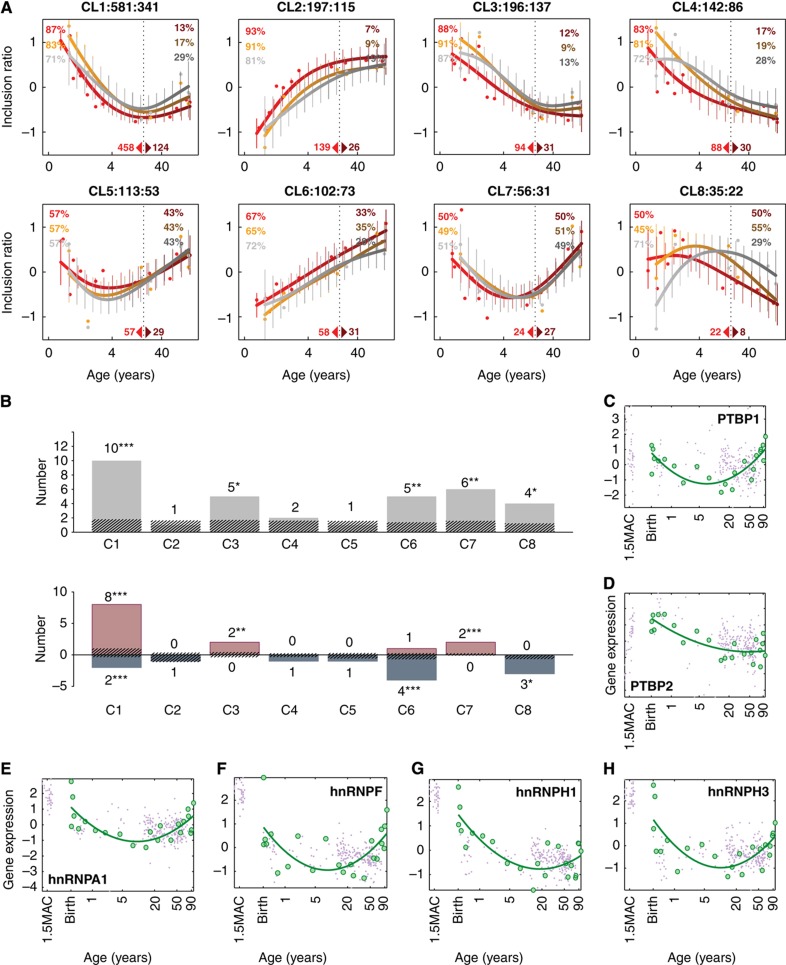
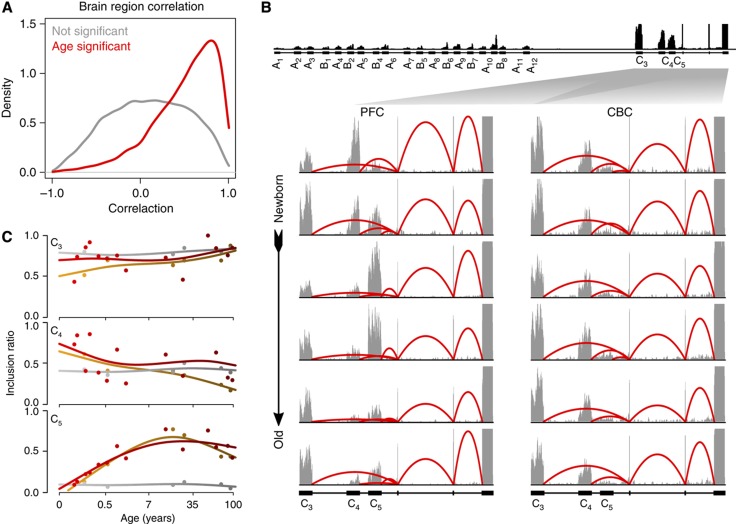
While splicing differences between tissues, sexes and species are well documented, little is known about the extent and the nature of splicing changes that take place during human or mammalian development and aging. Here, using high-throughput transcriptome sequencing, we have characterized splicing changes that take place during whole human lifespan in two brain regions: prefrontal cortex and cerebellum. Identified changes were confirmed using independent human and rhesus macaque RNA-seq data sets, exon arrays and PCR, and were detected at the protein level using mass spectrometry. Splicing changes across lifespan were abundant in both of the brain regions studied, affecting more than a third of the genes expressed in the human brain. Approximately 15% of these changes differed between the two brain regions. Across lifespan, splicing changes followed discrete patterns that could be linked to neural functions, and associated with the expression profiles of the corresponding splicing factors. More than 60% of all splicing changes represented a single splicing pattern reflecting preferential inclusion of gene segments potentially targeting transcripts for nonsense-mediated decay in infants and elderly.
Conflict of interest statement
The authors declare that they have no conflict of interest.
Figures
References
-
- Ashburner M, Ball CA, Blake JA, Botstein D, Butler H, Cherry JM, Davis AP, Dolinski K, Dwight SS, Eppig JT, Harris MA, Hill DP, Issel-Tarver L, Kasarskis A, Lewis S, Matese JC, Richardson JE, Ringwald M, Rubin GM, Sherlock G (2000) Gene ontology: tool for the unification of biology. The Gene Ontology Consortium. Nat Genet 25: 25–29 - PMC - PubMed
-
- Barash Y, Calarco JA, Gao WJ, Pan Q, Wang XC, Shai O, Blencowe BJ, Frey BJ (2010) Deciphering the splicing code. Nature 465: 53–59 - PubMed
-
- Benjamini Y, Hochberg Y (1995) Controlling the false discovery rate—a practical and powerful approach to multiple testing. J Roy Stat Soc B Met 57: 289–300
-
- Bernstein HG, Smalla KH, Bogerts B, Gordon-Weeks PR, Beesley PW, Gundelfinger ED, Kreutz MR (2007) The immunolocalization of the synaptic glycoprotein neuroplastin differs substantially between the human and the rodent brain. Brain Res 1134: 107–112 - PubMed
Publication types
MeSH terms
Substances
LinkOut - more resources
Full Text Sources
Other Literature Sources
Medical
Molecular Biology Databases