


Review
doi: 10.1007/s00018-012-1256-2.
Epub 2013 Jan 23.
The NuRD architecture
Affiliations
- PMID: 23340908
- PMCID: PMC3652912
- DOI: 10.1007/s00018-012-1256-2
Item in Clipboard
Review
The NuRD architecture
Cell Mol Life Sci.
2013 Oct.
Abstract
The nucleosome remodeling and deacetylase (NuRD) complex regulates chromatin organization, gene transcription, genomic stability and developmental signaling. NuRD has a unique dual enzymatic activity, containing an ATPase and a histone deacetylase among its six core subunits. Recent studies indicate that NuRD composition and the interplay between subunits may dictate the diverse functions of the complex. In this review, we examine the structures and biological roles of the NuRD subunits and discuss new avenues of research to advance our understanding of the NuRD-mediated signaling network.
Figures

The NuRD complex and its core components. a Interactions between subunits and binding of the individual subunits to histones, DNA and other proteins or co-factors (Co-F). Co-F of CHD3/4: hunchback, Tramtrack69, KAP1, NAB2, RFP, E7, RORγ, Ikaros, Ki-1/57 and CGI-55; of MBD2: MIZF and FAK; of RBBP7/4: FOG-1, BCL11B and BRCA1; of MTA: BCL-6, BCL11B, oestrogen receptor α, NRIF3, MAT1, MICoA, LMO4 and FOG-1. b Domain architecture of each subunit
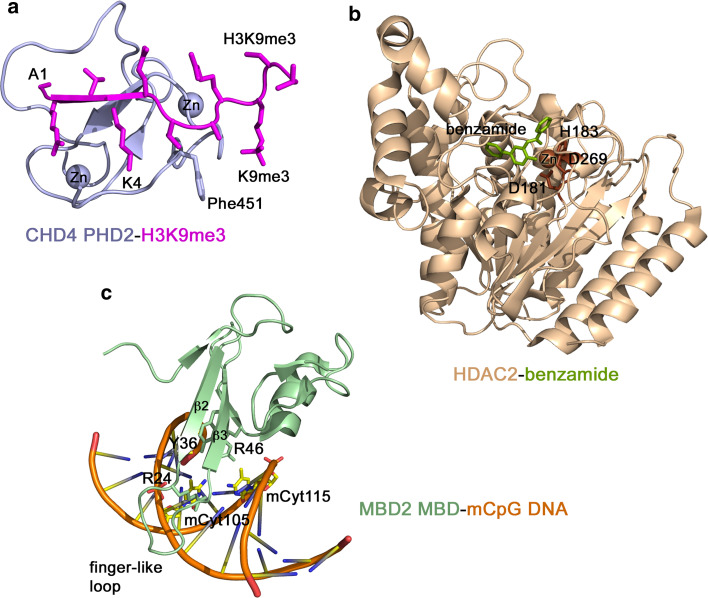
The structural basis for ligand binding by the NuRD components CHD4, HDAC2 and MBD2. a Solution structure of the CHD4 PHD2 finger in complex with a H3K9me3 peptide (PDB: 2L75). b Crystal structure of HDAC2 in complex with a small molecule inhibitor N-(4-aminobiphenyl-3-yl)benzamide (PDB: 3MAX). c Solution structure of the MBD module of MBD2 bound to a methylated DNA fragment, derived from the ρ-globin promoter (PDB: 2KY8)
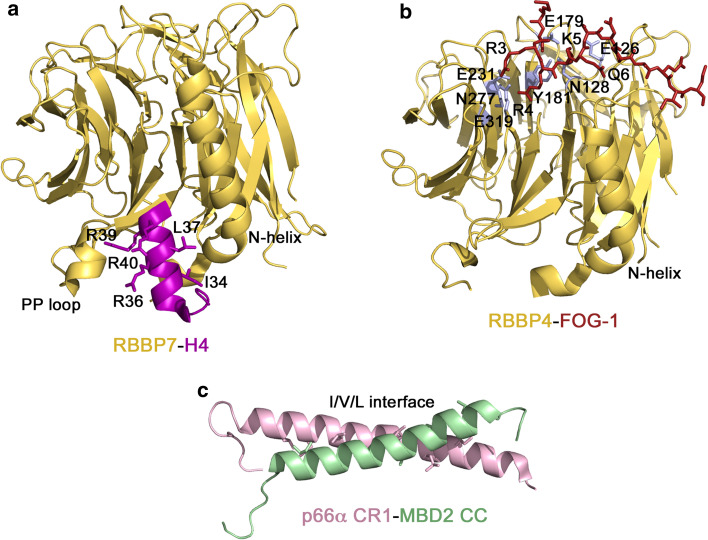
The structural basis for ligand binding by the NuRD components RBBP7/4 and p66α. a Crystal structure of RBBP7 in complex with a H4 peptide (PDB: 3CFS). b Crystal structure of RBBP4 in complex with a FOG-1 peptide (PDB: 2XU7). c Solution structure of CR1 of p66α bound to the CC domain of MBD2 (PDB: 2L2L). Hydrophobic Ile, Val and Leu residues forming the coiled-coil interface are shown
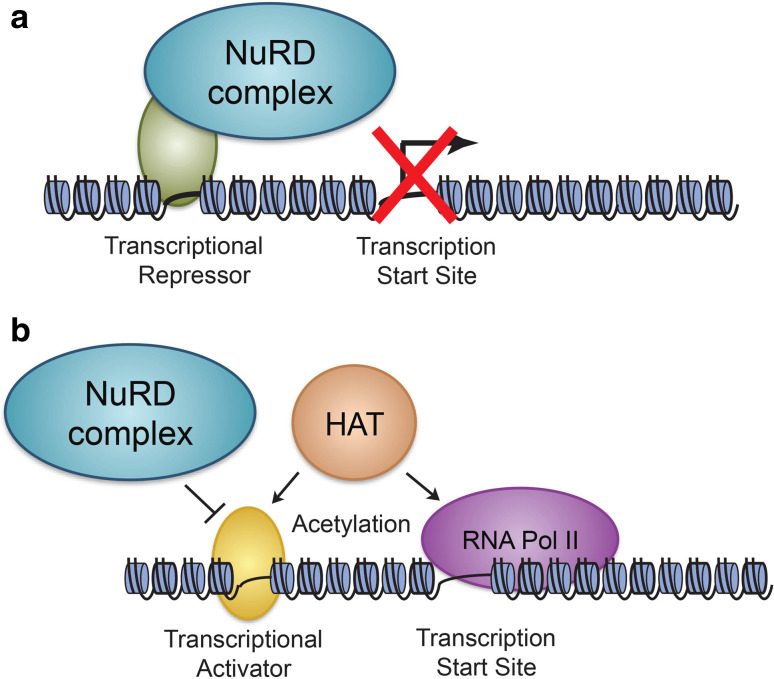
Models depicting NuRD complex recruitment and function. a The classic, static model of NuRD action shows association of the NuRD complex with inactive genes. Recruitment is typically depicted as resulting from direct interaction between a NuRD subunit and a transcriptional repressor. b A dynamic model for NuRD function shows NuRD as acting to maintain dynamic equilibrium of histone acetylation at an active gene, resulting in fine-tuning of gene expression
References
-
- Tong JK, Hassig CA, Schnitzler GR, Kingston RE, Schreiber SL. Chromatin deacetylation by an ATP-dependent nucleosome remodelling complex. Nature. 1998;395:917–921. - PubMed
-
- Wade PA, Jones PL, Vermaak D, Wolffe AP. A multiple subunit Mi-2 histone deacetylase from Xenopus laevis cofractionates with an associated Snf2 superfamily ATPase. Curr Biol. 1998;8:843–846. - PubMed
-
- Xue Y, Wong J, Moreno GT, Young MK, Cote J, Wang W. NURD, a novel complex with both ATP-dependent chromatin-remodeling and histone deacetylase activities. Mol Cell. 1998;2:851–861. - PubMed
-
- Zhang Y, LeRoy G, Seelig HP, Lane WS, Reinberg D. The dermatomyositis-specific autoantigen Mi2 is a component of a complex containing histone deacetylase and nucleosome remodeling activities. Cell. 1998;95:279–289. - PubMed
-
- Denslow SA, Wade PA. The human Mi-2/NuRD complex and gene regulation. Oncogene. 2007;26:5433–5438. - PubMed
Publication types
MeSH terms
Substances
Grants and funding
LinkOut - more resources
Full Text Sources
Other Literature Sources
