Health care provider communication: an empirical model of therapeutic effectiveness
- PMID: 23341092
- PMCID: PMC3654554
- DOI: 10.1002/cncr.27949
Health care provider communication: an empirical model of therapeutic effectiveness
Abstract
Background: Patients who are facing life-threatening and life-limiting cancer almost invariably experience psychological distress. Responding effectively requires therapeutic sensitivity and skill. In this study, we examined therapeutic effectiveness within the setting of cancer-related distress with the objective of understanding its constituent parts.
Methods: Seventy-eight experienced psychosocial oncology clinicians from 24 health care centers across Canada were invited to participate in 3 focus groups each. In total, 29 focus groups were held over 2 years, during which clinicians articulated the therapeutic factors deemed most helpful in mitigating patient psychosocial distress. The content of each focus group was summarized into major themes and was reviewed with participants to confirm their accuracy. Upon completion of the focus groups, workshops were held in various centers, eliciting participant feedback on an empirical model of therapeutic effectiveness based on the qualitative analysis of focus group data.
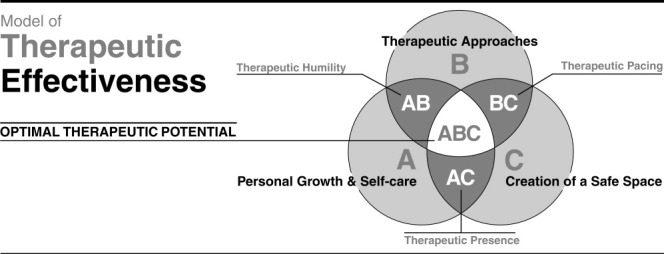
Results: Three primary, interrelated therapeutic domains emerged from the data, forming a model of optimal therapeutic effectiveness: 1) personal growth and self-care (domain A), 2) therapeutic approaches (domain B), and 3) creation of a safe space (domain C). Areas of domain overlap were identified and labeled accordingly: domain AB, therapeutic humility; domain BC, therapeutic pacing; and domain AC, therapeutic presence.
Conclusions: This empirical model provides detailed insights regarding the elements and pedagogy of effective communication and psychosocial care for patients who are experiencing cancer-related distress.
Copyright © 2012 American Cancer Society.
Figures
Comment in
-
The essential elements of a therapeutic presence.Cancer. 2013 May 1;119(9):1609-10. doi: 10.1002/cncr.27946. Epub 2013 Jan 22. Cancer. 2013. PMID: 23341022 No abstract available.
References
-
- Kendall J, Glaze K, Oakland S, Hansen J, Parry C. What do 1281 distress screeners tell us about cancer patients in a community cancer center? Psychooncology. 2011;20:594–600. - PubMed
-
- Holland JC, Alici Y. Management of distress in cancer patients. J Support Oncol. 2010;8:4–12. - PubMed
-
- Ernstmann N, Neumann M, Ommen O, et al. Determinants and implications of cancer patients' psychosocial needs. Support Care Cancer. 2009;17:1417–1423. - PubMed
Publication types
MeSH terms
Grants and funding
LinkOut - more resources
Full Text Sources
Other Literature Sources