


Male breast cancer according to tumor subtype and race: a population-based study
- PMID: 23341341
- PMCID: PMC3971835
- DOI: 10.1002/cncr.27905
Male breast cancer according to tumor subtype and race: a population-based study
Abstract
Background: Breast cancer occurs rarely in men. To the authors' knowledge, no population-based estimates of the incidence of human epidermal growth factor receptor 2 (HER2)-positive breast cancer or of the distribution of breast cancer subtypes among male breast cancer patients have been published to date. Therefore, the objective of the current study was to explore breast tumor subtype distribution by race/ethnicity among men in the large, ethnically diverse population of California.
Methods: This study included men who were diagnosed with invasive breast cancer between 2005 and 2009 with known estrogen receptor (ER) and progesterone receptor (PR) (together, hormone receptor [HR]) status and HER2 status reported to the California Cancer Registry. Among the men with HR-positive tumors, survival probabilities between groups were compared using log-rank tests.
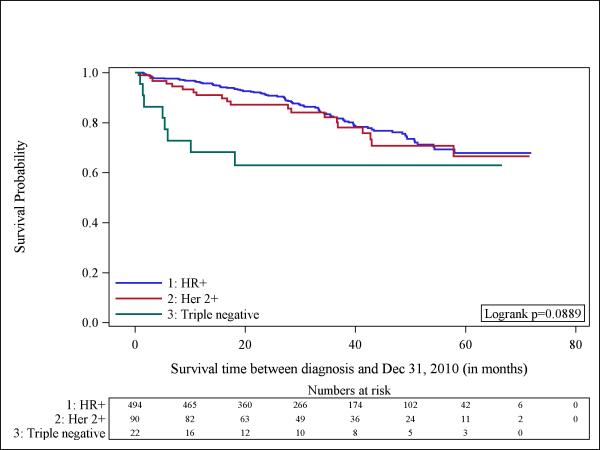
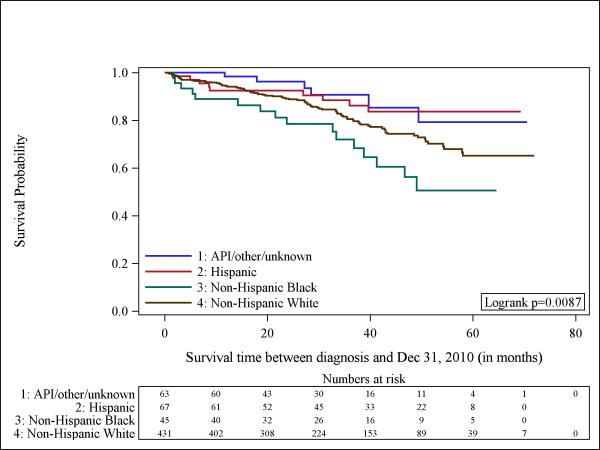
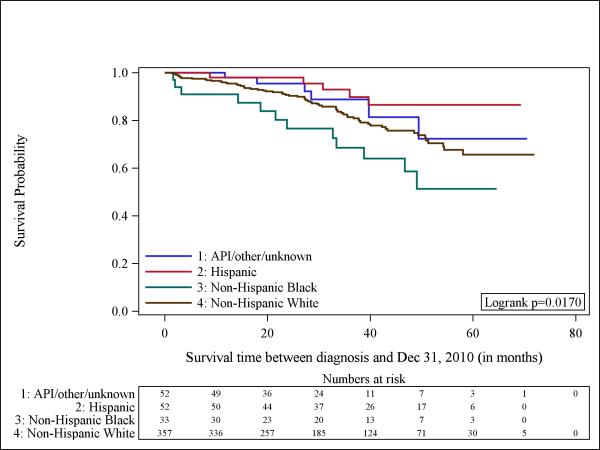
Results: Six hundred six patients were included. The median age at diagnosis was 68 years. Four hundred ninety-four men (81.5%) had HR-positive tumors (defined as ER-positive and/or PR-positive and HER2-negative). Ninety men (14.9%) had HER2-positive tumors, and 22 (3.6%) had triple receptor-negative (TN) tumors. Among the patients with HR-positive tumors, non-Hispanic black men and Hispanic men were more likely to have PR-negative tumors than non-Hispanic white men. No statistically significant differences in survival were observed according to tumor subtype (P = .08). Differences in survival according to race/ethnicity were observed among all patients (P = .087) and among those with HR-positive tumors (P = .0170), and non-Hispanic black men had poorer outcomes.
Conclusions: In this large, representative cohort of men with breast cancer, the distribution of tumor subtypes was different from that reported for women and varied by patient race/ethnicity. Non-Hispanic black men were more likely to have TN tumors and ER-positive/PR-negative tumors than white men.
Copyright © 2013 American Cancer Society.
Figures
References
-
- Giordano SH, Cohen DS, Buzdar AU, Perkins G, Hortobagyi GN. Breast carcinoma in men: a population-based study. Cancer. 2004;101(1):51–7. - PubMed
-
- Siegel R, Ward E, Brawley O, Jemal A. Cancer statistics, 2011: the impact of eliminating socioeconomic and racial disparities on premature cancer deaths. CA Cancer J Clin. 2011;61(4):212–36. - PubMed
-
- Giordano SH, Buzdar AU, Hortobagyi GN. Breast cancer in men. Ann Intern Med. 2002;137(8):678–87. - PubMed
-
- Anderson WF, Althuis MD, Brinton LA, Devesa SS. Is male breast cancer similar or different than female breast cancer? Breast Cancer Res Treat. 2004;83(1):77–86. - PubMed
Publication types
MeSH terms
Substances
Grants and funding
- P30 CA016672/CA/NCI NIH HHS/United States
- R01 CA121052/CA/NCI NIH HHS/United States
- U58 DP000807/DP/NCCDPHP CDC HHS/United States
- R01-ES015552/ES/NIEHS NIH HHS/United States
- N01 PC054404/CA/NCI NIH HHS/United States
- HHSN261201000040C/CA/NCI NIH HHS/United States
- R01 ES015552/ES/NIEHS NIH HHS/United States
- N01-PC-54,404/PC/NCI NIH HHS/United States
- R01-CA121052/CA/NCI NIH HHS/United States
- N01 PC035139/CA/NCI NIH HHS/United States
- 2P30 CA016672/CA/NCI NIH HHS/United States
- HHSN261201000040I/CA/NCI NIH HHS/United States
- N01-PC-35,139/PC/NCI NIH HHS/United States
- 1U58DP00807-01/DP/NCCDPHP CDC HHS/United States
LinkOut - more resources
Full Text Sources
Other Literature Sources
Medical
Research Materials
Miscellaneous
