Gene expression changes in adipose tissue with diet- and/or exercise-induced weight loss
- PMID: 23341572
- PMCID: PMC3738189
- DOI: 10.1158/1940-6207.CAPR-12-0212
Gene expression changes in adipose tissue with diet- and/or exercise-induced weight loss
Abstract
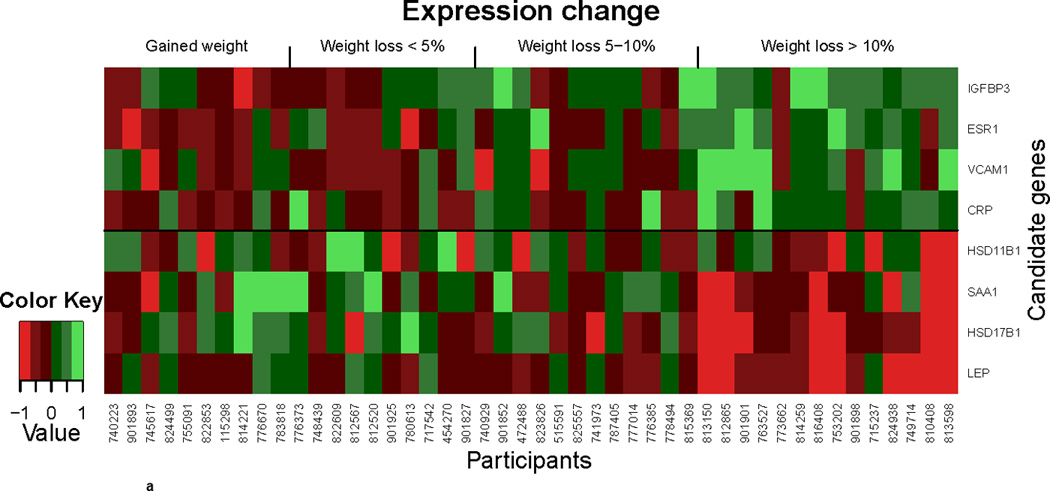
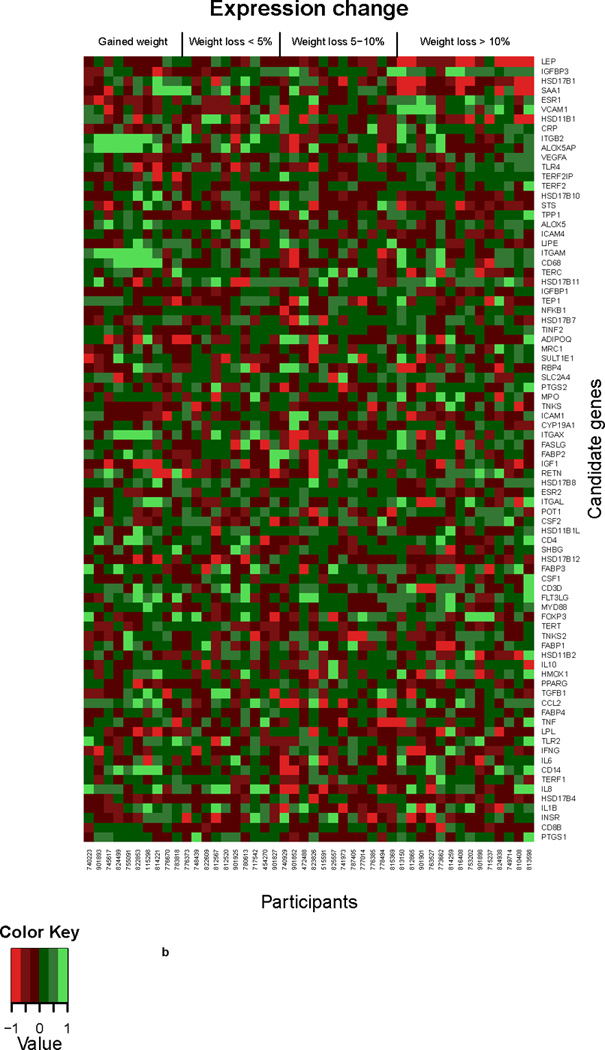
Adipose tissue plays a role in obesity-related cancers via increased production of inflammatory factors, steroid hormones, and altered adipokines. The impact of weight loss on adipose tissue gene expression may provide insights into pathways linking obesity with cancer risk. We conducted an ancillary study within a randomized trial of diet, exercise, or combined diet + exercise versus control among overweight/obese postmenopausal women. In 45 women, subcutaneous adipose tissue biopsies were conducted at baseline and after 6 months, and changes in adipose tissue gene expression were determined by microarray with an emphasis on prespecified candidate pathways as well as by unsupervised clustering of more than 37,000 transcripts (Illumina). Analyses were conducted first by randomization group and then by degree of weight change at 6-months in all women combined. At 6 months, diet, exercise, and diet + exercise participants lost a mean of 8.8, 2.5, and 7.9 kg (all P < 0.05 vs. no change in controls). There was no significant change in candidate gene expression by intervention group. In analysis by weight change category, greater weight loss was associated a decrease in 17β-hydroxysteroid dehydrogenase-1 (HSD17B1, Ptrend < 0.01) and leptin (LEP, Ptrend < 0.01) expression, and marginally significant increased expression of estrogen receptor-1 (ESR1, Ptrend = 0.08) and insulin-like growth factor-binding protein-3 (IGFBP3, Ptrend = 0.08). Unsupervised clustering revealed 83 transcripts with statistically significant changes. Multiple gene expression changes correlated with changes in associated serum biomarkers. Weight loss was associated with changes in adipose tissue gene expression after 6 months, particularly in two pathways postulated to link obesity and cancer, that is, steroid hormone metabolism and IGF signaling. Cancer Prev Res; 6(3); 217-31. ©2013 AACR.
©2013 AACR.
Figures
References
-
- Vainio H, Bianchini F, editors. Weight Control and Physical Activity. Lyon: IARC Press; 2002. - PubMed
-
- Friedenreich CM. Review of anthropometric factors and breast cancer risk. European J Cancer Prev. 2001;10:15–32. - PubMed
-
- McTiernan A. Obesity and cancer: the risks, science, and potential management strategies. Oncology (Williston Park) 2005;19:871–881. discussion 81–2, 85–6. - PubMed
-
- Calle EE, Rodriguez C, Walker-Thurmond K, Thun MJ. Overweight, obesity, and mortality from cancer in a prospectively studied cohort of U.S. adults. N Engl J Med. 2003;348:1625–1638. - PubMed
-
- Friedenreich CM. Physical activity and cancer prevention: From observational to intervention research. Cancer Epidemiol Biomarkers Prev. 2001;10:287–301. - PubMed
Publication types
MeSH terms
Grants and funding
LinkOut - more resources
Full Text Sources
Other Literature Sources
Medical
Molecular Biology Databases
Miscellaneous