Typical Features of Amelogenesis Imperfecta in Two Patients with Bartter's Syndrome
- PMID: 23341834
- PMCID: PMC3551389
- DOI: 10.1159/000345801
Typical Features of Amelogenesis Imperfecta in Two Patients with Bartter's Syndrome
Abstract
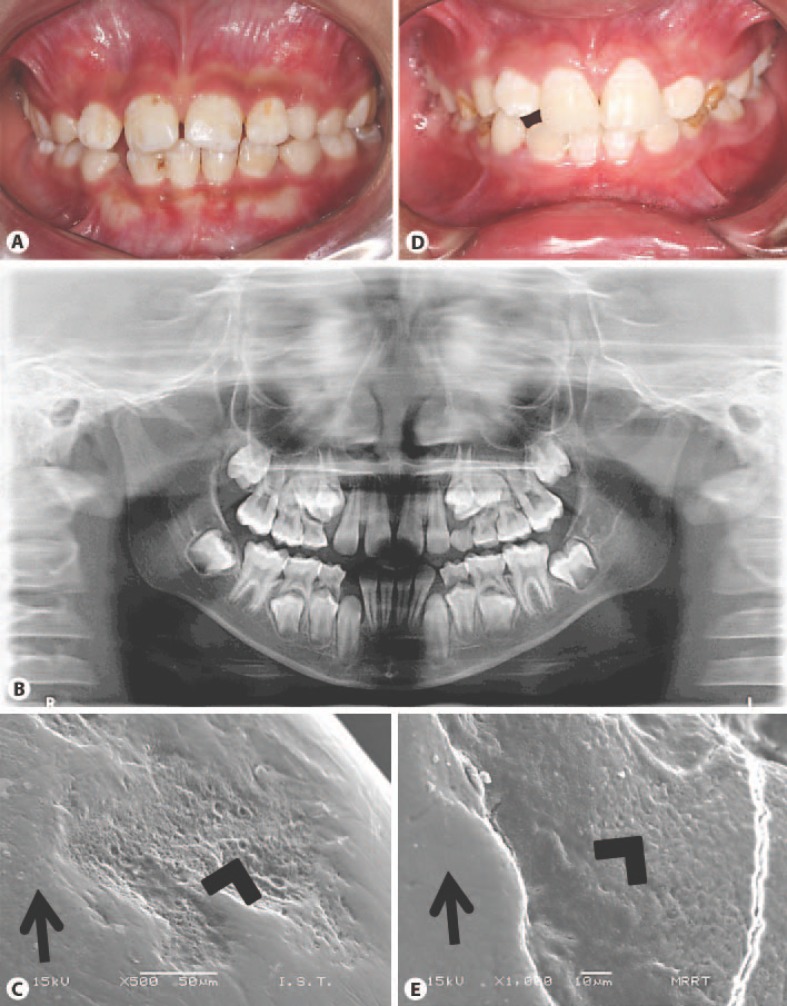
Background/aims: Amelogenesis imperfecta (AI) is due to many inherited defects of enamel formation that affect the quantity and quality of enamel, leading to delay in tooth eruption and cosmetic consequences. AI has been described in association with nephrocalcinosis, which is called the enamel-renal syndrome. The aim of this case report is to describe typical features of AI in 2 patients with Bartter's syndrome (BS) for the first time.
Methods: -Eight patients with confirmed BS were systematically screened for dental abnormalities as part of protocol. Those with suggestive clinical features of AI were submitted to panoramic X-ray and decayed teeth were analyzed by scanning electron microscopy.
Results: Typical features of AI were detected in 2 girls with BS. These 2 patients showed nephrocalcinosis, and diagnosis and adequate clinical control were delayed. Genetic analysis detected the mutation responsible for BS in 1 of these patients. In this case, BS was due to a homozygous mutation of exon 5 of the KCNJ1 gene resulting in a substitution of valine for alanine at the codon 214 (A214V).
Conclusions: The finding of typical features of AI in BS might constitute preliminary evidence that abnormalities of the biomineralization process found in patients with renal tubular disorders might also affect calcium deposition in dental tissues.
Keywords: Amelogenesis imperfecta; Bartter's syndrome; Enamel; Genetics.
Figures
References
-
- Brochard K, Boyer O, Blanchard A, Loirat C, Niaudet P, Macher MA, Deschenes G, Bensman A, Decramer S, Cochat P, Morin D, Broux F, Caillez M, Guyot C, Novo R, Jeunemaître X, Vargas-Poussou R. Phenotype-genotype correlation in antenatal and neonatal variants of Bartter syndrome. Nephrol Dial Transplant. 2009;24:1455–1464. - PubMed
-
- International Collaborative Study Group for Bartter-Like Syndromes Mutations in the gene encoding the inwardly-rectifying renal potassium channel, ROMK, cause the antenatal variant of Bartter syndrome: evidence for genetic heterogeneity. Hum Molec Genet. 1997;6:17–26. - PubMed
-
- Ohlsson A, Sieck U, Cumming W, Akhtar M, Serenius F. A variant of Bartter's syndrome: Bartter's syndrome associated with hydramnios, prematurity, hypercalciuria and nephrocalcinosis. Acta Paediatr Scand. 1984;73:868–874. - PubMed
-
- Witkop CJ., Jr Amelogenesis imperfecta, dentinogenesis imperfecta and dentin dysplasia revisited, problems in classification. J Oral Pathol. 1989;17:547–553. - PubMed
Publication types
LinkOut - more resources
Full Text Sources