


Evidence and impact of human papillomavirus latency
- PMID: 23341855
- PMCID: PMC3547385
- DOI: 10.2174/1874357901206010198
Evidence and impact of human papillomavirus latency
Abstract
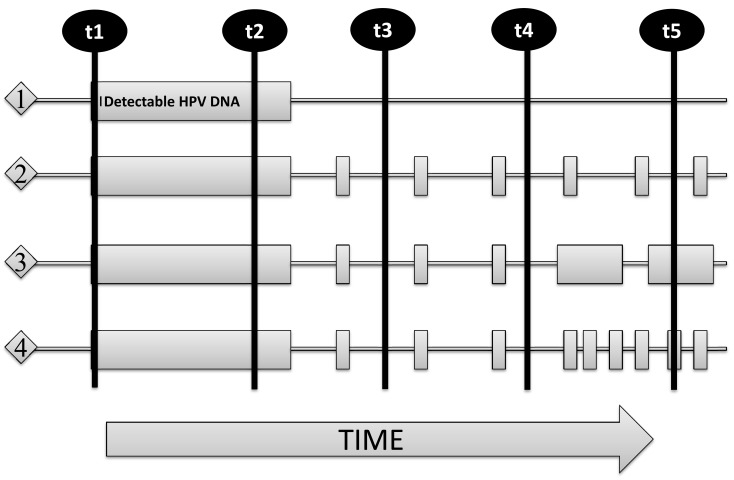
At present, there is no consensus in the scientific community regarding the ability for human papillomavirus (HPV) infections to establish latency. Based on animal studies, a model of papillomavirus latency has been proposed in which papillomaviruses can be retained in the basal epithelial stem cell pool as latent infections and periodically induced to reactivate when the stem cell divides and one daughter cell is committed to terminal differentiation and induction of the viral life cycle. Tissue resident memory T-cells are hypothesized to control these periodic reactivation episodes and thus limit their duration. In this paper, evidence from human studies consistent with this model of papillomavirus latency is reviewed. Given the strong circumstantial evidence supporting a natural history of HPV infection which includes a immunologically controlled latent state, the longer term implications of HPV latency on a highly infected and aging population may warrant a more serious evaluation.
Keywords: HPV; Papillomavirus; cervical cancer.; latency; reactivation.
Figures
References
-
- Knipe DM, Howley PM, editors. Fields Virology. 5th. Philadelphia: Lippincott: Williams and Wilkins; 2007. Howley and Lowy, Chapter 62. Papillomaviruses.
-
- Insinga RP, Perez G, Wheeler CM, et al. Incidence, duration, and reappearance of type-specific cervical human papillomavirus infections in young women. Cancer Epidemiol Biomarkers Prev. 2010;19(6 ):1585–94. - PubMed
Grants and funding
LinkOut - more resources
Full Text Sources