. 2013;8(1):e48495.
doi: 10.1371/journal.pone.0048495. Epub 2013 Jan 15.

Rare variant analysis for family-based design

Affiliations

Rare variant analysis for family-based design

Gourab De et al. PLoS One. 2013.

Abstract

Genome-wide association studies have been able to identify disease associations with many common variants; however most of the estimated genetic contribution explained by these variants appears to be very modest. Rare variants are thought to have larger effect sizes compared to common SNPs but effects of rare variants cannot be tested in the GWAS setting. Here we propose a novel method to test for association of rare variants obtained by sequencing in family-based samples by collapsing the standard family-based association test (FBAT) statistic over a region of interest. We also propose a suitable weighting scheme so that low frequency SNPs that may be enriched in functional variants can be upweighted compared to common variants. Using simulations we show that the family-based methods perform at par with the population-based methods under no population stratification. By construction, family-based tests are completely robust to population stratification; we show that our proposed methods remain valid even when population stratification is present.


Conflict of interest statement

Competing Interests: The authors have declared that no competing interests exist.

Figures

Figure 1
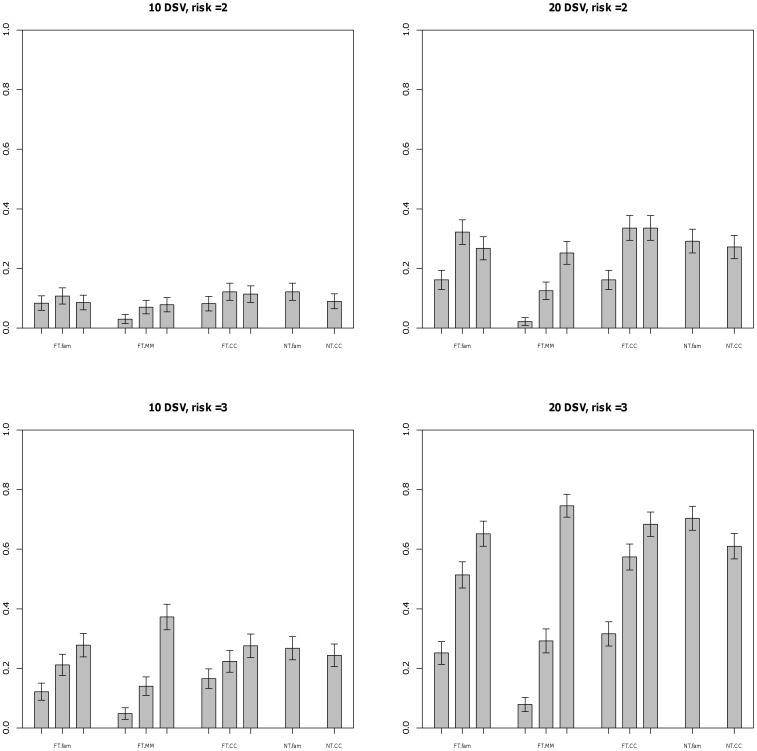
Figure 1. Power at 0.05 level for trios and case-control design - No population stratification is present and .
# of cases = 500. DSV’s have frequency less than 0.01 and equal effects. FT.fam - trios with fixed threshold method using threshold 0.005, 0.01 and 0.05, FT.MM - FBAT-MM test using threshold 0.005, 0.01 and 0.05, FT.CC - case-control with unweighted method using threshold 0.005, 0.01 and 0.05, NT.fam - trios with weighted method using no threshold, NT.CC - case-control with Madsen and Browning method.
Figure 2
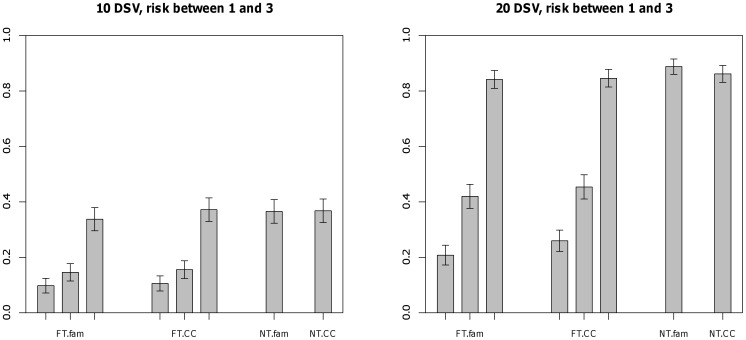
Figure 2. Power at 0.05 level for trios and case-control design - No population stratification is present and .
# of cases = 500. DSVs have frequency less than 0.01 and varying effects. FT.fam - trios with fixed threshold method using threshold 0.005, 0.01 and 0.05, FT.CC - case-control with unweighted method using threshold 0.005, 0.01 and 0.05, NT.fam - trios with weighted method using no threshold, NT.CC - case-control with Madsen and Browning method.
Figure 3
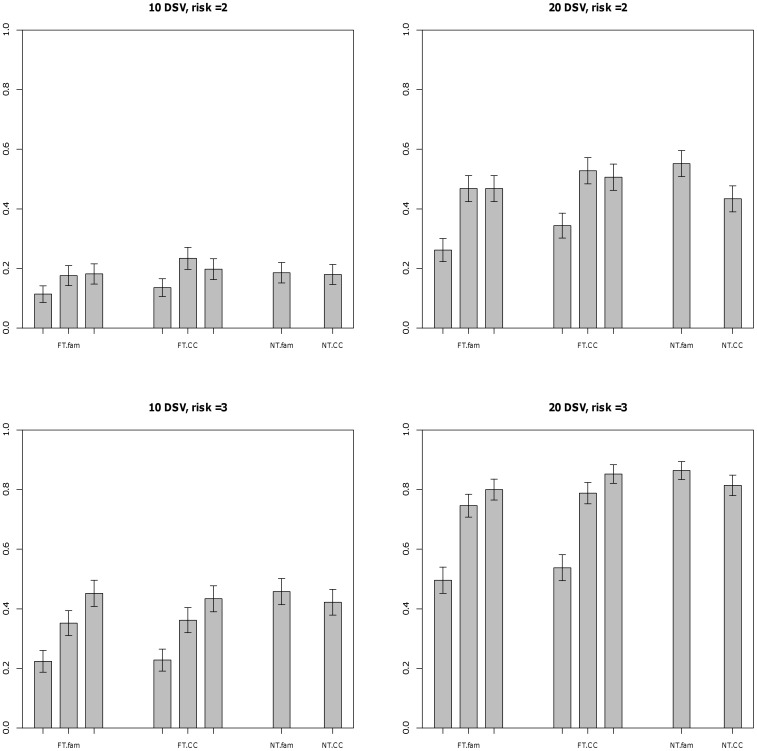
Figure 3. Power at 0.05 level for trios and case-control design - No population stratification is present and .
# of cases = 1000. DSV’s have frequency less than 0.01 and equal effects. FT.fam - trios with fixed threshold method using threshold 0.005, 0.01 and 0.05, FT.CC - case-control with unweighted method using threshold 0.005, 0.01 and 0.05, NT.fam - trios with weighted method using no threshold, NT.CC - case-control with Madsen and Browning method.

References

    1. Asimit J, Zeggini E (2010) Rare variant association analysis methods for complex traits. Annu Rev Genet 44: 293–308. - PubMed
    1. Bansal V, Libiger O, Torkamani A, Schork NJ (2010) Statistical analysis strategies for association studies involving rare variants. Nat Rev Genet 11: 773–785. - PMC - PubMed
    1. Morgenthaler S, Thilly WG (2010) A strategy to discover genes that carry multi-allelic or mono-allelic risk for common diseases : a cohort allelic sums test (CAST). Mutat Res 615: 28–56. - PubMed
    1. Li B, Leal SM (2008) Methods for detecting associations with rare variants for common diseases: application to analysis of sequence data. Am J Hum Genet 83: 311–321. - PMC - PubMed
    1. Madsen BE, Browning SR (2009) A groupwise association test for rare mutations using a weighted sum statistic. PLoS Genet 5: e1000384. - PMC - PubMed

Publication types

LinkOut - more resources