


High osmolality vitrification: a new method for the simple and temperature-permissive cryopreservation of mouse embryos
- PMID: 23341870
- PMCID: PMC3547031
- DOI: 10.1371/journal.pone.0049316
High osmolality vitrification: a new method for the simple and temperature-permissive cryopreservation of mouse embryos
Abstract
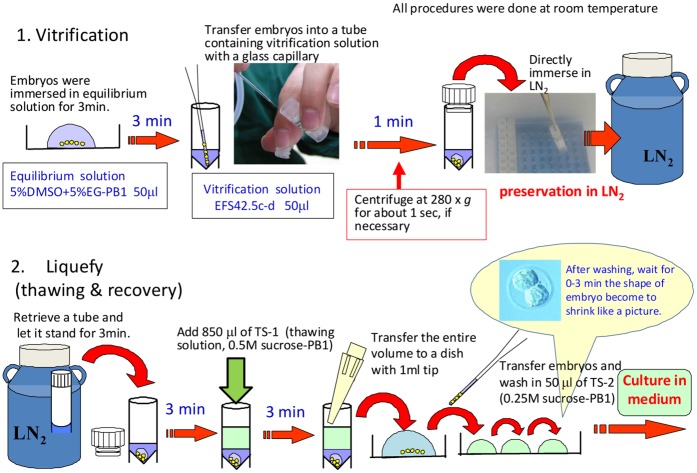
Procedures for cryopreserving embryos vary considerably, each having its specific advantages and disadvantages in terms of technical feasibility, embryo survival yield, temperature permissibility and species- or strain-dependent applicability. Here we report a high osmolality vitrification (HOV) method that is advantageous in these respects. Cryopreservation by vitrification is generally very simple, but, unlike slow freezing, embryos should be kept at a supercooling temperature (below -130°C) to avoid cryodamage. We overcame this problem by using an HOV solution containing 42.5% (v/v) ethylene glycol, 17.3% (w/v) Ficoll and 1.0 M sucrose. This solution is more viscous than other cryopreservation solutions, but easy handling of embryos was assured by employing a less viscous equilibration solution before vitrification. Most (>80%) embryos cryopreserved in this solution survived at -80°C for at least 30 days. Normal mice were recovered even after intercontinental transportation in a conventional dry-ice package for 2-3 days, indicating that special containers such as dry shippers with liquid nitrogen vapor are unnecessary. The HOV solution could also be employed for long-term storage in liquid nitrogen, as with other conventional cryoprotectants. Finally, we confirmed that this new vitrification method could be applied successfully to embryos of all six strains of mice we have tested so far. Thus, our HOV method provides an efficient and reliable strategy for the routine cryopreservation of mouse embryos in animal facilities and biomedical laboratories, and for easy and cheap transportation.
Conflict of interest statement
Figures
References
-
- Whittingham DG, Leibo SP, Mazur P (1972) Survival of mouse embryos frozen to –196 degrees and –269 degrees C. Science. 18: 411–414. - PubMed
-
- Mochida K, Ogura A (2010) Cryopreservation of embryos in laboratory species. J Mamm Ova Res 27: 87–92.
-
- Jin B, Mochida K, Ogura A, Hotta E, Kobayashi Y, et al. (2010) Equilibrium vitrification of mouse embryos. Biol Reprod 82: 444–450. - PubMed
-
- Yavin S, Arav A (2007) Measurement of essential physical properties of vitrification solutions. Theriogenology 67: 81–89. - PubMed
-
- Kasai M, Komi JH, Takakamo A, Tsudera H, Sakurai T, et al. (1990) A simple method for mouse embryo cryopreservation in a low toxicity vitrification solution, without appreciable loss of viability. J Reprod Fert 89: 91–97. - PubMed
Publication types
MeSH terms
Substances
Grants and funding
LinkOut - more resources
Full Text Sources
Other Literature Sources
