


Living with lions: the economics of coexistence in the Gir forests, India
- PMID: 23341871
- PMCID: PMC3547023
- DOI: 10.1371/journal.pone.0049457
Living with lions: the economics of coexistence in the Gir forests, India
Erratum in
- PLoS One. 2014;9(2):e89708
Abstract
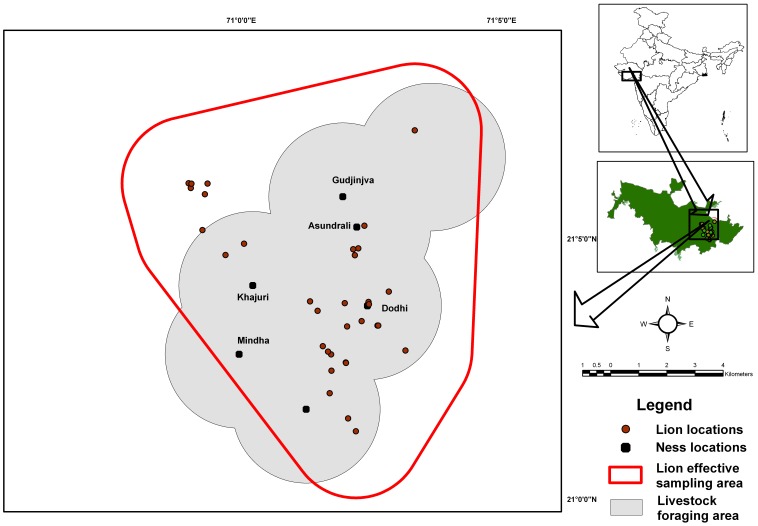
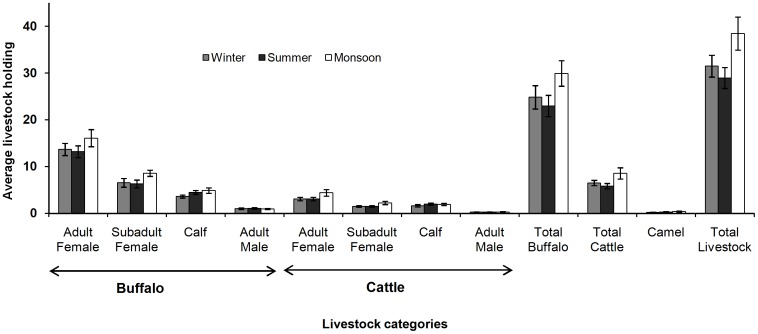
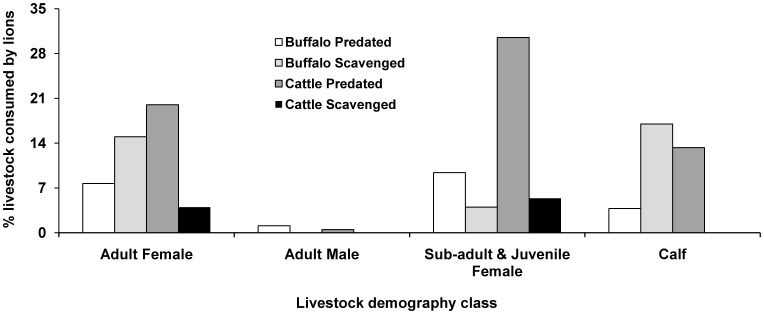
Rarely human communities coexist in harmony with large predators. Most often communities suffer due to predation on their stock while large carnivores suffer losses and at times extirpation due to retaliation. We examine the mechanisms permitting the coexistence of Asiatic lions (Panthera leo persica) and pastoral communities (Maldharis) in the Gir forests, India. We monitored six Maldhari settlements between 2005 and 2007 to quantify seasonal livestock holding, density and losses due to predation and other causes. Lion density, estimated by mark recapture, was 15±0.1 SE/100 km(2). Livestock density, estimated by total counts, ranged between 25/km(2)-31/km(2) with buffaloes being most abundant. Average livestock holding of Maldhari families was 33±3 SE. Lions predated mostly on unproductive cattle (30%). Scat analysis (n = 165), predation events (n = 180) and seven continuous monitoring sessions of 1,798 hours on four radio-collared lions estimated livestock to contribute between 25 to 42% of lions' biomass consumptions, of which only 16% was predated; rest scavenged. With free grazing rights within Gir forests, Maldharis offset 58±0.2 SE% of annual livestock rearing cost in comparison to non-forest dwelling pastoralists. With government compensation scheme for livestock predation, this profit margin augmented to 76±0.05 SE%. Lion density was higher in areas with Maldhari livestock in comparison to areas without livestock. Thus, the current lifestyles and livestock holdings of Maldharis seem to be beneficial to both lions and local pastoralists. We conclude that a combination of strict protection regime for lions, Maldharis' traditional reverence towards lions and the livelihood economics permit the delicate balance of lion-Maldhari coexistence. Indefinite increase in human and livestock population within Gir might upset this equilibrium undermining the conservation objectives. We see no end to compensation programs worldwide as they constitute a crucial element needed for human-carnivore coexistence.
Conflict of interest statement
Figures
References
-
- Ogada MO, Woodroffe R, Oguge ON, Frank GL (2003) Limiting depredation by African carnivores: the role of livestock husbandry. Conserv Biol 17: 1521–1530.
-
- Inskip C, Zimmerman A (2009) Human-felid conflict: a review of patterns and priorities worldwide. Oryx 43: 18–34.
-
- Treves A, Karanth KU (2003) Human–carnivore conflict and perspectives on carnivore management worldwide. Conserv Biol 17: 1491–1499.
-
- Karanth KU, Chellam R (2009) Carnivore conservation at the crossroads. Oryx 43: 1–2.
-
- Saberwal V, Gibbs JP, Chellam R, Johnsingh AJT (1994) Lion-human conflict in the Gir forest, India. Conserv Biol 8: 501–507.
Publication types
MeSH terms
LinkOut - more resources
Full Text Sources
Other Literature Sources
