


Triple-negative breast cancer: multipronged approach, single-arm pilot phase II study
- PMID: 23342258
- PMCID: PMC3544434
- DOI: 10.1002/cam4.3
Triple-negative breast cancer: multipronged approach, single-arm pilot phase II study
Abstract
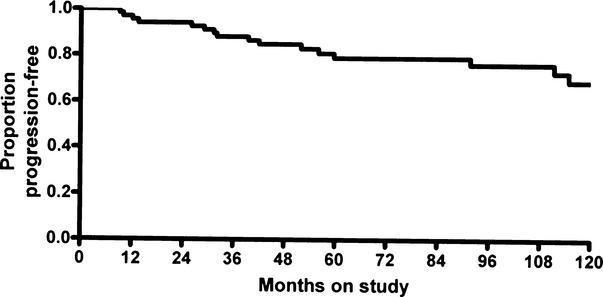
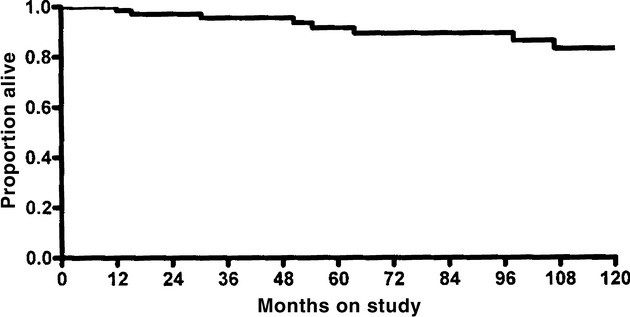
Anthracyclines (A) and taxanes (T) are standard first-line chemotherapy agents for patients with advanced breast cancer. Platinum analogues have also shown activity in the triple-negative breast cancer (TNBC) histology, but clinical data are limited. Here we report the long-term follow-up of a phase II study on TNBC treated with a combined modality therapy, including induction with AT, cyclophosphamide, methotrexate, and 5-fluorouracil (CMF) with concurrent radiation therapy, and a dose-dense consolidation chemotherapy (HDCT) with carboplatin (CBDCA), ifosfamide (IFX), etoposide (VP-16). Patients' median age was 44 years, with 73% premenopausal. Epirubicin 75 mg/m(2) and docetaxel 75 mg/m(2) were administered to 70 patients with TNBC: as neoadjuvant and adjuvant therapy to 12 and 58 patients, respectively. Postoperative radiation therapy, 5000 cGy, was delivered, synchronous with triweekly CMF. After radiation therapy, two courses of HDCT with CBDCA, IFX, VP-16, were given, with hematological growth factors. After a median follow-up of 81 months, all patients were evaluable for toxicity and response. Most important toxicity were grade 3 skin reaction and grade 4 hematological in 3% and 31% of patients, respectively. Pathological complete response was observed in 25% of patients receiving preoperative chemotherapy. Treatment failures were as follows: eight visceral, four contralateral breast cancer, four locoregional, and one leukemia. Five-year progression-free survival and overall survival rate were 78% and 91%, respectively. Induction chemotherapy, followed by chemoradiation therapy and HDCT, provides a prolonged disease-free period and a significant increase in overall survival in TNBC, with an acceptable toxicity profile.
Keywords: Concurrent chemotherapy and radiation therapy; high-dose chemotherapy; platinum analogues; triple-negative breast cancer.
Figures
References
-
- Dent R, Trudeau M, Pritchard KI, et al. Triplenegative breast cancer: clinical features and patterns of recurrence. Clin. Cancer Res. 2007;13:4429–4434. - PubMed
-
- Bauer KR, Brown M, Cress RD, et al. Descriptive analysis of estrogen receptor (ER)-negative, progesterone receptor (PR)-negative, and HER2-negative invasive breast cancer, the so-called triple-negative phenotype: a population-based study from the California Cancer Registry. Cancer. 2007;109:1721–1728. - PubMed
Publication types
MeSH terms
LinkOut - more resources
Full Text Sources
Other Literature Sources
