Review
. 2012 Dec;4(12):3625-46.
doi: 10.3390/v4123625.

A systems biology starter kit for arenaviruses

Affiliations
Review

A systems biology starter kit for arenaviruses

Magali E Droniou-Bonzom et al. Viruses. 2012 Dec.

Abstract

Systems biology approaches in virology aim to integrate viral and host biological networks, and thus model the infection process. The growing availability of high-throughput “-omics” techniques and datasets, as well as the ever-increasing sophistication of in silico modeling tools, has resulted in a corresponding rise in the complexity of the analyses that can be performed. The present study seeks to review and organize published evidence regarding virus-host interactions for the arenaviruses, from alterations in the host proteome during infection, to reported protein-protein interactions. In this way, we hope to provide an overview of the interplay between arenaviruses and the host cell, and lay the foundations for complementing current arenavirus research with a systems-level approach.


Figures
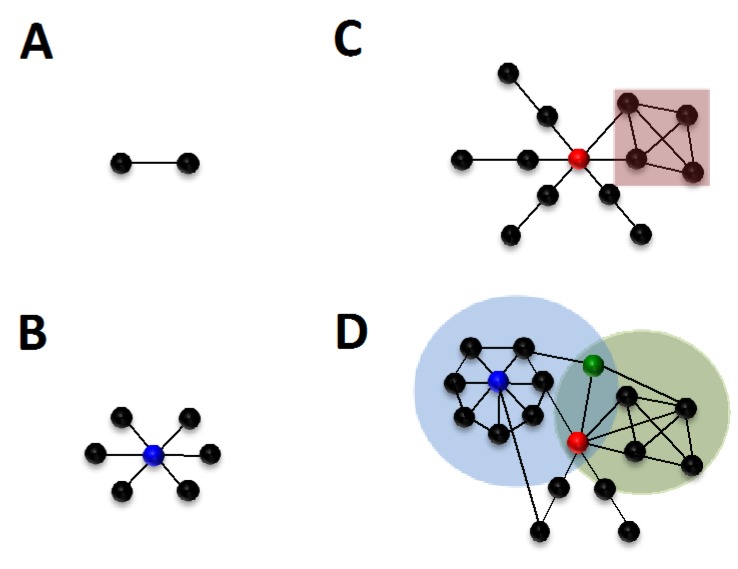
Figure 1
Figure 1
Basic concepts in network analysis. (A) Two nodes are connected by an edge. (B) One node is connected to several nodes, the blue color denotes the highest connectivity (k) value within the network. (C) The red node displays high centrality (b). The red square designates a 4-node clique. (D) The network is more complex, the red node indicates the node with the highest centrality, but is not the node with the highest connectivity (blue node). The light green and blue circles show two communities in this network, and their shared nodes, the bridging node is shown as green.
Figure 2
Figure 2
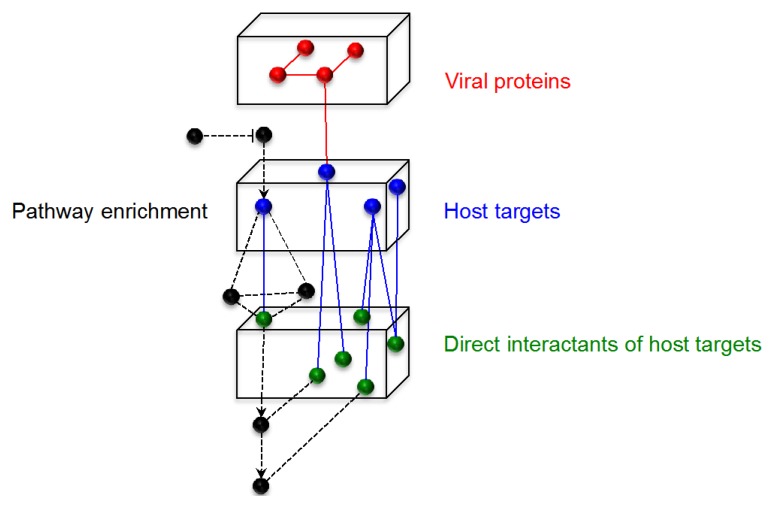
Construction of the arenavirus-host network. Schematic representation of steps in the construction of the arenavirus-host network. The four arenavirus proteins are represented by red nodes, host targets identified in the literature are blue nodes, and the directly interacting partners of these host targets, obtained from databases, are represented by green nodes. Black nodes represent proteins uploaded into the network through pathway enrichment performed on the host targets, and may contain, in addition to protein-protein interaction data, additional information about functional interactions between proteins. Edges indicate a relationship between two proteins, such as a direct protein-protein interaction or a process of protein modification, such as phosphorylation or ubiquitination.
Figure 3
Figure 3
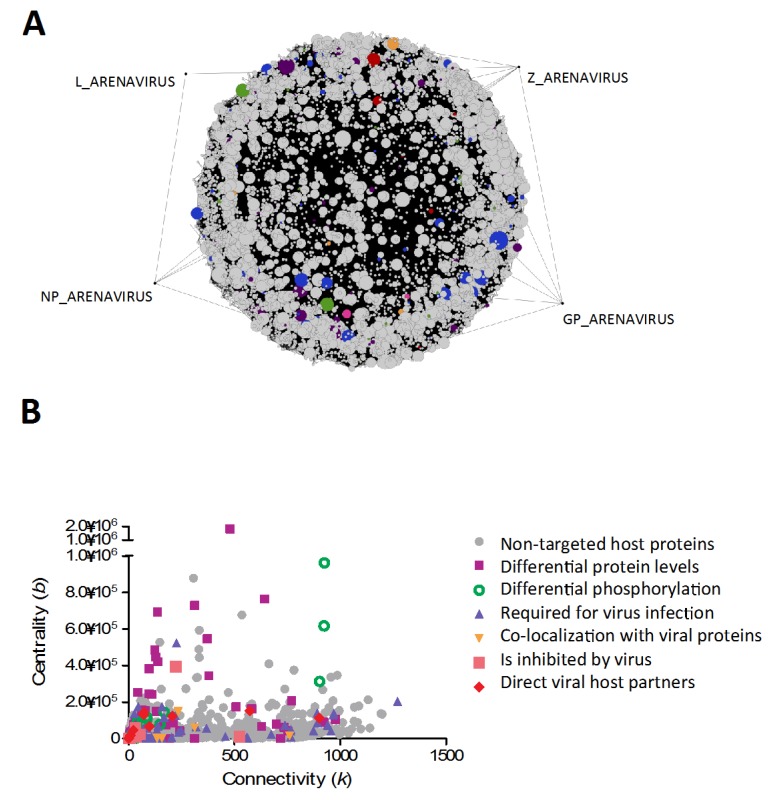
Common element network of arenavirus-host interactions, describing pathways targeted/perturbed during infection by all arenaviruses. (A) In this graphical representation, the arenaviral proteins (GP, NP, L and Z) are highlighted by dragging out of the main connected components, to facilitate visualization. Nodes are color-coded depending on role during arenavirus infection (see key in part b). Node size was correlated to node degree, to facilitate visualization of their relative importance within the network. Interested users can find the filter used to generate this network pre-loaded within the supplemental network file (Supplemental Data: Arenavirus-Host Full Network.cys; Filter name: Common elements of arenavirus replication).(B) Graphical representation of characteristics of nodes (connectivity and centrality values). Nodes of particular importance are revealed by high values in both parameters. The nodes are color-coded depending on their identified role during virus infection.

Similar articles

References

    1. Pawson T., Warner N. Oncogenic re-wiring of cellular signaling pathways. Oncogene. 2007;26:1268–1275. doi: 10.1038/sj.onc.1210255. - DOI - PubMed
    1. Davey N.E., Trave G., Gibson T.J. How viruses hijack cell regulation. Trends Biochem. Sci. 2011;36:159–169. - PubMed
    1. Navratil V., de Chassey B., Rabourdin-Combe C., Lotteau V. When the human viral infectome and diseasome networks collide: towards a systems biology platform for the aetiology of human diseases. BMC Syst. Biol. 2011;5:13. doi: 10.1186/1752-0509-5-13. - DOI - PMC - PubMed
    1. Dyer M.D., Murali T.M., Sobral B.W. The landscape of human proteins interacting with viruses and other pathogens. PLoSPathog. 2008;4:e32. - PMC - PubMed
    1. Diamond D.L., Syder A.J., Jacobs J.M., Sorensen C.M., Walters K.A., Proll S.C., McDermott J.E., Gritsenko M.A., Zhang Q., Zhao R., et al. Temporal proteome and lipidome profiles reveal hepatitis C virus-associated reprogramming of hepatocellular metabolism and bioenergetics. PLoS Pathog. 2010;6:e1000719. - PMC - PubMed

Publication types

LinkOut - more resources