Review
. 2013 Jan 23;20(1):3.
doi: 10.1186/1423-0127-20-3.

Beyond NF-κB activation: nuclear functions of IκB kinase α

Affiliations
Review

Beyond NF-κB activation: nuclear functions of IκB kinase α

Wei-Chien Huang et al. J Biomed Sci. .

Abstract

IκB kinase (IKK) complex, the master kinase for NF-κB activation, contains two kinase subunits, IKKα and IKKβ. In addition to mediating NF-κB signaling by phosphorylating IκB proteins during inflammatory and immune responses, the activation of the IKK complex also responds to various stimuli to regulate diverse functions independently of NF-κB. Although these two kinases share structural and biochemical similarities, different sub-cellular localization and phosphorylation targets between IKKα and IKKβ account for their distinct physiological and pathological roles. While IKKβ is predominantly cytoplasmic, IKKα has been found to shuttle between the cytoplasm and the nucleus. The nuclear-specific roles of IKKα have brought increasing complexity to its biological function. This review highlights major advances in the studies of the nuclear functions of IKKα and the mechanisms of IKKα nuclear translocation. Understanding the nuclear activity is essential for targeting IKKα for therapeutics.


Figures
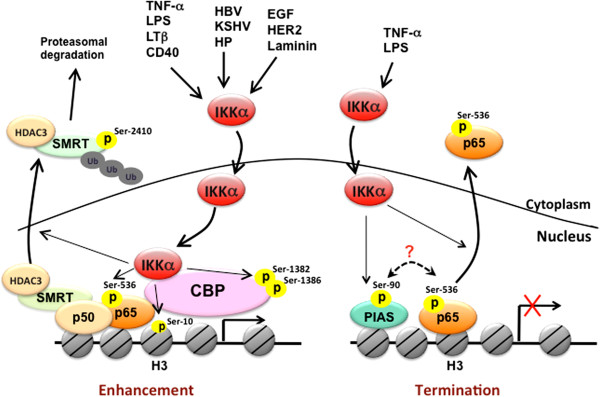
Figure 1
Figure 1
Nuclear IKKα-dependent molecular regulations of NF-κB-mediated gene transcription. In response to a variety of stimuli, including proinflammatory cytokines, pathogens, and growth factors, IKKα translocates into the nucleus and bind to DNA in association with CBP to phosphorylate histone H3 at Ser10, CBP at Ser1382/1386, and p65 at S536. Nuclear IKKα also removes repressive HDAC3/SMRT complex from NF-κB-dependent gene expression through phosphorylating SMRT at Ser2410. These events facilitate the formation of transcriptional enhanceosome to increase NF-κB-dependent gene expression. On the other hand, nuclear IKKα also contributes to the termination of NF-κB-mediated gene transcriptions by phosphorylating p65 at Ser536 and PIAS at Ser90 to facilitate the turnover of p65 in response to TNF-α or LPS stimulation.
Figure 2
Figure 2
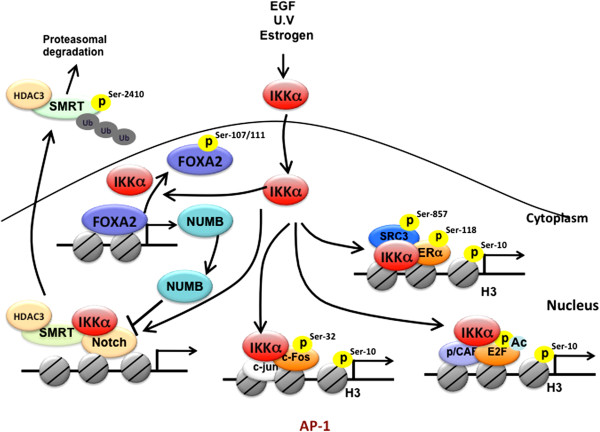
The roles of nuclear IKKα in the regulation of NF-κB-independent gene transcription. Nuclear IKKα enhances Notch-dependent gene transcriptional by phosphorylating and removing co-repressor SMRT from target gene promoters. IKKα also contributes to Notch transcriptional activity through phosphorylating and inactivating FOXA2, which subsequently leads to NUMB suppression. By direct target on transcription factors, nuclear IKKα also increases AP-1, ERα, and E2F-mediated gene transcription. Phosphorylation of SRC3 at Ser857 by nuclear IKKα also contributes to ERα transcriptional activity.
Figure 3
Figure 3
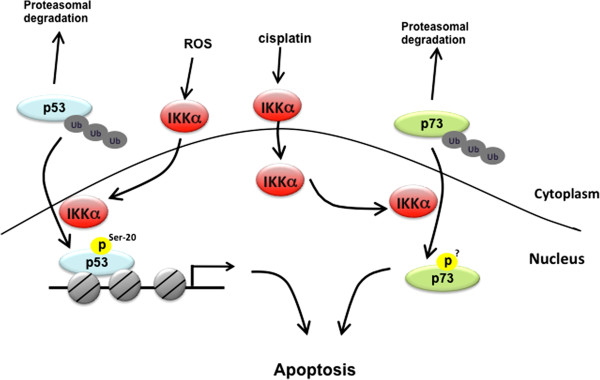
Nuclear IKKα targets p53 and p73 to mediate apoptosis. In response to DNA damage induced by ROS and cisplatin, nuclear IKKα stabilizes p53 and p73 protein level respectively to promote apoptosis.
Figure 4
Figure 4
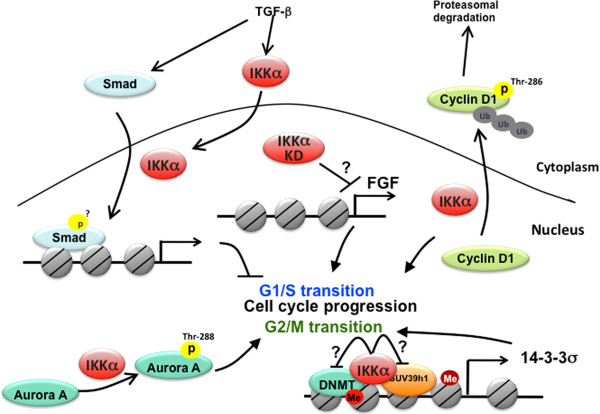
Regulations of cell cycle progression by nuclear IKKα. In the nucleus, IKKα is involved in cell cycle arrest at G1/S transition by increasing Smad transcriptional activity, facilitating cyclin D1 proteasomal degradation, and FGF gene expression. Nuclear IKKα also promotes G2/M phase progression by increasing kinase activity of Aurora A and by de-repressing 14-3-3 σ gene expression through preventing DNA and histone methylation on the promoter.
Figure 5
Figure 5
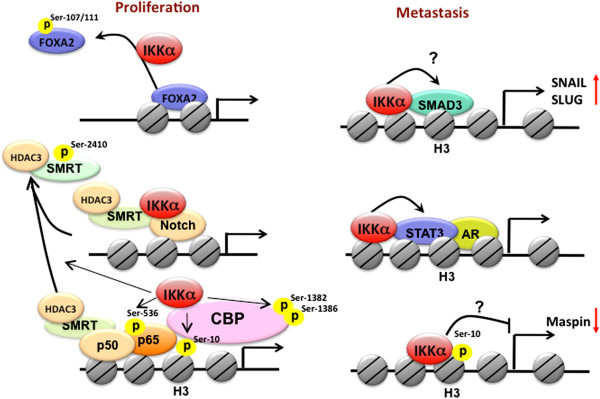
Nuclear IKKα and tumor progression. Nuclear IKKα promotes tumor growth by enhancing NF-κB- and Notch-dependent gene transcriptions and suppressing FOXA2-mediated gene expression. By promoting Smad and STAT3 transcriptional activity and suppressing maspin gene expression, nuclear IKKα contributes to cancer metastasis.
Figure 6
Figure 6
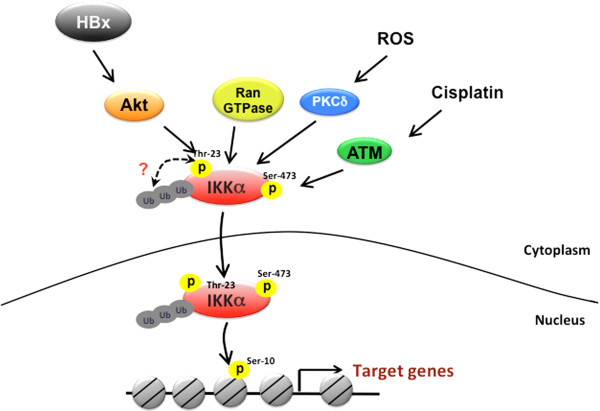
Molecular mechanisms of IKKα nuclear transportation. Ran GTPase activity is required for the nuclear transport of IKKα through interacting with importin-α. In response to HBx overexpression and cisplatin treatment, phosphorylations of IKKα at Thr23 and Ser473 by Akt and ATM respectively promote its nuclear translocation. The ubiquitination of IKKα is essential for the Akt-regulated IKKα nuclear import. Under exposure to ROS, activated PKCδ also enhances the nuclear accumulation of IKKα.

References

    1. Gilmore TD. Introduction to NF-kappaB: players, pathways, perspectives. Oncogene. 2006;25(51):6680–6684. doi: 10.1038/sj.onc.1209954. - DOI - PubMed
    1. Hayden MS, Ghosh S. Shared principles in NF-kappaB signaling. Cell. 2008;132(3):344–362. doi: 10.1016/j.cell.2008.01.020. - DOI - PubMed
    1. Hu MC, Hung MC. Role of IkappaB kinase in tumorigenesis. Future Oncol. 2005;1(1):67–78. doi: 10.1517/14796694.1.1.67. - DOI - PubMed
    1. Yang JY, Hung MC. A new fork for clinical application: targeting forkhead transcription factors in cancer. Clin Cancer Res. 2009;15(3):752–757. doi: 10.1158/1078-0432.CCR-08-0124. - DOI - PMC - PubMed
    1. Solt LA, May MJ. The IkappaB kinase complex: master regulator of NF-kappaB signaling. Immunol Res. 2008;42(1–3):3–18. - PMC - PubMed

Publication types

LinkOut - more resources