


Reliability of patient-reported functional outcome in a joint replacement registry. A comparison of primary responders and non-responders in the Danish Shoulder Arthroplasty Registry
- PMID: 23343374
- PMCID: PMC3584596
- DOI: 10.3109/17453674.2013.765622
Reliability of patient-reported functional outcome in a joint replacement registry. A comparison of primary responders and non-responders in the Danish Shoulder Arthroplasty Registry
Abstract
Background and purpose: Patient-reported outcome measures (PROMs) are used by some arthroplasty registries to evaluate results after surgery, but non-response may bias the results. The aim was to identify a potential bias in the outcome scores of subgroups in a cohort of patients from the Danish Shoulder Arthroplasty Registry (DSR) and to characterize non-responders.
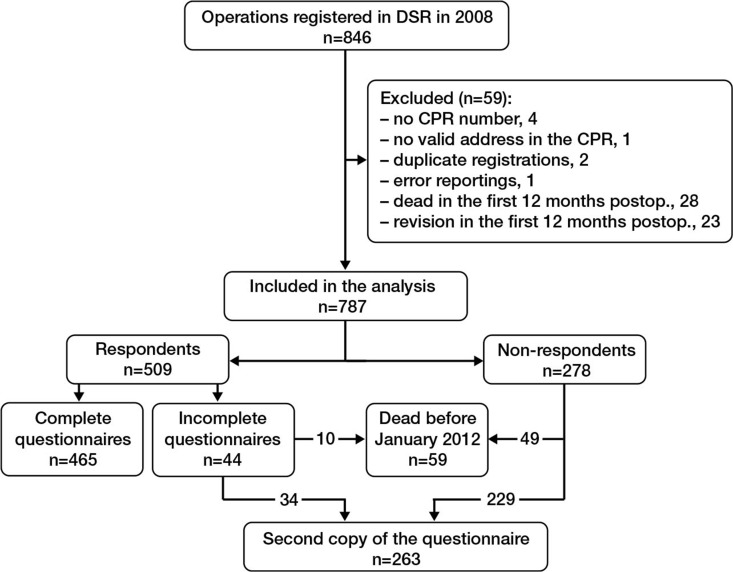
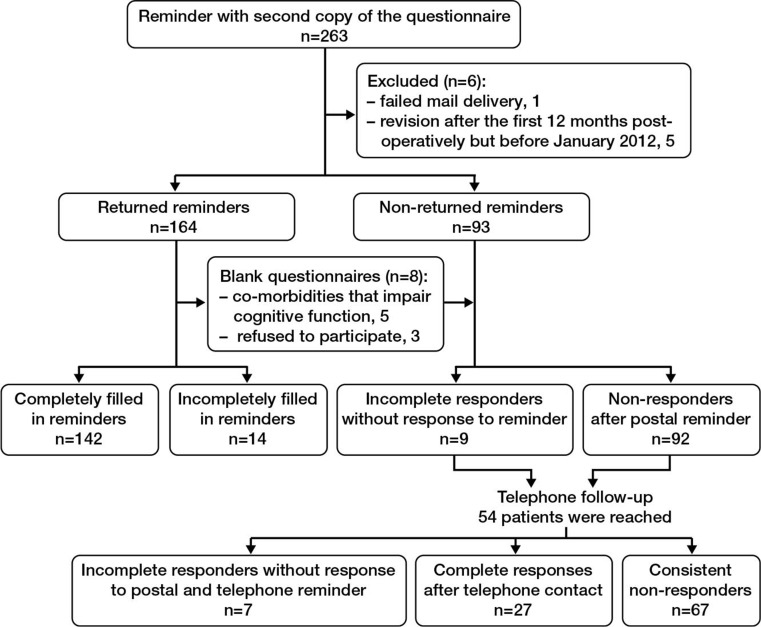
Methods: Patient-reported outcome of 787 patients operated in 2008 was assessed 12 months postoperatively using the Western Ontario Osteoarthritis of the Shoulder (WOOS) index. In January 2012, non-responders and incomplete responders were sent a postal reminder. Non-responders to the postal reminder were contacted by telephone. Total WOOS score and WOOS subscales were compared for initial responders (n = 509), responders to the postal reminder (n = 156), and responders after telephone contact (n = 27). The predefined variables age, sex, diagnosis, geographical region, and reoperation rate were compared for responding and non-responding cohorts.
Results: A postal reminder increased the response rate from 65% (6% incomplete) to 80% (3% incomplete) and telephone contact resulted in a further increase to 82% (2% incomplete). We did not find any statistically significant differences in total WOOS score or in any of the WOOS subscales between responders to the original questionnaire, responders to the postal reminder, and responders after telephone contact. However, a trend of worse outcome for non-responders was found. The response rate was lower in younger patients.
Interpretation: Non-responders did not appear to bias the overall results after shoulder replacement despite a trend of worse outcome for a subgroup of non-responders. As response rates rose markedly by the use of postal reminders, we recommend the use of reminders in arthroplasty registries using PROMs.
Figures
References
-
- Cazeneuve JF, Cristofari DJ. Long term functional outcome following reverse shoulder arthroplasty in the elderly. Orthop Traumatol Surg Res. 2011;97(6):583–9. - PubMed
-
- Gluud LL. Bias in clinical intervention research. Am J Epidemiol. 2006;163(6):493–501. - PubMed
-
- Goodfellow JW, O’Connor JJ, Murray DW. A critique of revision rate as an outcome measure: re-interpretation of knee joint registry data. J Bone Joint Surg (Br) 2010;92(12):1628–31. - PubMed
-
- Grimes DA, Schulz KF. Bias and causal associations in observational research. Lancet. 2002;359(9302):248–52. - PubMed
-
- Guillemin F, Bombardier C, Beaton D. Cross-cultural adaptation of health-related quality of life measures: literature review and proposed guidelines. J Clin Epidemiol. 1993;46(12):1417–32. - PubMed
Publication types
MeSH terms
LinkOut - more resources
Full Text Sources
Other Literature Sources
Research Materials