


Somatosensory responses in a human motor cortex
- PMID: 23343902
- PMCID: PMC3628033
- DOI: 10.1152/jn.00368.2012
Somatosensory responses in a human motor cortex
Abstract
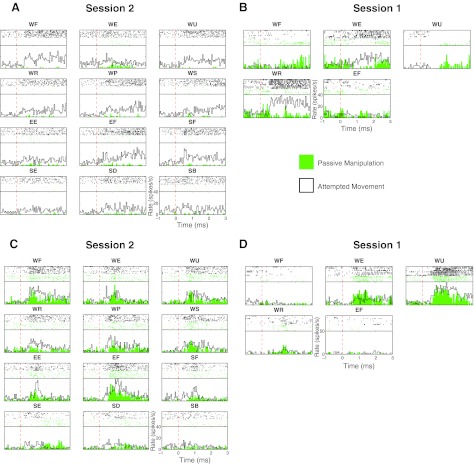
Somatic sensory signals provide a major source of feedback to motor cortex. Changes in somatosensory systems after stroke or injury could profoundly influence brain computer interfaces (BCI) being developed to create new output signals from motor cortex activity patterns. We had the unique opportunity to study the responses of hand/arm area neurons in primary motor cortex to passive joint manipulation in a person with a long-standing brain stem stroke but intact sensory pathways. Neurons responded to passive manipulation of the contralateral shoulder, elbow, or wrist as predicted from prior studies of intact primates. Thus fundamental properties and organization were preserved despite arm/hand paralysis and damage to cortical outputs. The same neurons were engaged by attempted arm actions. These results indicate that intact sensory pathways retain the potential to influence primary motor cortex firing rates years after cortical outputs are interrupted and may contribute to online decoding of motor intentions for BCI applications.
Figures
References
-
- Albe-Fessard D, Liebeskind J. Origine des messages somatosensitifs activant les cellules du cortex moteur chez le singe. Exp Brain Res 1: 127–146, 1966 - PubMed
-
- Benjamini Y, Hochberg Y. Controlling the false discovery rate: a practical and powerful approach to multiple testing. J R Stat Soc Series B Methodol 57: 289–289, 1995
Publication types
MeSH terms
Grants and funding
LinkOut - more resources
Full Text Sources
Other Literature Sources
