


Estimating the burden of total knee replacement in the United States
- PMID: 23344005
- PMCID: PMC3748969
- DOI: 10.2106/JBJS.L.00206
Estimating the burden of total knee replacement in the United States
Abstract
Background: In the last decade, the number of total knee replacements performed annually in the United States has doubled, with disproportionate increases among younger adults. While total knee replacement is a highly effective treatment for end-stage knee osteoarthritis, total knee replacement recipients can experience persistent pain and severe complications. We are aware of no current estimates of the prevalence of total knee replacement among adults in the U.S.
Methods: We used the Osteoarthritis Policy Model, a validated computer simulation model of knee osteoarthritis, and data on annual total knee replacement utilization to estimate the prevalence of primary and revision total knee replacement among adults fifty years of age or older in the U.S. We combined these prevalence estimates with U.S. Census data to estimate the number of adults in the U.S. currently living with total knee replacement. The annual incidence of total knee replacement was derived from two longitudinal knee osteoarthritis cohorts and ranged from 1.6% to 11.9% in males and from 2.0% to 10.9% in females.
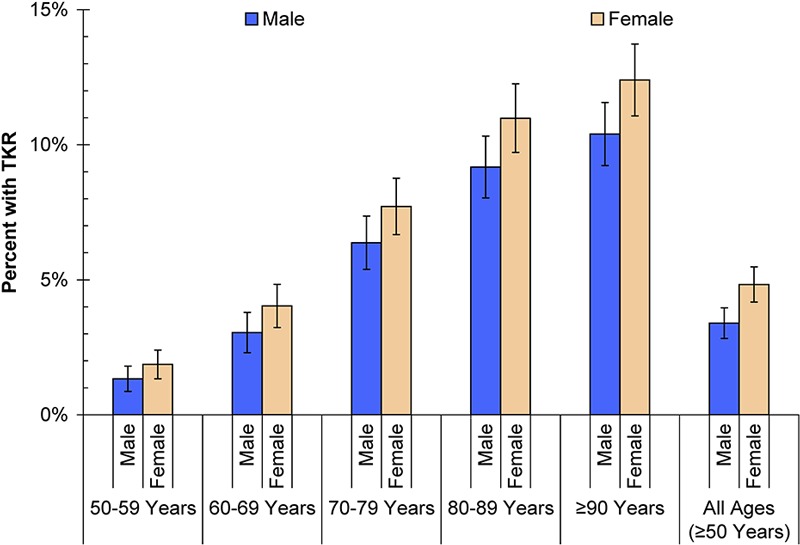
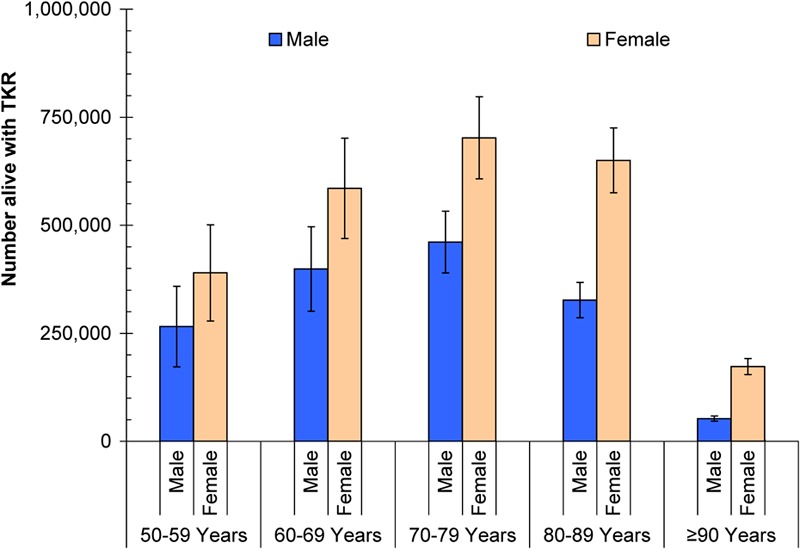
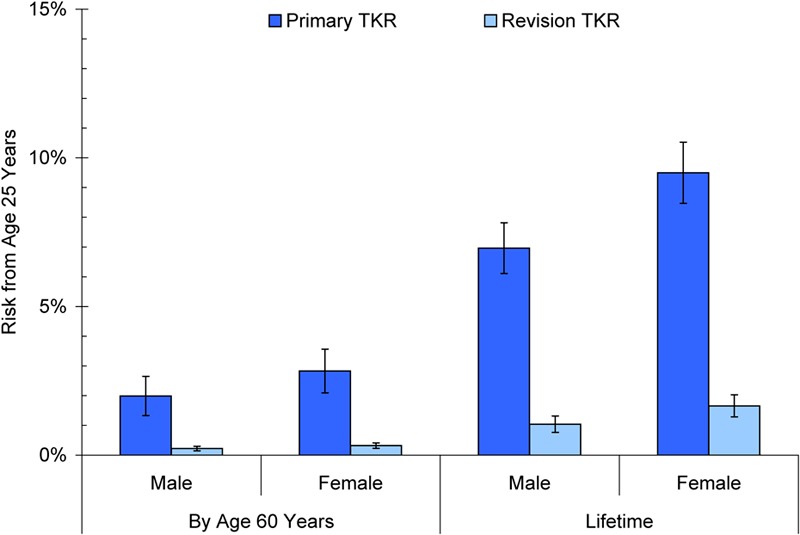
Results: We estimated that 4.0 million (95% confidence interval [CI]: 3.6 million to 4.4 million) adults in the U.S. currently live with a total knee replacement, representing 4.2% (95% CI: 3.7% to 4.6%) of the population fifty years of age or older. The prevalence was higher among females (4.8%) than among males (3.4%) and increased with age. The lifetime risk of primary total knee replacement from the age of twenty-five years was 7.0% (95% CI: 6.1% to 7.8%) for males and 9.5% (95% CI: 8.5% to 10.5%) for females. Over half of adults in the U.S. diagnosed with knee osteoarthritis will undergo a total knee replacement.
Conclusions: Among older adults in the U.S., total knee replacement is considerably more prevalent than rheumatoid arthritis and nearly as prevalent as congestive heart failure. Nearly 1.5 million of those with a primary total knee replacement are fifty to sixty-nine years old, indicating that a large population is at risk for costly revision surgery as well as possible long-term complications of total knee replacement.
Figures
References
-
- American College of Rheumatology Subcommittee on Osteoarthritis Guidelines Recommendations for the medical management of osteoarthritis of the hip and knee: 2000 update. Arthritis Rheum. 2000;43(9):1905-15 - PubMed
-
- Richmond J, Hunter D, Irrgang J, Jones MH, Snyder-Mackler L, Van Durme D, Rubin C, Matzkin EG, Marx RG, Levy BA, Watters WC, 3rd, Goldberg MJ, Keith M, Haralson RH, 3rd, Turkelson CM, Wies JL, Anderson S, Boyer K, Sluka P, St Andre J, McGowan R; American Academy of Orthopaedic Surgeons American Academy of Orthopaedic Surgeons clinical practice guideline on the treatment of osteoarthritis (OA) of the knee. J Bone Joint Surg Am. 2010;92(4):990-3 - PubMed
-
- Zhang W, Nuki G, Moskowitz RW, Abramson S, Altman RD, Arden NK, Bierma-Zeinstra S, Brandt KD, Croft P, Doherty M, Dougados M, Hochberg M, Hunter DJ, Kwoh K, Lohmander LS, Tugwell P. OARSI recommendations for the management of hip and knee osteoarthritis: part III: Changes in evidence following systematic cumulative update of research published through January 2009. Osteoarthritis Cartilage. 2010;18(4):476-99 - PubMed
-
- Healthcare Cost and Utilization Project (HCUP) Nationwide Inpatient Sample (NIS). Agency for Healthcare Research and Quality; 1999-2009. http://hcupnet.ahrq.gov/. Accessed 2012 Jan 3
Publication types
MeSH terms
Grants and funding
LinkOut - more resources
Full Text Sources
Other Literature Sources
Medical
