. 2013 Apr 1;304(7):C604-13.
doi: 10.1152/ajpcell.00318.2012. Epub 2013 Jan 23.

Redox artifacts in electrophysiological recordings

Affiliations

Redox artifacts in electrophysiological recordings

Jonathan M Berman et al. Am J Physiol Cell Physiol. .

Abstract

Electrophysiological techniques make use of Ag/AgCl electrodes that are in direct contact with cells or bath. In the bath, electrodes are exposed to numerous experimental conditions and chemical reagents that can modify electrode voltage. We examined voltage offsets created in Ag/AgCl electrodes by exposure to redox reagents used in electrophysiological studies. Voltage offsets were measured in reference to an electrode separated from the solution by an agar bridge. The reducing reagents Tris-2-carboxyethly-phosphine, dithiothreitol (DTT), and glutathione, as well as the oxidizing agent H(2)O(2) used at experimentally relevant concentrations reacted with Ag in the electrodes to produce voltage offsets. Chloride ions and strong acids and bases produced offsets at millimolar concentrations. Electrolytic depletion of the AgCl layer, to replicate voltage clamp and sustained use, resulted in increased sensitivity to flow and DTT. Offsets were sensitive to electrode silver purity and to the amount and method of chloride deposition. For example, exposure to 10 μM DTT produced a voltage offset between 10 and 284 mV depending on the chloride deposition method. Currents generated by these offsets are significant and dependent on membrane conductance and by extension the expression of ion channels and may therefore appear to be biological in origin. These data demonstrate a new source of artifacts in electrophysiological recordings that can affect measurements obtained from a variety of experimental techniques from patch clamp to two-electrode voltage clamp.


Figures
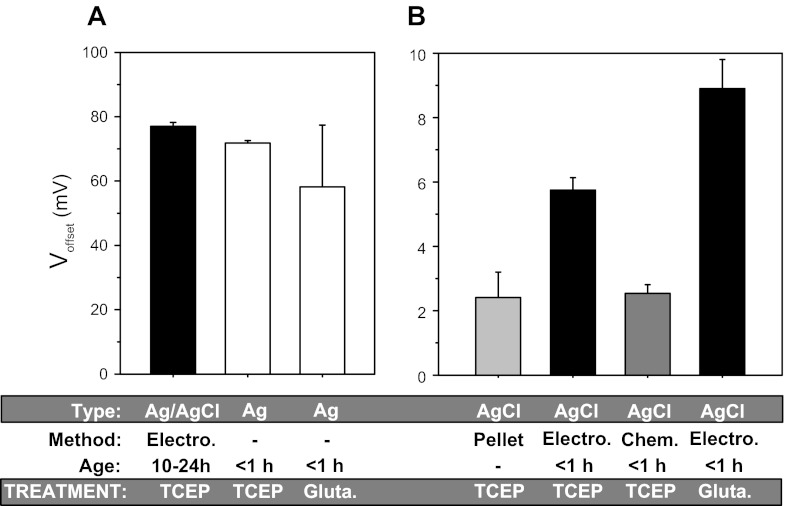
Fig. 1.
Fig. 1.
The reducing agent Tris-2-carboxyethly-phosphine (TCEP) and glutathione cause large voltage offsets in Ag/AgCl electrodes. Summary of the voltage offsets produced by 500 μM TCEP and 5 mM glutathione with various silver-based electrodes. Electrodes were made from electrically chlorided silver wire (electro.), chemically chlorided silver wire (chem.), and sintered Ag/AgCl pellets (pellet). Electrodes were either freshly made (<1 h) or left overnight in amphibian Ringer's solution (10- to 24-h aged electrodes). A: bare, or aged wire. B: chlorided wire. Note the much larger y-axis scale in A; n = 4–8 in each group as described in the text.
Fig. 2.
Fig. 2.
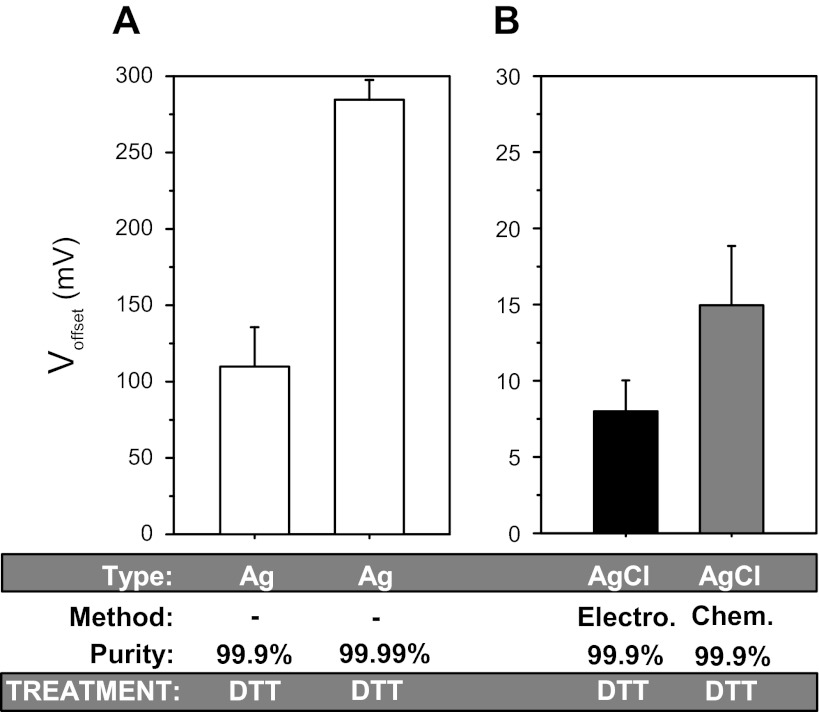
The reducing agent dithiothreitol (DTT) causes large voltage offsets in Ag/AgCl electrodes. Summary of the voltage offsets produced by 1 mM DTT. Two wire purities of 99.9 and 99.99% silver were examined. As in Fig. 1, bare wire (A), which simulates the use and poor chloriding scenarios, caused much larger offsets than chlorided wire (B). Note the much larger y-axis scale in A. See text and Fig. 1 legend for additional details; n = 4–8 in each group.
Fig. 3.
Fig. 3.
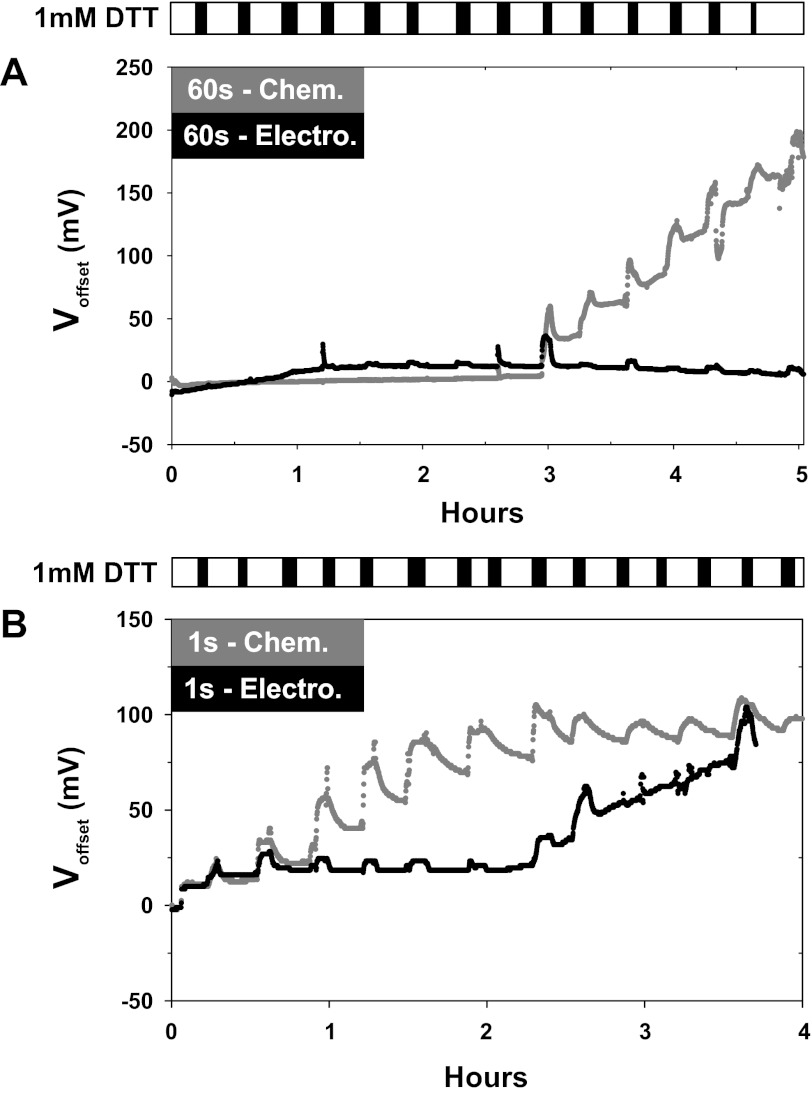
Time and use dependent increase in the offsets caused by DTT. Both electrically and chemically chlorided Ag/AgCl electrodes were examined. To simulate use and deplete the layer of deposited AgCl, a −80-μA current was applied to each electrode for the 4–5 h experimental duration. At ∼15-min intervals, DTT was applied for 3–5 min as shown by the scale bar at the bottom. A: electrodes chlorided for 60 s showed no initial effects of DTT for up to 3 h. After this time period, the chemically chlorided Ag/AgCl electrodes developed a >200-mV offset with no effects on the electrically chlorided electrode. B: electrodes chlorided for 1 s showed large offsets in response to DTT with the chemically chlorided electrode developing an offset first. In both cases the electrodes developed offsets were similar in magnitude to those observed with bare silver wires; n = 4 in each group.
Fig. 4.
Fig. 4.
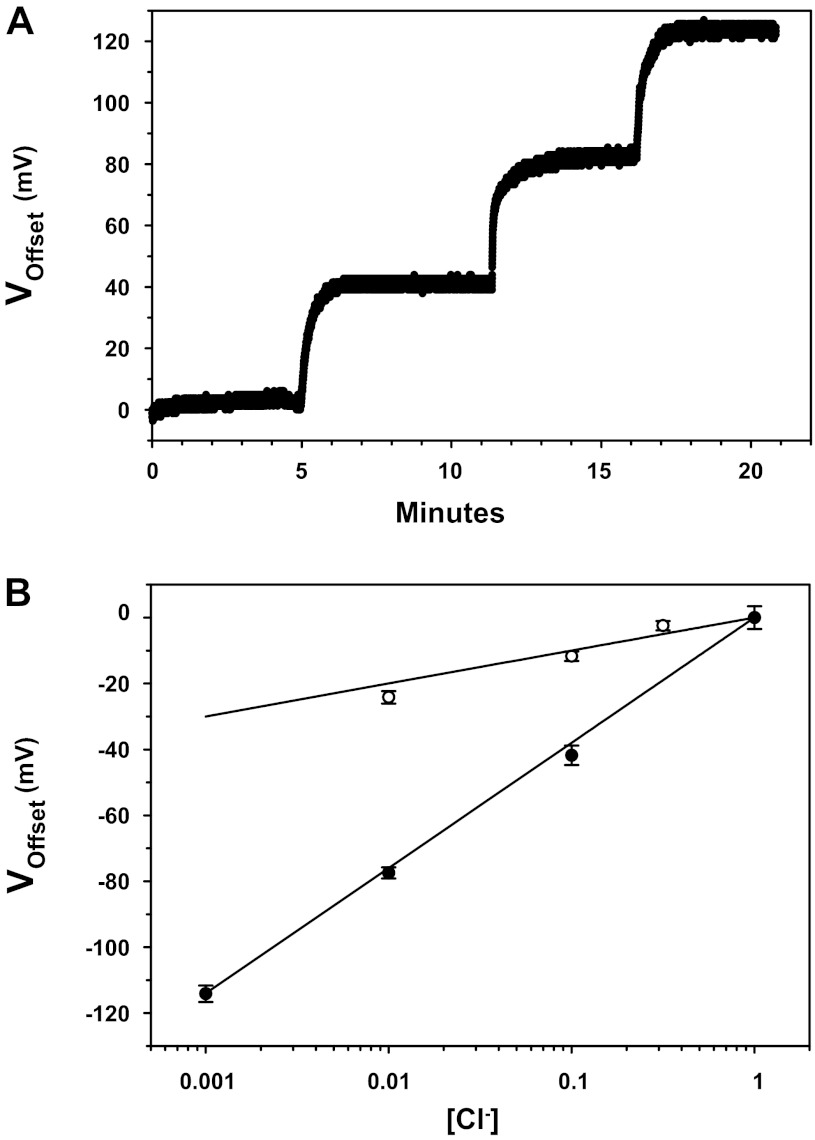
Offsets produced by chloride on Ag/AgCl electrodes. A: representative voltage trace of the response of an electrically chlorided wire as experimental solution increases in chloride concentration (1 mM, 10 mM, 100 mM, and 1 M). B: semilogarithmic plot of electrode voltage and chloride concentration. Best fit shown represents a line with a slope of 38 mV/decade concentration change for electrically chlorided wire (●), and 10 mV/decade for bare wire (○). See text for more details; n = 4 in each group.
Fig. 5.
Fig. 5.
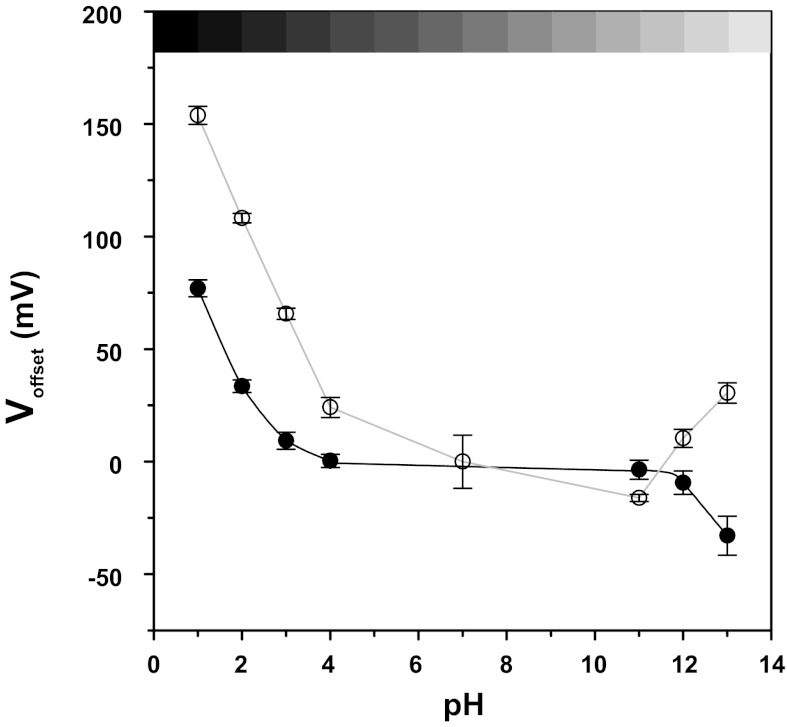
Voltage offsets produced by exposure of electrically chlorided Ag/AgCl electrodes (●) and bare silver wire (○) to solutions of various pH. Experiments were performed in unbuffered solution. All data points were corrected for the effects of Cl concentration ([Cl]) on Ag/AgCl electrodes as described in the text; n = 4 in each group.
Fig. 6.
Fig. 6.
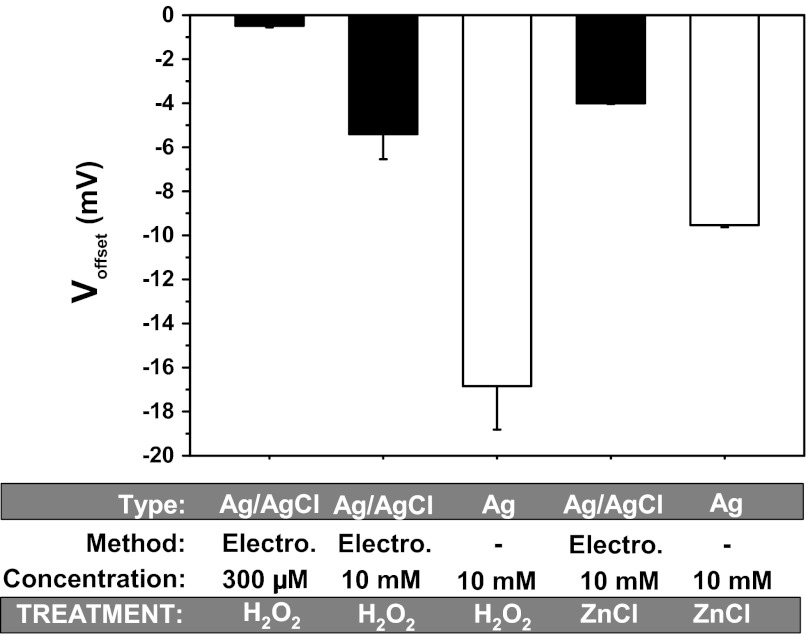
Voltage offsets produced by exposure of different electrodes to oxidizing agents. Two oxidizing agents were examined: H2O2 and ZnCl, and offsets were examined in electrically chlorided Ag/AgCl electrodes and bare wires. Although both reagents produced significant offsets, the effects were much smaller than those seen with the reducing agents. See text and discussion for additional details; n = 4–8 in each group.
Fig. 7.
Fig. 7.
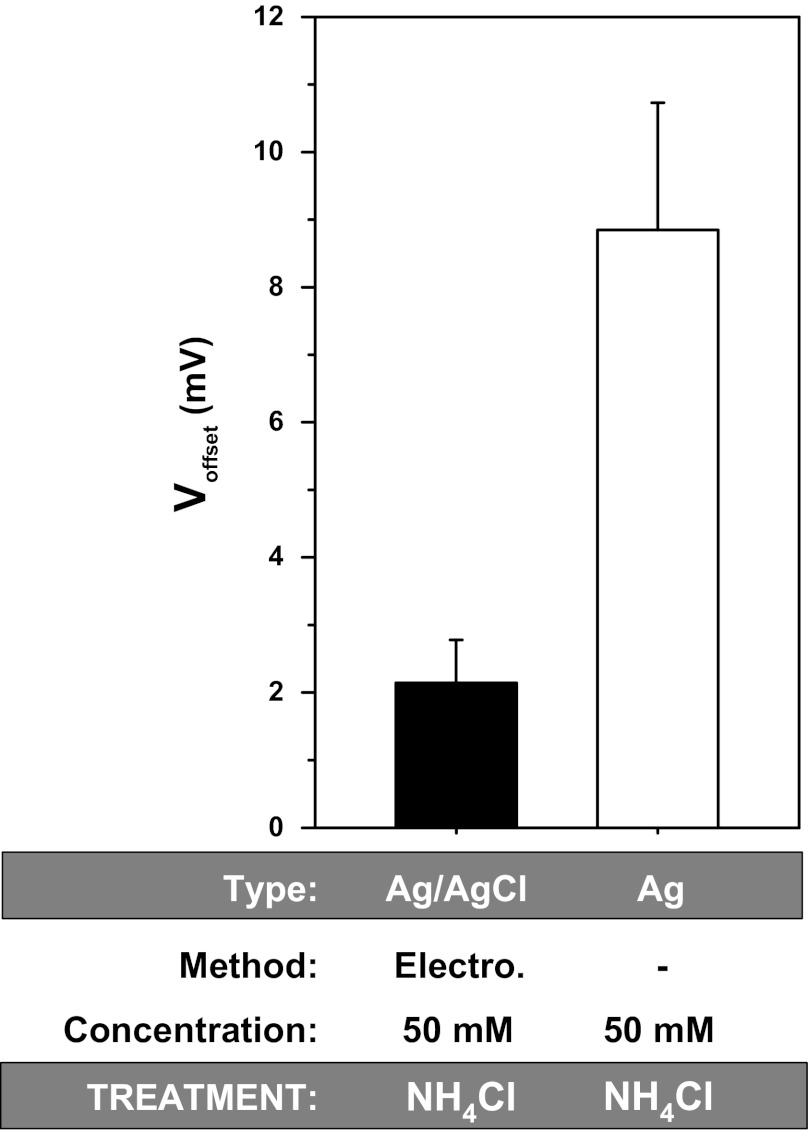
Voltage offsets caused by exposure of electrically chlorided and bare wire to NH4Cl. Summarized offsets were compensated for the effects of [Cl] as described in results; n = 4 in each group.
Fig. 8.
Fig. 8.
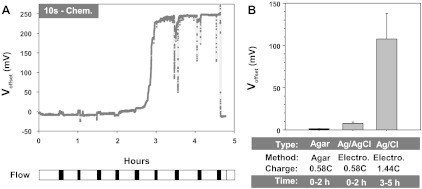
Time and use dependent increase in sensitivity of Ag/AgCl electrodes to motion artifacts. A: to simulate use and deplete the layer of deposited AgCl, a −80-μA current was applied to each electrode for the 4- to 5-h experimental duration. At ∼30-min intervals flow was stopped for ∼5 min as shown by the scale bar at the bottom. Data representative of n = 4. B: comparison of the average magnitude of offset in response to flow in the first and last 2 h of the experiment. Charge in Coulombs indicates the total charge passed to deplete the deposited AgCl under each experimental condition (calculated from current and time); n = 4 in each group.
Fig. 9.
Fig. 9.
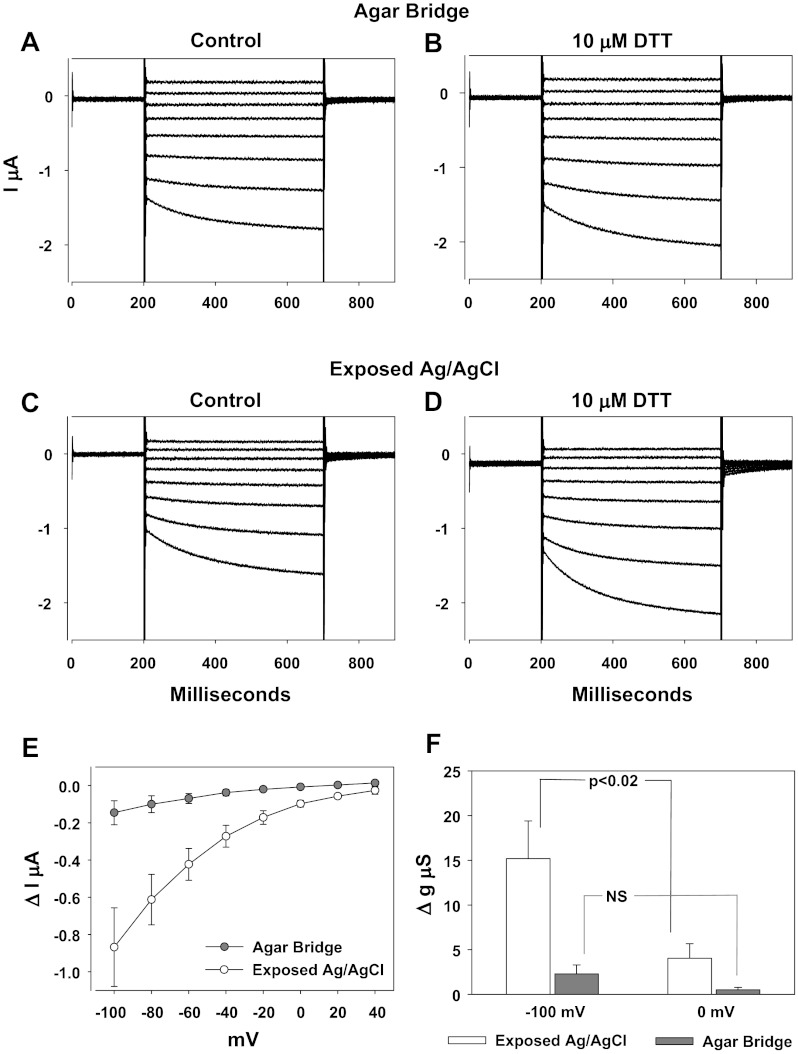
Apparent stimulation of epithelial Na+ channel (ENaC) by DTT in poorly chlorided Ag/AgCl electrodes. Whole cell current in ENaC expressing oocytes were obtained between −100 and +40 mV as described in text. A and B: absence of an effect of 10 μM DTT on ENaC whole currents in an experiment which utilized agar bridge reference electrodes. C and D: apparent stimulation of whole cell currents in an experiment utilizing poorly chlorided Ag/AgCl reference electrodes (exposed electrodes). E: averaged differential I/V curves between control currents and those measured after 10 μM DTT. Note the much larger current differential at −100 mV in poorly chlorided electrodes. F: mean change of the slope conductance at 0 and −100 mV caused by 10 μM DTT; n = 4 in each group.

References

    1. Abriel H, Horisberger JD. Feedback inhibition of rat amiloride-sensitive epithelial sodium channels expressed in Xenopus laevis oocytes. J Physiol 516: 31–43, 1999 - PMC - PubMed
    1. Adeva MM, Souto G, Blanco N, Donapetry C. Ammonium metabolism in humans. Metabolism 61: 1495–1511, 2012 - PubMed
    1. Alesutan I, Daryadel A, Mohebbi N, Pelzl L, Leibrock C, Voelkl J, Bourgeois S, Dossena S, Nofziger C, Paulmichl M, Wagner CA, Lang F. Impact of bicarbonate, ammonium chloride, and acetazolamide on hepatic and renal SLC26A4 expression. Cell Physiol Biochem 28: 553–558, 2011 - PubMed
    1. Asami M, Kosaka K, Kunikane S. Bromate, chlorate, chlorite and perchlorate in sodium hypochlorite solution used in water supply. J Water Supply 58: 107–115, 2009
    1. Awayda MS. Specific and nonspecific effects of protein kinase C on the epithelial Na (+) channel. J Gen Physiol 115: 559–570, 2000 - PMC - PubMed

Publication types

LinkOut - more resources