


Surveillance for foodborne disease outbreaks--United States, 2009-2010
- PMID: 23344696
- PMCID: PMC4604871
Surveillance for foodborne disease outbreaks--United States, 2009-2010
Abstract
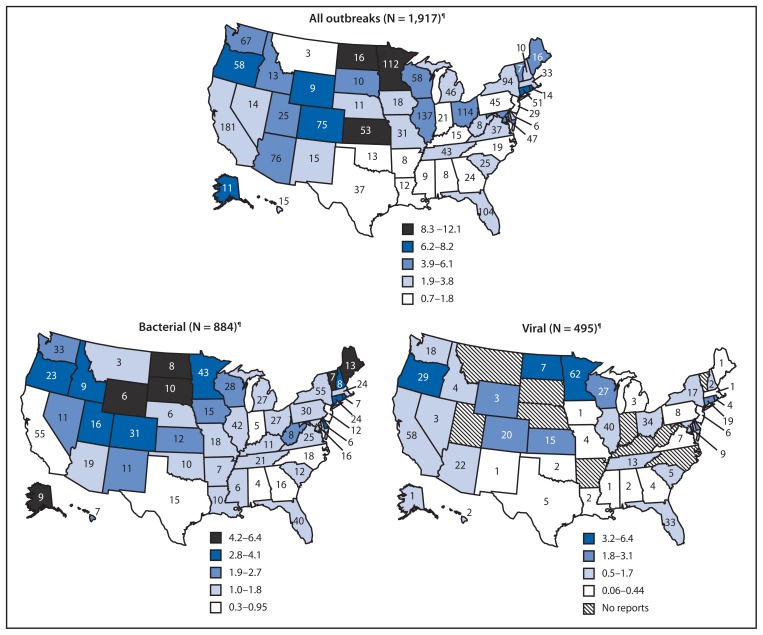
Known pathogens cause an estimated 9.4 million foodborne illnesses annually in the United States. CDC collects data on foodborne disease outbreaks submitted by all states, the District of Columbia, and Puerto Rico through CDC's Foodborne Disease Outbreak Surveillance System. Data reported for each outbreak include the number of illnesses, hospitalizations, and deaths; the etiologic agent; the implicated food vehicle; and other factors involved in food preparation and consumption. During 2009-2010, a total of 1,527 foodborne disease outbreaks (675 in 2009 and 852 in 2010) were reported, resulting in 29,444 cases of illness, 1,184 hospitalizations, and 23 deaths. Among the 790 outbreaks with a single laboratory-confirmed etiologic agent, norovirus was the most commonly reported, accounting for 42% of outbreaks. Salmonella was second, accounting for 30% of outbreaks. Among the 299 outbreaks attributed to a food composed of ingredients from one of 17 predefined, mutually exclusive food commodities, those most often implicated were beef (13%), dairy (12%), fish (12%), and poultry (11%). The commodities in the 299 outbreaks associated with the most illnesses were eggs (27% of illnesses), beef (11%), and poultry (10%). Public health, regulatory, and food industry professionals can use this information when creating targeted control strategies along the farm-to-table continuum for specific agents, specific foods, and specific pairs of agents and foods. This information also supports efforts to promote safe food-handling practices among food workers and the public.
Figures
Comment in
-
Infectious disease/CDC update. Update on emerging infections: news from the Centers for Disease Control and Prevention.Ann Emerg Med. 2013 Jul;62(1):91-3. doi: 10.1016/j.annemergmed.2013.04.001. Ann Emerg Med. 2013. PMID: 23842055 No abstract available.
References
-
- Painter JA, Ayers T, Woodruff R, et al. Recipes for foodborne outbreaks: a scheme for categorizing and grouping implicated foods. Foodborne Pathog Dis. 2009;6:1259–64. - PubMed
-
- Neil KP, Biggerstaff G, MacDonald JK, et al. A novel vehicle for transmission of Escherichia coli O157:H7 to humans: multistate outbreak of E. coli O157:H7 infections associated with consumption of ready-to-bake commercial prepackaged cookie dough—United States, 2009. Clin Infect Dis. 2012;54:511–8. - PubMed
-
- CDC. Surveillance for foodborne disease outbreaks—United States, 2008. MMWR. 2011;60:1197–202. - PubMed
-
- CDC. Updated norovirus outbreak management and disease prevention guidelines. MMWR. 2011;60(RR-3) - PubMed
MeSH terms
LinkOut - more resources
Full Text Sources
Medical
Molecular Biology Databases
