. 2013 Jan 23;33(4):1441-50.
doi: 10.1523/JNEUROSCI.2420-12.2013.

Amygdala β-noradrenergic receptors modulate delayed downregulation of dopamine activity following restraint

Affiliations

Amygdala β-noradrenergic receptors modulate delayed downregulation of dopamine activity following restraint

Chun-hui Chang et al. J Neurosci. .

Abstract

Stress, which involves a heightened arousal and excitability, triggers important adaptive responses to maintain homeostasis and prepare a response. In the current studies, we administered a psychological stressor of 2 h acute restraint on rats, and found that 24 h after the cessation of the restraint session, there was a significant decrease in ventral tegmental area dopaminergic (DA) neuron population activity and a significant attenuation in amphetamine-induced locomotor activity. Systemic or intra-basolateral nuclei of the amygdala administration of the β-noradrenergic receptor antagonist, propranolol, reversed the decrease, suggesting that the delayed attenuation of DA neuron firing following a stressor depends on a noradrenaline-mediated mechanism. This alteration in DA activity may adaptively prepare the individual to avoid the stressor, or in the extreme, may be a factor that contributes to pathological changes in behavior or physiological responses.


Figures
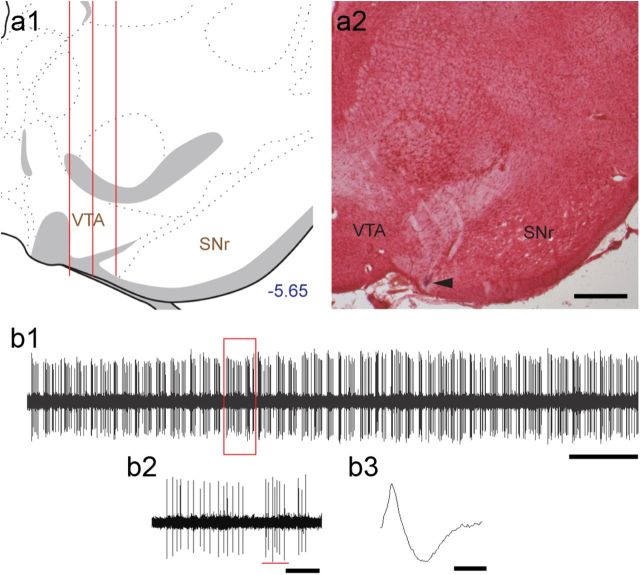
Figure 1.
Figure 1.
Evaluation of VTA DA neuron activity states. a1, DA neurons were sampled with predetermined grid pattern of six (3 × 2) to nine (3 × 3) tracks separated by 200 μm. a2, A representative Pontamine sky blue deposit. Arrowhead indicates the final location of the electrode. Scale bar, 500 μm. b1, A segment of spontaneous VTA DA activity. Scale bar, 10 s. b2, A closer view of DA activity. Underlying red line indicates a burst event. Calibration: 1 s. b3, A representative waveform of a DA neuron. Scale bar, 1 ms. SNr, Substantia nigra pars compacta.
Figure 2.
Figure 2.
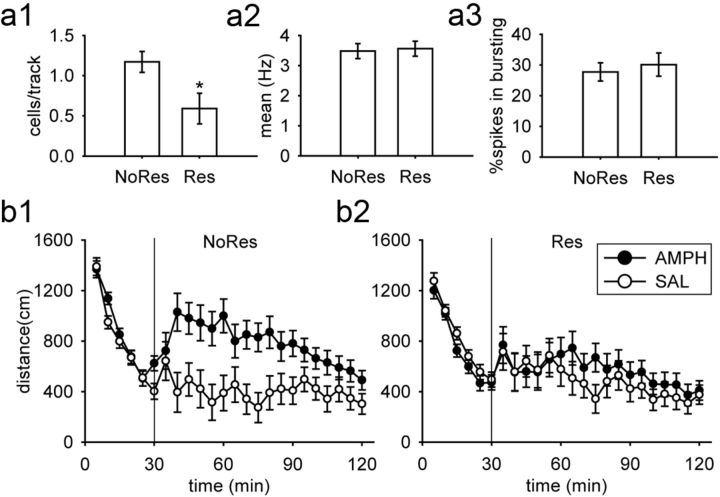
There was a significant decrease in VTA DA neuron population activity and an attenuated amphetamine-induced locomotor response measured 24 h after acute restraint. a1a3, DA neuron population activity in Restraint rats (Res; n = 10) was significantly lower than No-Restraint (NoRes; n = 8) controls (*p < 0.05) (a1), with no significant difference between mean firing rates (a2) or bursting activity (a3). DA neurons recorded: Res (n = 53), NoRes (n = 83). b1, b2, AMPH induced significantly higher locomotor activity in NoRes rats (b1), but not in Res rats (b2); (p < 0.05). Group sizes: Res-SAL (n = 10), Res-AMPH (n = 10), NoRes-SAL (n = 9), and NoRes-AMPH (n = 10).
Figure 3.
Figure 3.
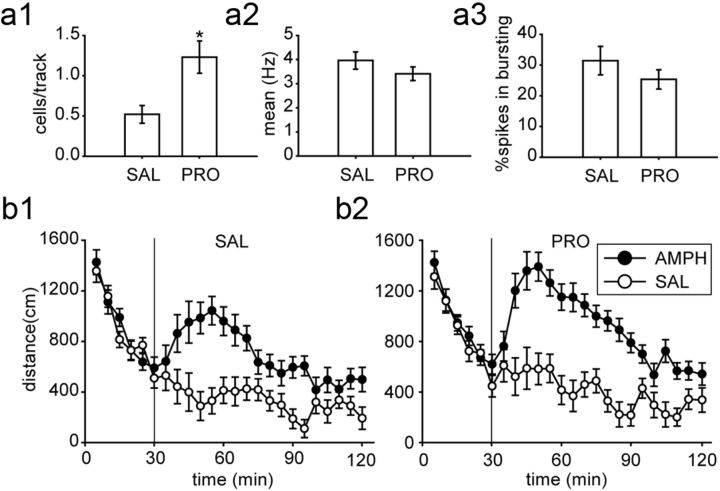
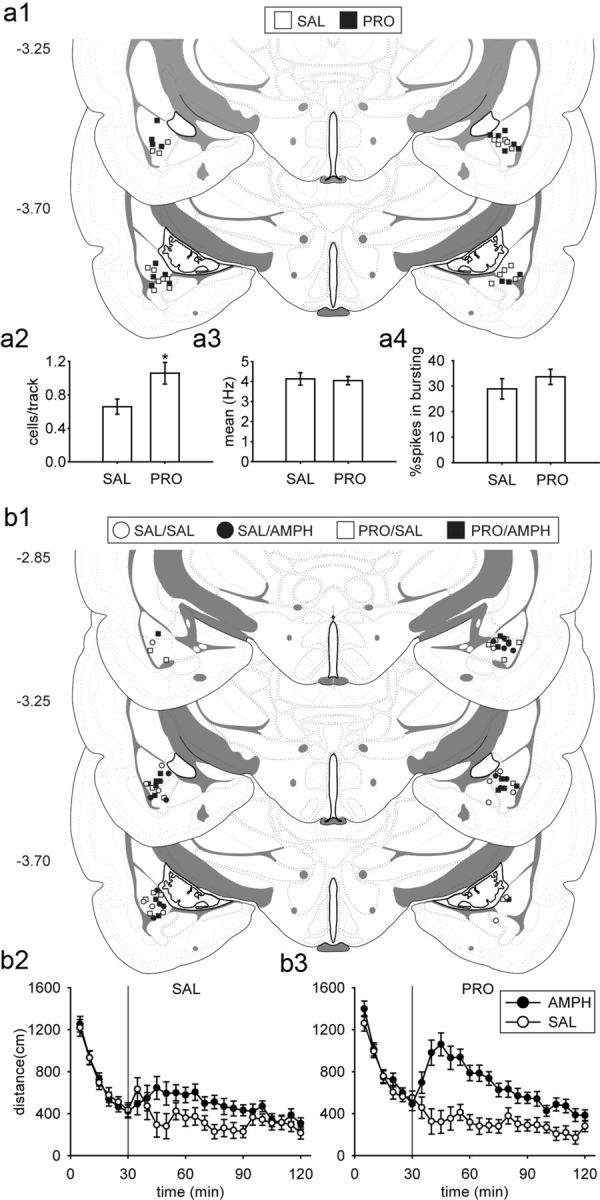
Prerestraint systemic administration of the β-noradrenergic receptor antagonist, propranolol, blocked the decrease in VTA DA neuron population activity and prevented the attenuation of amphetamine-induced locomotor activity measured 24 h after restraint. a1a3, For all rats restrained for a 2 h session, propranolol pretreatment (PRO; n = 8) significantly increased the DA neuron population activity compared with saline (SAL; n = 9) control (*p < 0.05) (a1), with no significant difference between mean firing rates (a2) or bursting activity (a3). DA neurons recorded: SAL (n = 42), PRO (n = 78). b1, b2, AMPH induced higher locomotor activity regardless pretreatment (b1, SAL; b2, PRO), with significantly higher locomotor activity produced in rats pretreated with PRO. (all ps < 0.05). Group sizes: SAL-SAL (n = 6), SAL-AMPH (n = 5), PRO-SAL (n = 5), and PRO-AMPH (n = 6).
Figure 4.
Figure 4.
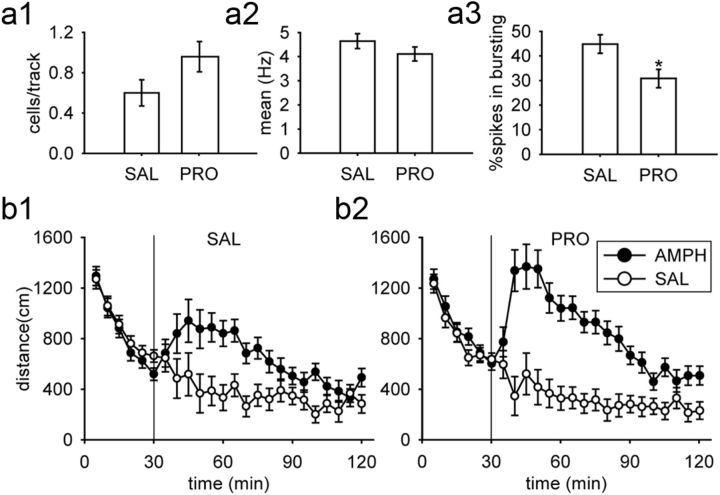
Postrestraint systemic administration of the β-noradrenergic receptor antagonist, propranolol, blocked the decrease in VTA DA neuron population activity and prevented the attenuation of amphetamine-induced locomotor activity observed 24 h after restraint. a1a3, For all rats restrained for a 2 h session, propranolol post-treatment (PRO; n = 8) restored (a1) the DA neuron population activity to that of nonrestrained controls, with no significant difference between (a2) mean firing rates and (a3) a significant decrease in bursting activity (*p < 0.05). DA neurons recorded: SAL (n = 52), PRO (n = 56). b1, b2, AMPH induced higher locomotor activity regardless post-treatment (b1, SAL; b2, PRO), with significantly higher locomotor activity for rats pretreated with PRO (all ps < 0.05). Group sizes: SAL-SAL (n = 8), SAL-AMPH (n = 8), PRO-SAL (n = 8), and PRO-AMPH (n = 7).
Figure 5.
Figure 5.
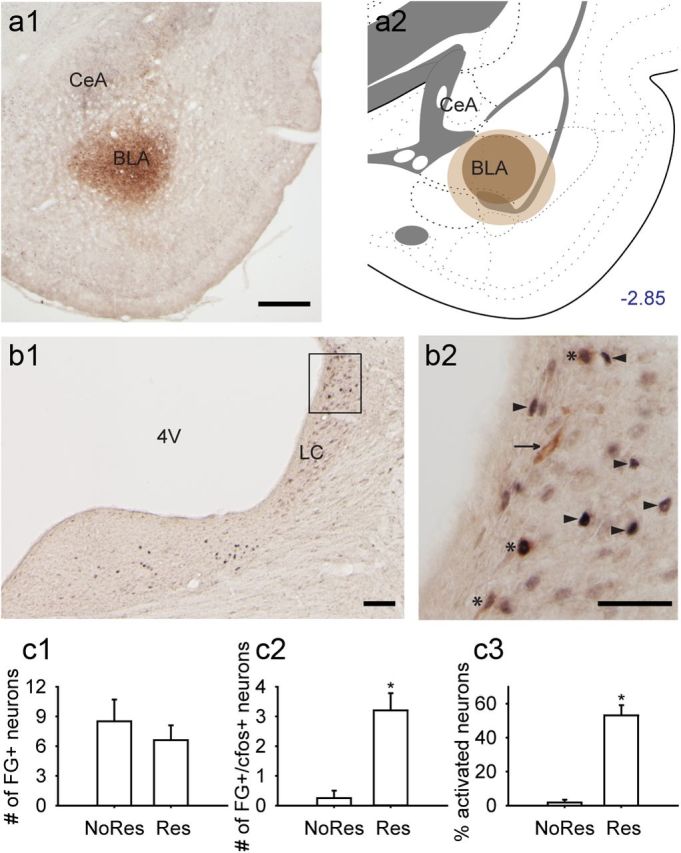
Acute restraint activated LC neurons projecting to the BLA. a1, A representative tracer delivery site of FG into the BLA. Scale bar, 500 μm. a2, Illustration showing the largest (light brown) and smallest (dark brown) spread sizes of the tracer at the delivery site. b1, Retrogradely labeled BLA afferents were found in the LC. Scale bar, 100 μm. b2, A magnified view of LC. Arrowhead, c-fos only. Arrow, tracer only. *, tracer + c-fos. Scale bar, 50 μm. c1, The number of retrogradely labeled LC neurons [(tracer only) + (tracer + c-fos)] were equivalent across restraint (Res; n = 5) and control (NoRes; n = 4) conditions. c2, The number of dual-labeled neurons was significantly higher for Restraint rats than No-Restraint controls (*p < 0.05). c3, Acute restraint activated a significantly higher percentage of the LC neurons that directly project to the BLA (*p < 0.05). CeA, Central nucleus of the amygdala; 4V, fourth ventricle.
Figure 6.
Figure 6.
Prerestraint intra-BLA administration of the β-noradrenergic receptor antagonist, propranolol, blocked the decrease in VTA DA neuron population activity and reversed the attenuation of amphetamine-induced locomotor activity measured 24 h after restraint. a1, b1, Cannulae placements of all rats included in this study. a2a4, For all rats restrained for a 2 h session, propranolol pretreatment (PRO; n = 9) significantly increased (a2) the DA neuron population activity than saline (SAL; n = 10) control (*p < 0.05), with no significant difference between (a3) mean firing rates or (a4) bursting activity. DA neurons recorded: SAL (n = 59), PRO (n = 86). b2, b3, AMPH induced higher locomotor activity regardless of pretreatment (b2, SAL; b3, PRO), with significantly higher locomotor activity in rats pretreated with PRO (all ps < 0.05). Group sizes: SAL-SAL (n = 7), SAL-AMPH (n = 8), PRO-SAL (n = 8), and PRO-AMPH (n = 8).

References

    1. Aston-Jones G, Chiang C, Alexinsky T. Discharge of noradrenergic locus coeruleus neurons in behaving rats and monkeys suggests a role in vigilance. Prog Brain Res. 1991;88:501–520. - PubMed
    1. Bienkowski MS, Rinaman L. Immune challenge activates neural inputs to the ventrolateral bed nucleus of the stria terminalis. Physiol Behav. 2011;104:257–265. - PMC - PubMed
    1. Buffalari DM, Grace AA. Noradrenergic modulation of basolateral amygdala neuronal activity: opposing influences of alpha-2 and beta receptor activation. J Neurosci. 2007;27:12358–12366. - PMC - PubMed
    1. Cabib S, Puglisi-Allegra S. Stress, depression and the mesolimbic dopamine system. Psychopharmacology. 1996;128:331–342. - PubMed
    1. Cifelli P, Grace AA. Pilocarpine-induced temporal lobe epilepsy in the rat is associated with increased dopamine neuron activity. Int J Neuropsychopharmacol. 2012;15:957–964. - PMC - PubMed

Publication types

LinkOut - more resources