


Major histocompatibility complex peptide ligands as olfactory cues in human body odour assessment
- PMID: 23345577
- PMCID: PMC3574394
- DOI: 10.1098/rspb.2012.2889
Major histocompatibility complex peptide ligands as olfactory cues in human body odour assessment
Erratum in
- Proc Biol Sci. 2013 Mar 22;280(1755):20130381
Abstract
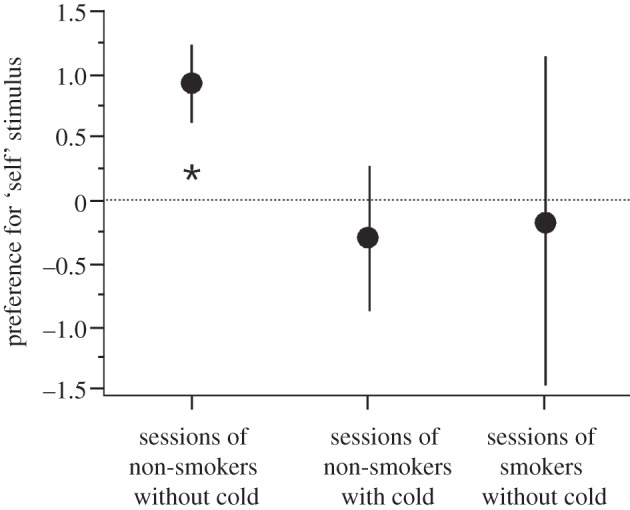
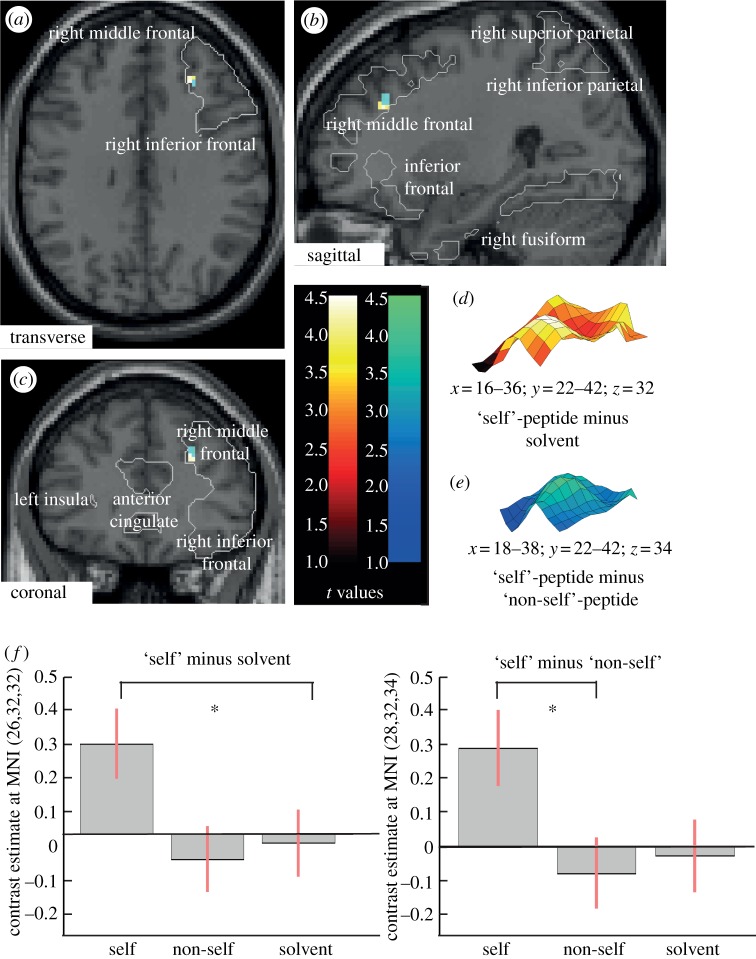
In many animal species, social communication and mate choice are influenced by cues encoded by the major histocompatibility complex (MHC). The mechanism by which the MHC influences sexual selection is a matter of intense debate. In mice, peptide ligands of MHC molecules activate subsets of vomeronasal and olfactory sensory neurons and influence social memory formation; in sticklebacks, such peptides predictably modify the outcome of mate choice. Here, we examine whether this evolutionarily conserved mechanism of interindividual communication extends to humans. In psychometric tests, volunteers recognized the supplementation of their body odour by MHC peptides and preferred 'self' to 'non-self' ligands when asked to decide whether the modified odour smelled 'like themselves' or 'like their favourite perfume'. Functional magnetic resonance imaging indicated that 'self'-peptides specifically activated a region in the right middle frontal cortex. Our results suggest that despite the absence of a vomeronasal organ, humans have the ability to detect and evaluate MHC peptides in body odour. This may provide a basis for the sensory evaluation of potential partners during human mate choice.
Figures
Comment in
-
A human chemosensory modality to detect peptides in the nose?Proc Biol Sci. 2013 Dec 11;281(1776):20131678. doi: 10.1098/rspb.2013.1678. Print 2014 Feb 7. Proc Biol Sci. 2013. PMID: 24335978 Free PMC article. No abstract available.
References
-
- Trowsdale J. 2011. The MHC, disease and selection. Immunol. Lett. 137, 1–8 10.1016/j.imlet.2011.01.002 (doi:10.1016/j.imlet.2011.01.002) - DOI - PubMed
-
- Eizaguirre C, Lenz TL, Kalbe M, Milinski M. 2012. Rapid and adaptive evolution of MHC genes under parasite selection in experimental vertebrate populations. Nat. Commun. 3, 621. 10.1038/ncomms1632 (doi:10.1038/ncomms1632) - DOI - PMC - PubMed
-
- Kubinak JL, Ruff JS, Hyzer CW, Slev PR, Potts WK. 2012. Experimental viral evolution to specific host MHC genotypes reveals fitness and virulence trade-offs in alternative MHC types. Proc. Natl Acad. Sci. USA 109, 3422–3427 10.1073/pnas.1112633109 (doi:10.1073/pnas.1112633109) - DOI - PMC - PubMed
-
- Nikolich-Žugich J, Fremont DH, Miley MJ, Messaoudi I. 2004. The role of MHC polymorphism in anti-microbial resistance. Microbes Infect. 6, 501–512 10.1016/j.micinf.2004.01.006 (doi:10.1016/j.micinf.2004.01.006) - DOI - PubMed
-
- Piertney SB, Oliver MK. 2006. The evolutionary ecology of the major histocompatibility complex. Heredity 96, 7–21 10.1038/sj.hdy.6800724 (doi:10.1038/sj.hdy.6800724) - DOI - PubMed
Publication types
MeSH terms
Substances
LinkOut - more resources
Full Text Sources
Other Literature Sources
Research Materials
