


Prognostic value of innate and adaptive immunity in colorectal cancer
- PMID: 23345940
- PMCID: PMC3547568
- DOI: 10.3748/wjg.v19.i2.174
Prognostic value of innate and adaptive immunity in colorectal cancer
Abstract
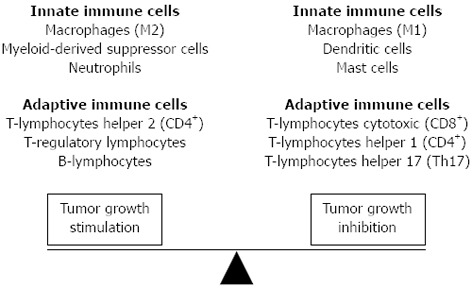
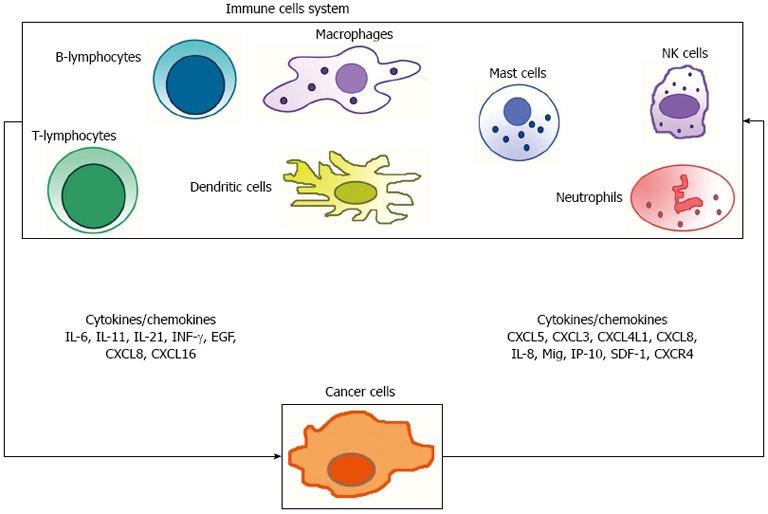
Colorectal cancer (CRC) remains one of the major public health problems throughout the world. Originally depicted as a multi-step dynamical disease, CRC develops slowly over several years and progresses through cytologically distinct benign and malignant states, from single crypt lesions through adenoma, to malignant carcinoma with the potential for invasion and metastasis. Moving from histological observations since a long time, it has been recognized that inflammation and immunity actively participate in the pathogenesis, surveillance and progression of CRC. The advent of immunohistochemical techniques and of animal models has improved our understanding of the immune dynamical system in CRC. It is well known that immune cells have variable behavior controlled by complex interactions in the tumor microenvironment. Advances in immunology and molecular biology have shown that CRC is immunogenic and that host immune responses influence survival. Several lines of evidence support the concept that tumor stromal cells, are not merely a scaffold, but rather they influence growth, survival, and invasiveness of cancer cells, dynamically contributing to the tumor microenvironment, together with immune cells. Different types of immune cells infiltrate CRC, comprising cells of both the innate and adaptive immune system. A relevant issue is to unravel the discrepancy between the inhibitory effects on cancer growth exerted by the local immune response and the promoting effects on cancer proliferation, invasion, and dissemination induced by some types of inflammatory cells. Here, we sought to discuss the role played by innate and adaptive immune system in the local progression and metastasis of CRC, and the prognostic information that we can currently understand and exploit.
Keywords: Colorectal cancer; Immunity; Inflammation; Metastasis; Prognosis.
Figures
References
-
- Michor F, Iwasa Y, Lengauer C, Nowak MA. Dynamics of colorectal cancer. Semin Cancer Biol. 2005;15:484–493. - PubMed
-
- Jass JR. Colorectal cancer: a multipathway disease. Crit Rev Oncog. 2006;12:273–287. - PubMed
-
- Fearon ER, Vogelstein B. A genetic model for colorectal tumorigenesis. Cell. 1990;61:759–767. - PubMed
-
- Vogelstein B, Fearon ER, Hamilton SR, Kern SE, Preisinger AC, Leppert M, Nakamura Y, White R, Smits AM, Bos JL. Genetic alterations during colorectal-tumor development. N Engl J Med. 1988;319:525–532. - PubMed
Publication types
MeSH terms
LinkOut - more resources
Full Text Sources
Other Literature Sources
Medical
