. 2013 Jan 18:3:440.
doi: 10.3389/fmicb.2012.00440. eCollection 2012.

Aspergillus fumigatus melanins: interference with the host endocytosis pathway and impact on virulence

Affiliations

Aspergillus fumigatus melanins: interference with the host endocytosis pathway and impact on virulence

Thorsten Heinekamp et al. Front Microbiol. .

Abstract

The opportunistic human pathogenic fungus Aspergillus fumigatus produces at least two types of melanin, namely pyomelanin and dihydroxynaphthalene (DHN) melanin. Pyomelanin is produced during tyrosine catabolism via accumulation of homogentisic acid. Although pyomelanin protects the fungus against reactive oxygen species (ROS) and acts as a defense compound in response to cell wall stress, mutants deficient for pyomelanin biosynthesis do not differ in virulence when tested in a murine infection model for invasive pulmonary aspergillosis. DHN melanin is responsible for the characteristic gray-greenish color of A. fumigatus conidia. Mutants lacking a functional polyketide synthase PksP, the enzyme responsible for the initial step in DHN-melanin formation, i.e., the synthesis of naphthopyrone, produce white spores and are attenuated in virulence. The activity of PksP was found to be essential not only for inhibition of apoptosis of phagocytes by interfering with the host PI3K/Akt signaling cascade but also for effective inhibition of acidification of conidia-containing phagolysosomes. These features allow A. fumigatus to survive in phagocytes and thereby to escape from human immune effector cells and to become a successful pathogen.

Keywords: Aspergillus fumigatus; apoptosis; endocytosis; melanin; phagocytes; virulence.


Figures
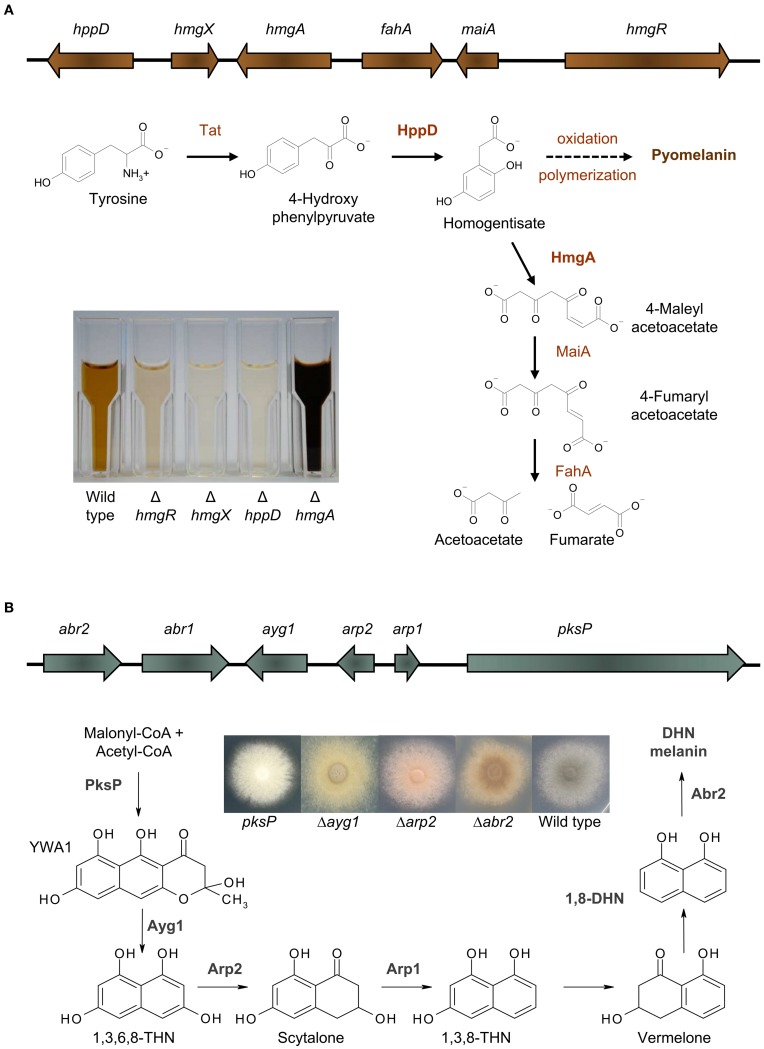
Figure 1
Figure 1
Melanins in A. fumigatus. (A) Pyomelanin: the tyrosine degradation pathway and genomic organization of the genes involved in tyrosine degradation and pyomelanin formation. The degradation of tyrosine starts with the formation of p-hydroxyphenylpyruvate (pHPP), which is then converted to HGA by the p-hydroxyphenylpyruvate dioxygenase (HppD). HGA is either degraded enzymatically by maleylacetoacetate isomerase (MaiA) and fumarylacetoacetate hydrolase (FahA) to fumarate and acetoacetate, compounds of the primary metabolism, or homogentisate polymerizes oxidatively to pyomelanin. Pyomelanin production is shown in supernatants of different A. fumigatus strains cultivated in minimal medium with addition of tyrosine. (B) DHN melanin: the DHN-melanin biosynthesis pathway and genomic organization of the genes involved in DHN-melanin biosynthesis [adapted from Langfelder et al. (2003) and Tsai et al. (2001)]. Starting from acetyl-CoA and malonyl-CoA, PksP produces the heptaketide naphthopyrone YWA1, which is shortened by hydrolytic activity of Ayg1 to 1,3,6,8-tetrahydroxy naphthalene (THN). This pentaketide undergoes reduction, mediated by the THN reductase Arp2 and dehydration by the scytalone dehydratase Arp1. Finally, the laccase Abr2 catalyses oxidative polymerization of 1,8-DHN to form the final pigment (Tsai et al., ; Fujii et al., ; Sugareva et al., 2006). The picture shows the color of conidia of different DHN-melanin biosynthesis mutants.
Figure 2
Figure 2
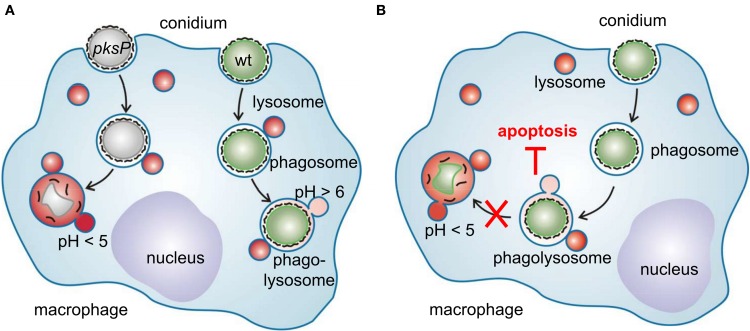
Interference of A. fumigatus conidia with macrophages. (A) Different intracellular fate of wild-type and pksP conidia. After recognition, swollen conidia are phagocytosed and fusion of the conidium-containing phagosome with lysosomal vesicles forms the phagolysosome. Wild-type conidia but not pksP conidia are able to inhibit phagolysosomal acidification (pH <5) and thereby prevent to be degraded by lytic proteins. (B) Intracellular presence of conidia is essential to protect macrophages from cell death. Conidia in acidified phagosomes do not exhibit anti-apoptotic properties.

References

    1. Aimanianda V., Bayry J., Bozza S., Kniemeyer O., Perruccio K., Elluru S. R., et al. (2009). Surface hydrophobin prevents immune recognition of airborne fungal spores. Nature 460, 1117–1121 10.1038/nature08264 - DOI - PubMed
    1. Altschul S. F., Gish W., Miller W., Myers E. W., Lipman D. J. (1990). Basic local alignment search tool. J. Mol. Biol. 215, 403–410 10.1016/S0022-2836(05)80360-2 - DOI - PubMed
    1. Behnsen J., Lessing F., Schindler S., Wartenberg D., Jacobsen I. D., Thoen M., et al. (2010). Secreted Aspergillus fumigatus protease Alp1 degrades human complement proteins C3, C4, and C5. Infect. Immun. 78, 3585–3594 10.1128/IAI.01353-09 - DOI - PMC - PubMed
    1. Bok J. W., Balajee S. A., Marr K. A., Andes D., Nielsen K. F., Frisvad J. C., et al. (2005). LaeA, a regulator of morphogenetic fungal virulence factors. Eukaryot. Cell 4, 1574–1582 10.1128/EC.4.9.1574-1582.2005 - DOI - PMC - PubMed
    1. Brakhage A. A. (2005). Systemic fungal infections caused by Aspergillus species: epidemiology, infection process and virulence determinants. Curr. Drug Targets 6, 875–886 10.2174/138945005774912717 - DOI - PubMed

LinkOut - more resources