Changes of the liver volume and the Child-Pugh score after high dose hypofractionated radiotherapy in patients with small hepatocellular carcinoma
- PMID: 23346538
- PMCID: PMC3546287
- DOI: 10.3857/roj.2012.30.4.189
Changes of the liver volume and the Child-Pugh score after high dose hypofractionated radiotherapy in patients with small hepatocellular carcinoma
Abstract
Purpose: To investigate the safety of high dose hypofractionated radiotherapy (RT) in patients with small hepatocellular carcinoma (HCC) in terms of liver volumetric changes and clinical liver function.
Materials and methods: We retrospectively reviewed 16 patients with small HCC who were treated with high dose hypofractionated RT between 2006 and 2009. The serial changes of the liver volumetric parameter were analyzed from pre-RT and follow-up (FU) computed tomography (CT) scans. We estimated linear time trends of whole liver volume using a linear mixed model. The serial changes of the Child-Pugh (CP) scores were also analyzed in relation to the volumetric changes.
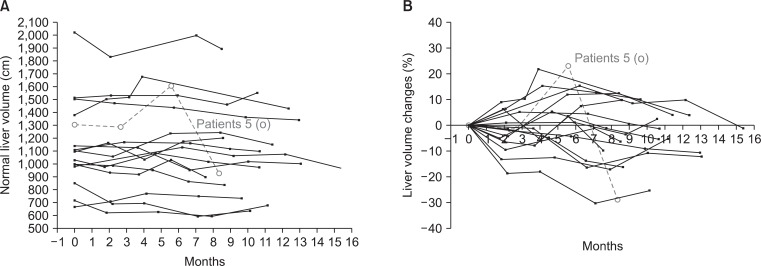
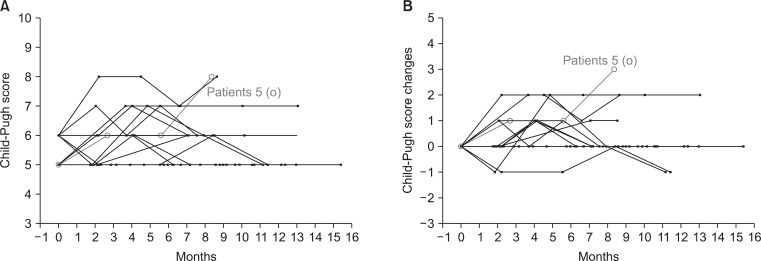
Results: Mean pre-RT volume of entire liver was 1,192.2 mL (range, 502.6 to 1,310.2 mL) and mean clinical target volume was 14.7 mL (range, 1.56 to 70.07 mL). Fourteen (87.5%) patients had 4 FU CT sets and 2 (12.5%) patients had 3 FU CT sets. Mean interval between FU CT acquisition was 2.5 months. After considering age, gender and the irradiated liver volume as a fixed effects, the mixed model analysis confirmed that the change in liver volume is not significant throughout the time course of FU periods. Majority of patients had a CP score change less than 2 except in 1 patient who had CP score change more than 3.
Conclusion: The high dose hypofractionated RT for small HCC is relatively safe and feasible in terms of liver volumetric changes and clinical liver function.
Keywords: Hepatocellular carcinoma; Radiotherapy.
Conflict of interest statement
No potential conflict of interest relevant to this article was reported.
Figures
References
-
- Korean Liver Cancer Study Group and National Cancer Center, Korea. Practice guidelines for management of hepatocellular carcinoma 2009. Korean J Hepatol. 2009;15:391–423. - PubMed
-
- Kokudo N, Makuuchi M. Evidence-based clinical practice guidelines for hepatocellular carcinoma in Japan: the J-HCC guidelines. J Gastroenterol. 2009;44(Suppl 19):119–121. - PubMed
-
- Forner A, Reig ME, de Lope CR, Bruix J. Current strategy for staging and treatment: the BCLC update and future prospects. Semin Liver Dis. 2010;30:61–74. - PubMed
-
- Zhou XD, Tang ZY, Yang BH, et al. Experience of 1000 patients who underwent hepatectomy for small hepatocellular carcinoma. Cancer. 2001;91:1479–1486. - PubMed
-
- Llovet JM, Fuster J, Bruix J. Intention-to-treat analysis of surgical treatment for early hepatocellular carcinoma: resection versus transplantation. Hepatology. 1999;30:1434–1440. - PubMed
LinkOut - more resources
Full Text Sources
Miscellaneous