


In Situ, noninvasive, T2*-weighted MRI-derived parameters predict ex vivo structural properties of an anterior cruciate ligament reconstruction or bioenhanced primary repair in a porcine model
- PMID: 23348076
- PMCID: PMC3593999
- DOI: 10.1177/0363546512472978
In Situ, noninvasive, T2*-weighted MRI-derived parameters predict ex vivo structural properties of an anterior cruciate ligament reconstruction or bioenhanced primary repair in a porcine model
Abstract
Background: Magnetic resonance imaging (MRI) is a noninvasive technology that can quantitatively assess anterior cruciate ligament (ACL) graft size and signal intensity. However, how those properties relate to reconstructed or repaired ligament strength during the healing process is yet unknown.
Hypothesis: Magnetic resonance imaging-derived measures of graft volume and signal intensity are significant predictors of the structural properties of an ACL or ACL graft after 15 weeks and 52 weeks of healing.
Study design: Controlled laboratory study.
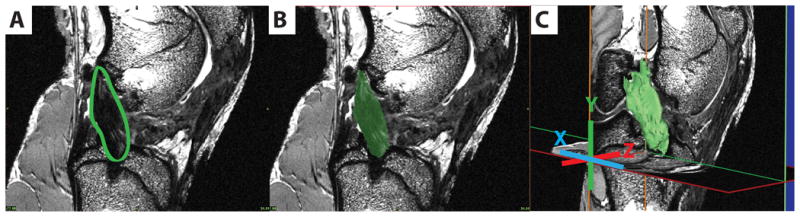
Methods: The current data were gathered from 2 experiments evaluating ACL reconstruction and repair techniques. In the first experiment, pigs underwent unilateral ACL transection and received (1) ACL reconstruction, (2) ACL reconstruction with collagen-platelet composite (CPC), or (3) no treatment. The surgical legs were harvested after 15 weeks of healing. In the second experiment, pigs underwent ACL transection and received (1) ACL reconstruction, (2) ACL reconstruction with CPC, (3) bioenhanced ACL primary repair with CPC, or (4) no treatment. The surgical legs were harvested after 52 weeks. The harvested knees were imaged using a T2*-weighted 3-dimensional constructive interference in steady state (CISS) sequence. Each ligament was segmented from the scans, and the intra-articular volume and the median grayscale values were determined. Mechanical testing was performed to establish the ligament structural properties.
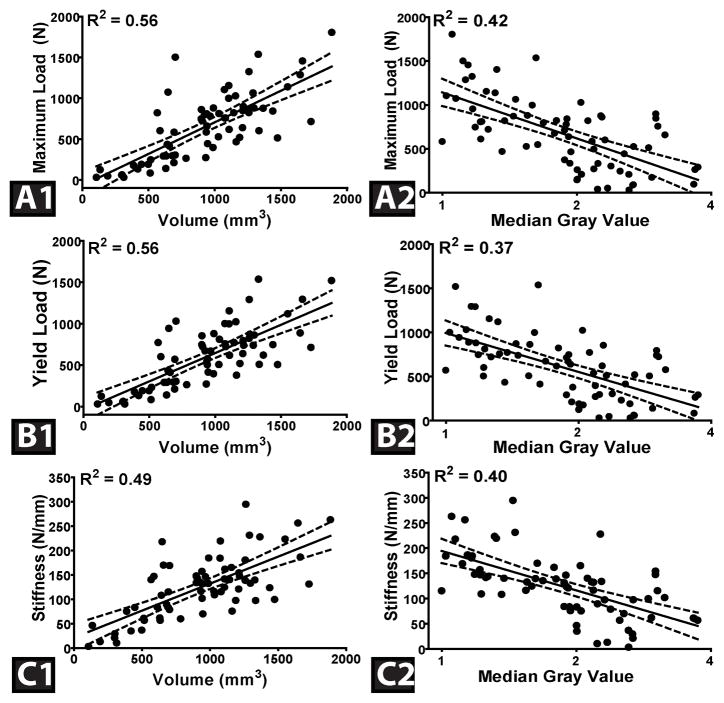
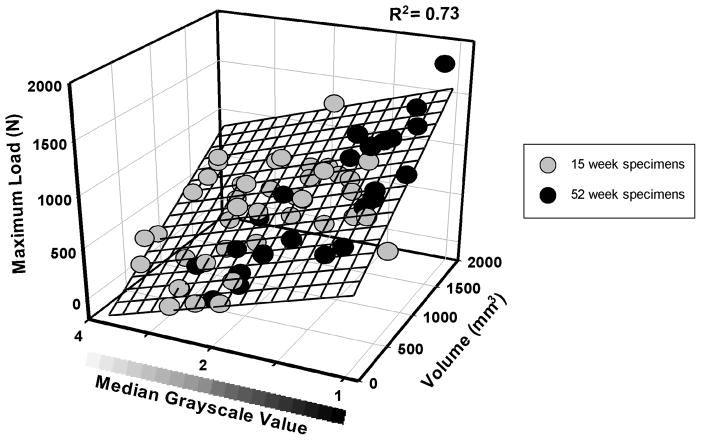
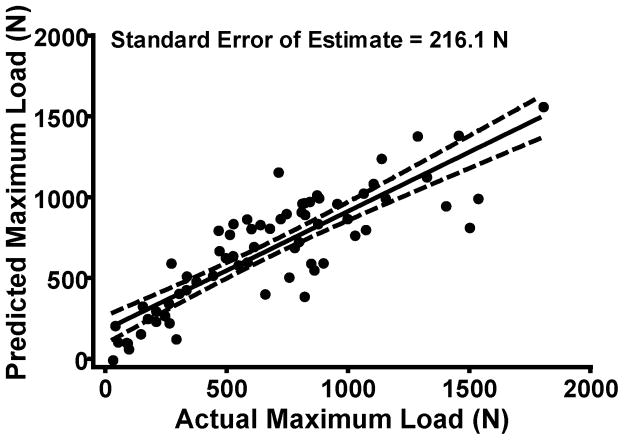
Results: Volume significantly predicted the structural properties (maximum load, yield load, and linear stiffness) of the ligaments and grafts (R (2) = 0.56, 0.56, and 0.49, respectively; P ≤ .001). Likewise, the median grayscale values (ie, signal intensity) significantly predicted the structural properties of the ligaments and grafts (R (2) = 0.42, 0.37, and 0.40, respectively; P < .001). The combination of these 2 parameters in a multiple regression model improved the predictions (R (2) = 0.73, 0.72, and 0.68, respectively; P ≤ .001).
Conclusion: Volume and grayscale values from high-resolution T2*-weighted MRI scans are predictive of structural properties of the healing ligament or graft in a porcine model.
Clinical relevance: This study provides a critical step in the development of a noninvasive method to predict the structural properties of the healing ACL graft or repair. This technique may prove beneficial as a surrogate outcome measure in preclinical animal and clinical studies.
Figures
References
-
- Chandrashekar N, Slauterbeck J, Hashemi J. Re: Sex-based differences in the anthropometric characteristics of the anterior cruciate ligament and its relation to intercondylar notch geometry: a cadaveric study. Am J Sports Med. 2009;37(2):423. - PubMed
-
- Figueroa D, Melean P, Calvo R, et al. Magnetic Resonance Imaging Evaluation of the Integration and Maturation of Semitendinosus-Gracilis Graft in Anterior Cruciate Ligament Reconstruction Using Autologous Platelet Concentrate. Arthroscopy: The Journal of Arthroscopic & Related Surgery. 2010;26(10):1318–1325. - PubMed
Publication types
MeSH terms
Substances
Grants and funding
LinkOut - more resources
Full Text Sources
Other Literature Sources
Medical
