


Marginal zone B cells: virtues of innate-like antibody-producing lymphocytes
- PMID: 23348416
- PMCID: PMC3652659
- DOI: 10.1038/nri3383
Marginal zone B cells: virtues of innate-like antibody-producing lymphocytes
Abstract
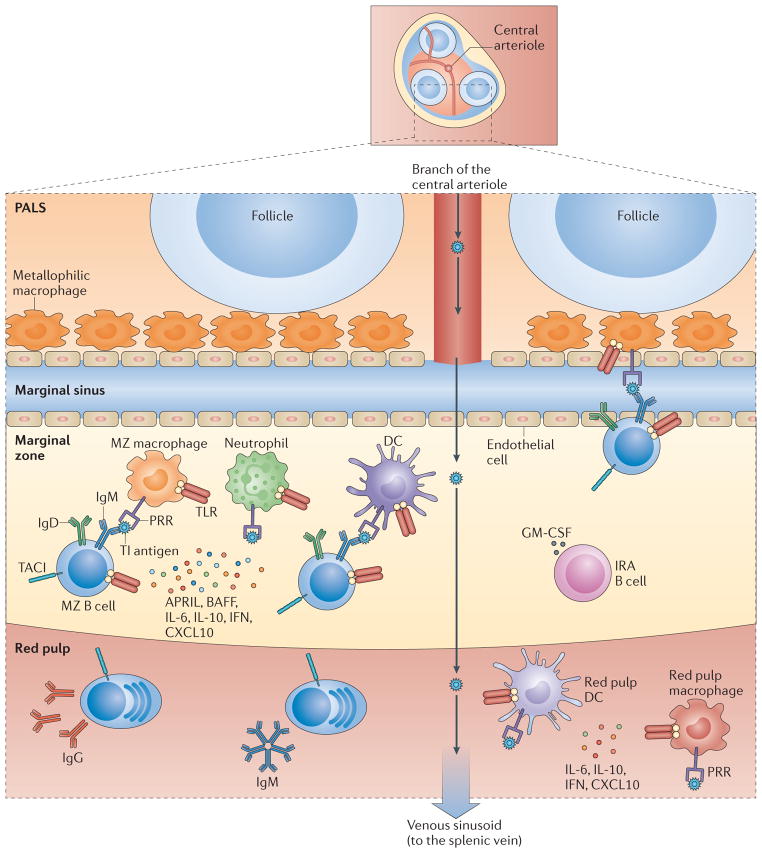
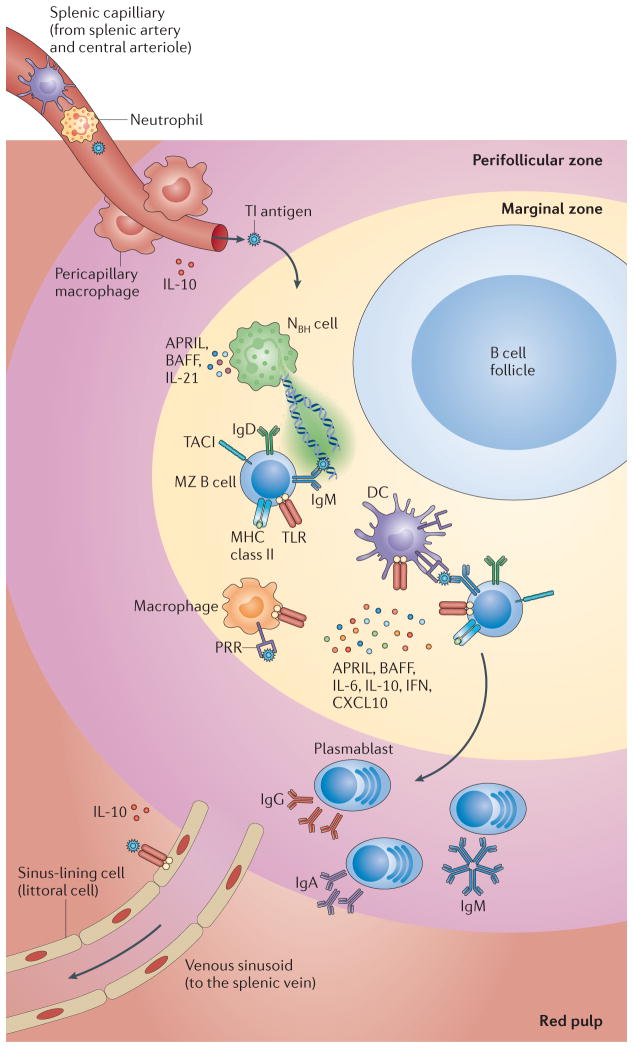
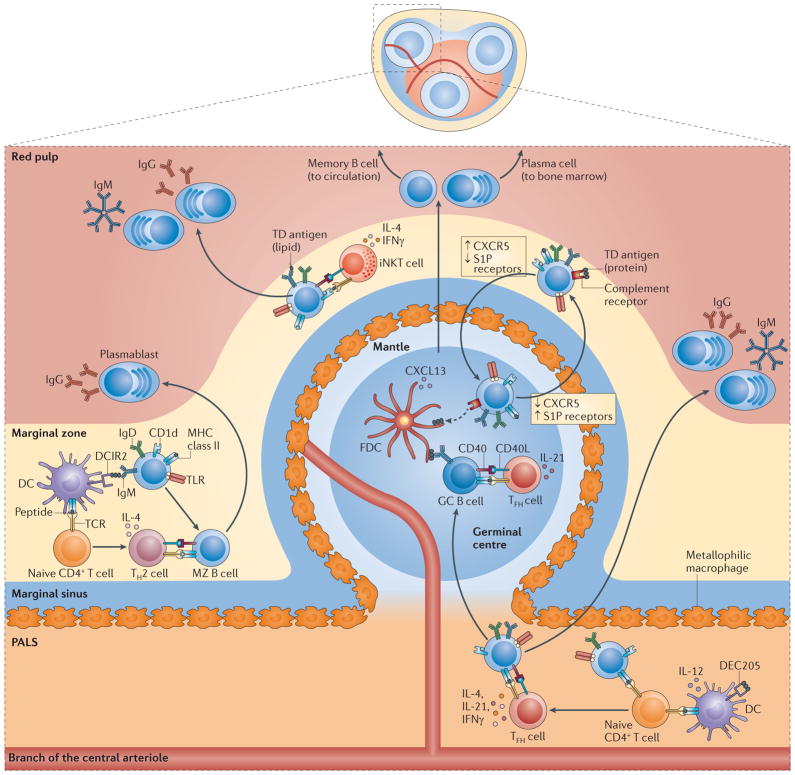
Protective responses to microorganisms involve the nonspecific but rapid defence mechanisms of the innate immune system, followed by the specific but slow defence mechanisms of the adaptive immune system. Located as sentinels at the interface between the circulation and lymphoid tissue, splenic marginal zone B cells rapidly respond to blood-borne antigens by adopting 'crossover' defensive strategies that blur the conventional boundaries of innate and adaptive immunity. This Review discusses how marginal zone B cells function as innate-like lymphocytes that mount rapid antibody responses to both T cell-dependent and T cell-independent antigens. These responses require the integration of activation signals from germline-encoded and somatically recombined receptors for microorganisms with helper signals from effector cells of the innate and adaptive immune systems.
Conflict of interest statement
The authors declare no competing financial interests.
Figures
Similar articles
-
The soluble pattern recognition receptor PTX3 links humoral innate and adaptive immune responses by helping marginal zone B cells.J Exp Med. 2016 Sep 19;213(10):2167-85. doi: 10.1084/jem.20150282. Epub 2016 Sep 12. J Exp Med. 2016. PMID: 27621420 Free PMC article.
-
New helping friends for B cells.Eur J Immunol. 2012 Aug;42(8):1956-68. doi: 10.1002/eji.201242594. Eur J Immunol. 2012. PMID: 22865046 Free PMC article. Review.
-
Innate lymphoid cells integrate stromal and immunological signals to enhance antibody production by splenic marginal zone B cells.Nat Immunol. 2014 Apr;15(4):354-364. doi: 10.1038/ni.2830. Epub 2014 Feb 23. Nat Immunol. 2014. PMID: 24562309 Free PMC article.
-
T-Independent immune response: new aspects of B cell biology.Science. 2000 Oct 6;290(5489):89-92. doi: 10.1126/science.290.5489.89. Science. 2000. PMID: 11021805 Review.
-
Regulation of frontline antibody responses by innate immune signals.Immunol Res. 2012 Dec;54(1-3):4-13. doi: 10.1007/s12026-012-8307-5. Immunol Res. 2012. PMID: 22477522 Free PMC article. Review.
Cited by
-
The Traf2DNxBCL2-tg Mouse Model of Chronic Lymphocytic Leukemia/Small Lymphocytic Lymphoma Recapitulates the Biased IGHV Gene Usage, Stereotypy, and Antigen-Specific HCDR3 Selection of Its Human Counterpart.Front Immunol. 2021 Apr 12;12:627602. doi: 10.3389/fimmu.2021.627602. eCollection 2021. Front Immunol. 2021. PMID: 33912159 Free PMC article.
-
Pattern recognition receptor ligand-induced differentiation of human transitional B cells.PLoS One. 2022 Aug 30;17(8):e0273810. doi: 10.1371/journal.pone.0273810. eCollection 2022. PLoS One. 2022. PMID: 36040923 Free PMC article.
-
Marginal zone B cells are responsible for the production of alloantibodies following platelet transfusion in mice.Blood Adv. 2023 Apr 25;7(8):1356-1365. doi: 10.1182/bloodadvances.2022008411. Blood Adv. 2023. PMID: 36490266 Free PMC article.
-
Immature B cell homing shapes human lymphoid tissue structure and function.J Exp Med. 2024 Sep 2;221(9):e20240085. doi: 10.1084/jem.20240085. Epub 2024 Aug 2. J Exp Med. 2024. PMID: 39093311 Free PMC article.
-
Effects of a Fully Humanized Type II Anti-CD20 Monoclonal Antibody on Peripheral and CNS B Cells in a Transgenic Mouse Model of Multiple Sclerosis.Int J Mol Sci. 2022 Mar 15;23(6):3172. doi: 10.3390/ijms23063172. Int J Mol Sci. 2022. PMID: 35328594 Free PMC article.
References
-
- Janeway CA, Jr, Medzhitov R. Innate immune recognition. Annu Rev Immunol. 2002;20:197–216. - PubMed
-
- Cooper MD, Alder MN. The evolution of adaptive immune systems. Cell. 2006;124:815–822. - PubMed
-
- Bendelac A, Bonneville M, Kearney JF. Autoreactivity by design: innate B and T lymphocytes. Nature Rev Immunol. 2001;1:177–186. - PubMed
-
- Martin F, Oliver AM, Kearney JF. Marginal zone and B1 B cells unite in the early response against T-independent blood-borne particulate antigens. Immunity. 2001;14:617–629. - PubMed
-
- Martin F, Kearney JF. Marginal-zone B cells. Nature Rev Immunol. 2002;2:323–335. References 3 and 5 describe the function, ontogeny and reactivity of MZ B cells. - PubMed
Publication types
MeSH terms
Substances
Grants and funding
LinkOut - more resources
Full Text Sources
Other Literature Sources
