


Cortisol response to challenge involving low controllability: the role of control beliefs and age
- PMID: 23348557
- PMCID: PMC3640489
- DOI: 10.1016/j.biopsycho.2013.01.003
Cortisol response to challenge involving low controllability: the role of control beliefs and age
Abstract
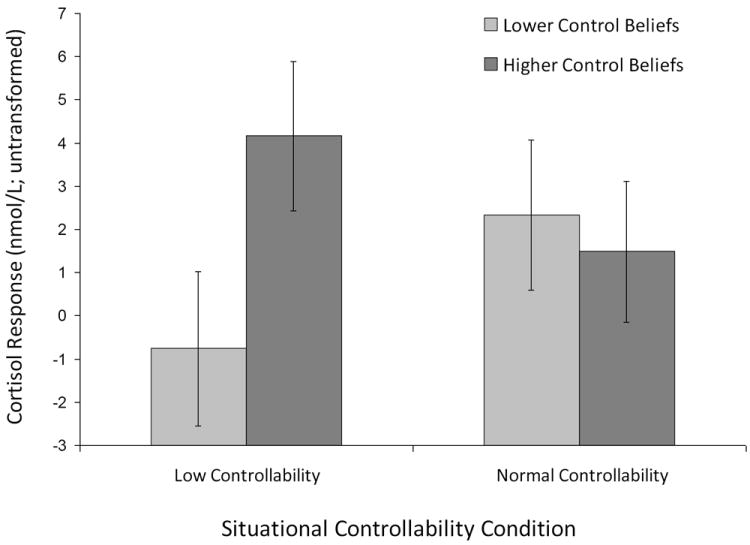
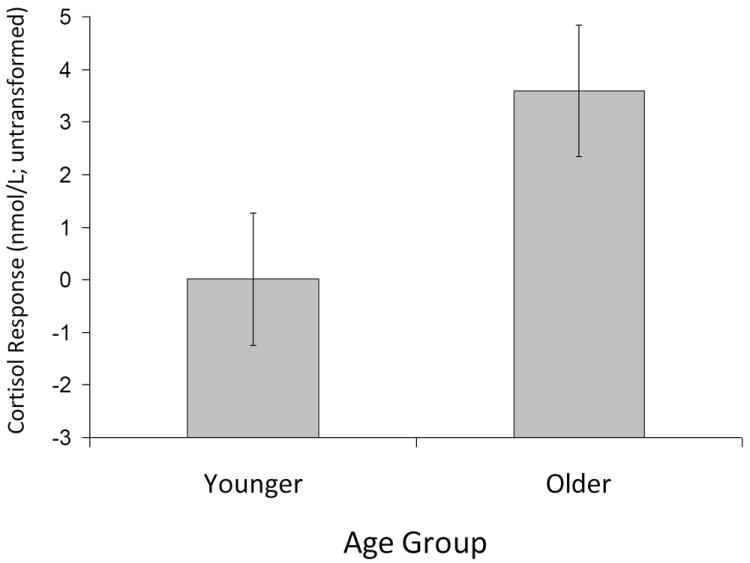
Cortisol responses are typically more pronounced under low controllability conditions, yet little is known about the role of individual differences. This study examined whether cortisol response to a situation with low controllability differs as a function of preexisting control beliefs and age. We manipulated level of controllability using a driving simulator. Control beliefs were assessed prior to the lab session. Salivary cortisol was measured before and after the driving simulation. Participants were 152 adults aged 22-84 from a Boston area sample. In comparison to the normal controllability condition, those in the low controllability condition reported less perceived control over driving, supporting the effectiveness of the manipulation. In the low controllability condition those with higher control beliefs showed a greater cortisol response than those with low control beliefs. Older adults showed a greater cortisol response than younger adults during the challenge. Implications of acute cortisol responses for performance outcomes are discussed.
Copyright © 2013 Elsevier B.V. All rights reserved.
Figures
References
-
- Bollini AM, Walker EF, Hamann S, Kestler L. The influence of perceived control and locus of control on the cortisol and subjective responses to stress. Biological Psychology. 2004;67:245–260. - PubMed
-
- Dess NK, Linwick D, Patterson J, Overmier JB, Levine S. Immediate and proactive effects of controllability and predictability on plasma cortisol responses to shocks in dogs. Behavioral Neuroscience. 1983;97:1005–1016. - PubMed
-
- Dickerson SS, Kemeny ME. Acute stressors and cortisol responses: A theoretical integration and synthesis of laboratory research. Psychological Bulletin. 2004;130:355–391. - PubMed
-
- Domes G, Heinrichs M, Reichwald U, Hautzinger M. Hypothalamic-pituitary-adrenal axis reactivity to psychological stress and memory in middleaged women: high responders exhibit enhanced declarative memory performance. Psychoneuroendocrinology. 2002;27:843–853. - PubMed
-
- Evans GW, Shapiro DH, Lewis MA. Specifying dysfunctional mismatches between different control dimensions. British Journal of Psychology. 1993;84:255–273.
Publication types
MeSH terms
Substances
Grants and funding
LinkOut - more resources
Full Text Sources
Other Literature Sources
Miscellaneous
