


Concurrent chemotherapy inhibits herpes simplex virus-1 replication and oncolysis
- PMID: 23348635
- PMCID: PMC3865714
- DOI: 10.1038/cgt.2012.97
Concurrent chemotherapy inhibits herpes simplex virus-1 replication and oncolysis
Abstract
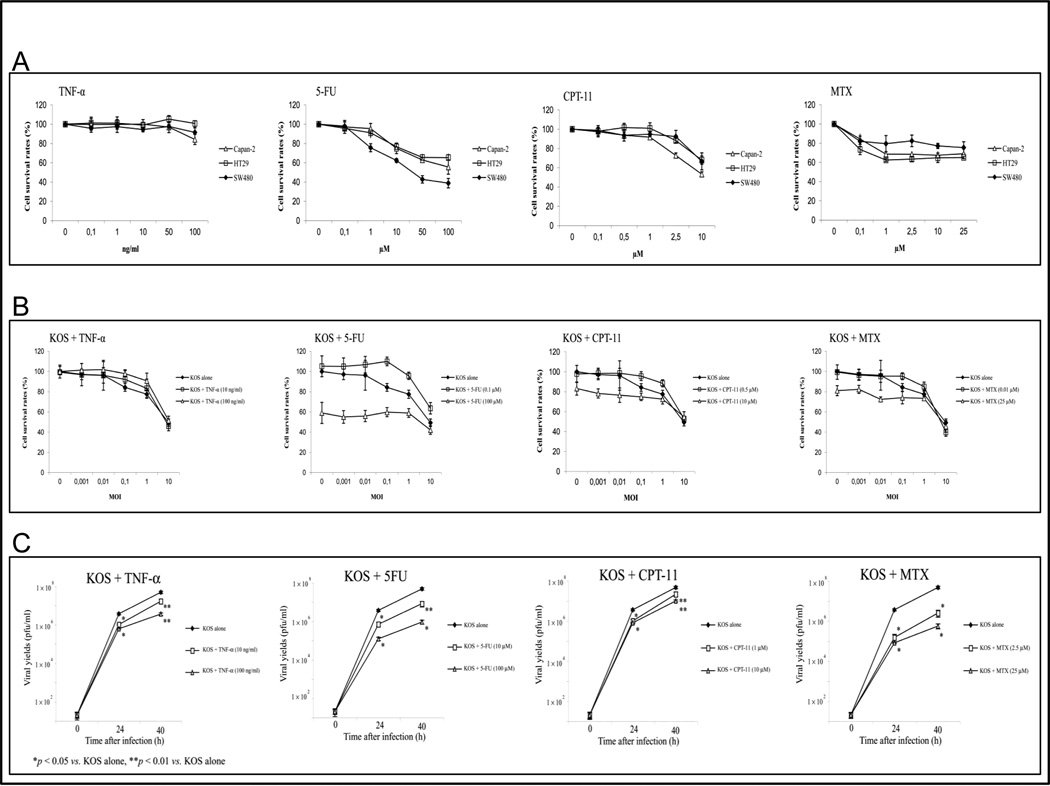
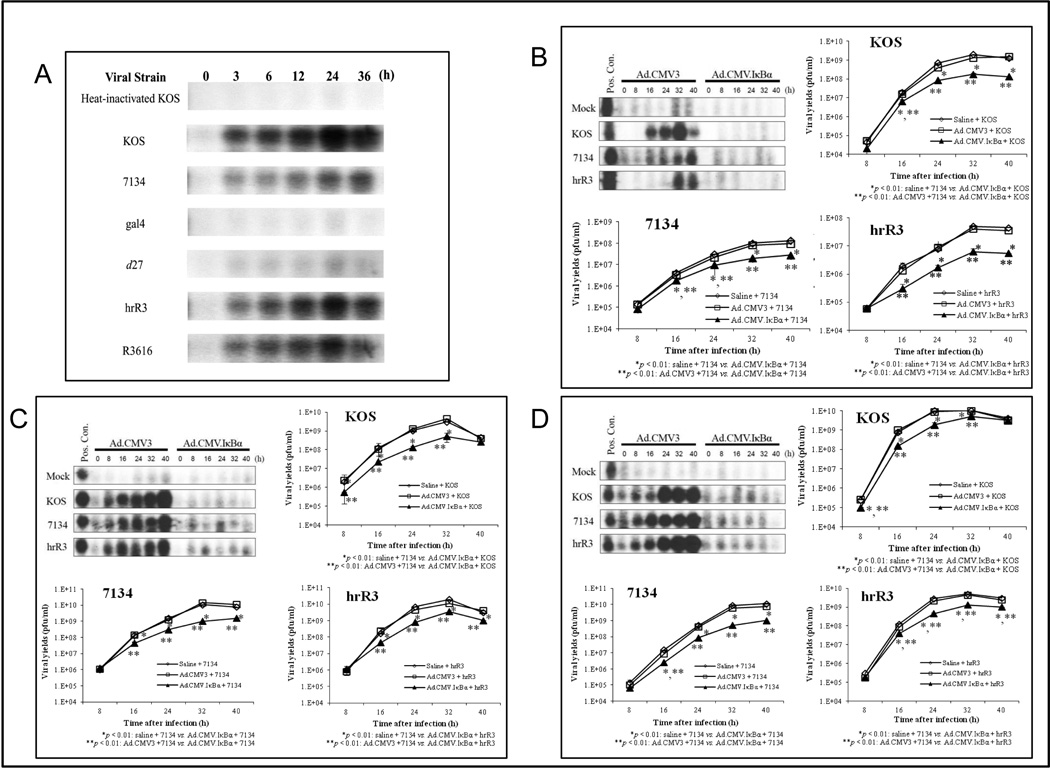
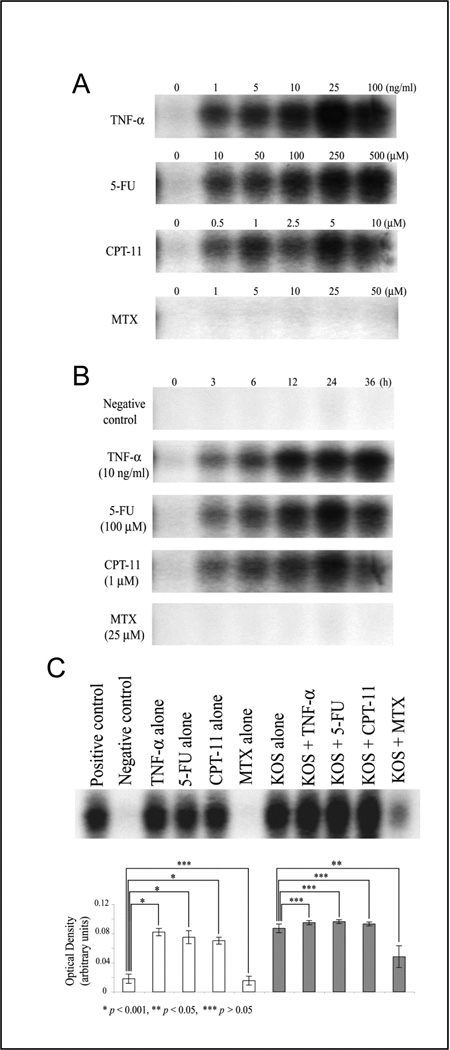
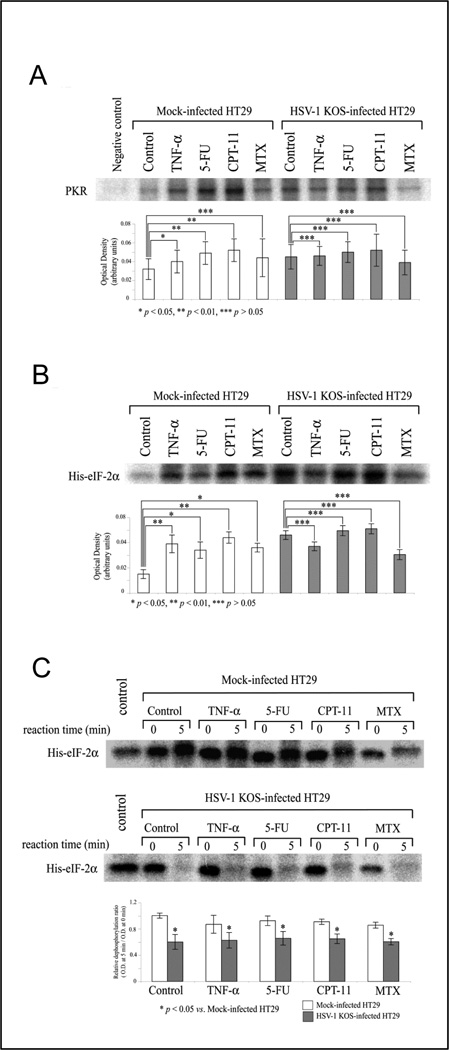
Herpes simplex virus-1 (HSV-1) replication in cancer cells leads to their destruction (viral oncolysis) and has been under investigation as an experimental cancer therapy in clinical trials as single agents, and as combinations with chemotherapy. Cellular responses to chemotherapy modulate viral replication, but these interactions are poorly understood. To investigate the effect of chemotherapy on HSV-1 oncolysis, viral replication in cells exposed to 5-fluorouracil (5-FU), irinotecan (CPT-11), methotrexate (MTX) or a cytokine (tumor necrosis factor-α (TNF-α)) was examined. Exposure of colon and pancreatic cancer cells to 5-FU, CPT-11 or MTX in vitro significantly antagonizes both HSV-1 replication and lytic oncolysis. Nuclear factor-κB (NF-κB) activation is required for efficient viral replication, and experimental inhibition of this response with an IκBα dominant-negative repressor significantly antagonizes HSV-1 replication. Nonetheless, cells exposed to 5-FU, CPT-11, TNF-α or HSV-1 activate NF-κB. Cells exposed to MTX do not activate NF-κB, suggesting a possible role for NF-κB inhibition in the decreased viral replication observed following exposure to MTX. The role of eukaryotic initiation factor 2α (eIF-2α) dephosphorylation was examined; HSV-1-mediated eIF-2α dephosphorylation proceeds normally in HT29 cells exposed to 5-FU, CPT-11 or MTX. This report demonstrates that cellular responses to chemotherapeutic agents provide an unfavorable environment for HSV-1-mediated oncolysis, and these observations are relevant to the design of both preclinical and clinical studies of HSV-1 oncolysis.
Conflict of interest statement
We declare that we have no conflict of interest.
Figures
References
-
- Pawlik TM, Nakamura H, Yoon SS, Mullen JT, Chandrasekhar S, Chiocca EA, et al. Oncolysis of diffuse hepatocellular carcinoma by intravascular administration of a replication-competent, genetically engineered herpesvirus. Cancer Res. 2000;60(11):2790–2795. - PubMed
-
- Yoon SS, Nakamura H, Carroll NM, Bode BP, Chiocca EA, Tanabe KK. An oncolytic herpes simplex virus type 1 selectively destroys diffuse liver metastases from colon carcinoma. FASEB J. 2000;14(2):301–311. - PubMed
-
- Mullen JT, Donahue JM, Chandrasekhar S, Yoon SS, Liu W, Ellis LM, et al. Oncolysis by viral replication and inhibition of angiogenesis by a replication-conditional herpes simplex virus that expresses mouse endostatin. Cancer. 2004;101(4):869–877. - PubMed
-
- Nakamura H, Mullen JT, Chandrasekhar S, Pawlik TM, Yoon SS, Tanabe KK. Multimodality therapy with a replication-conditional herpes simplex virus 1 mutant that expresses yeast cytosine deaminase for intratumoral conversion of 5-fluorocytosine to 5-fluorouracil. Cancer Res. 2001;61(14):5447–5452. - PubMed
Publication types
MeSH terms
Substances
Grants and funding
LinkOut - more resources
Full Text Sources
Other Literature Sources
Medical
