Review
. 2013 Mar;19(3):127-40.
doi: 10.1002/psc.2482. Epub 2013 Jan 24.

Max Bergmann lecture protein epitope mimetics in the age of structural vaccinology

Affiliations
Free PMC article
Review

Max Bergmann lecture protein epitope mimetics in the age of structural vaccinology

John A Robinson. J Pept Sci. 2013 Mar.
Free PMC article

Abstract

This review highlights the growing importance of protein epitope mimetics in the discovery of new biologically active molecules and their potential applications in drug and vaccine research. The focus is on folded β-hairpin mimetics, which are designed to mimic β-hairpin motifs in biologically important peptides and proteins. An ever-growing number of protein crystal structures reveal how β-hairpin motifs often play key roles in protein-protein and protein-nucleic acid interactions. This review illustrates how using protein structures as a starting point for small-molecule mimetic design can provide novel ligands as protein-protein interaction inhibitors, as protease inhibitors, and as ligands for chemokine receptors and folded RNA targets, as well as novel antibiotics to combat the growing health threat posed by the emergence of antibiotic-resistant bacteria. The β-hairpin antibiotics are shown to target a β-barrel outer membrane protein (LptD) in Pseudomonas sp., which is essential for the biogenesis of the outer cell membrane. Another exciting prospect is that protein epitope mimetics will be of increasing importance in synthetic vaccine design, in the emerging field of structural vaccinology. Crystal structures of protective antibodies bound to their pathogen-derived epitopes provide an ideal starting point for the design of synthetic epitope mimetics. The mimetics can be delivered to the immune system in a highly immunogenic format on the surface of synthetic virus-like particles. The scientific challenges in molecular design remain great, but the potential significance of success in this area is even greater.


Figures

Figure 1
Figure 1
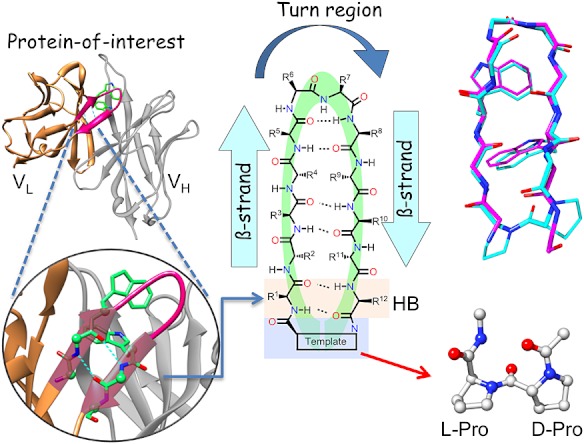
A β-hairpin loop identified in a protein crystal structure (left) can be transplanted onto a d-Pro- l-Pro template (right), resulting in cyclic β-hairpin mimetic (center). The template in the mimetic helps to stabilize folded β-hairpin conformations and fixes the hairpin register. A comparison of one NMR structure of a CDR loop mimetic (blue) with the same loop in the protein crystal structure is shown (right) [20].
Figure 2
Figure 2
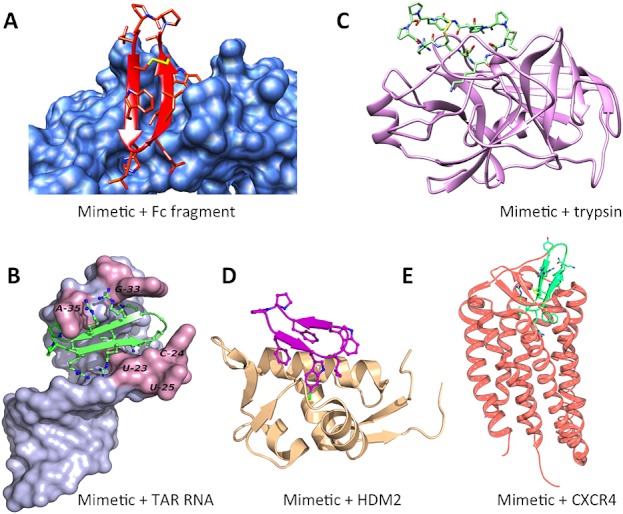
β-Hairpin mimetics have been discovered that bind with high affinity to the targets shown. The complexes with the Fc fragment (A) and trypsin (C) are computer models based upon crystal structures of target-bound phage (1DN2) or natural product (1SFI) leads. The complexes shown with TAR RNA (2KDQ) (B), HDM2 (2AXI) (D), and CXCR4 (3OE0) (E) are crystal or NMR structures, available in the Protein Data Bank database.
Figure 3
Figure 3
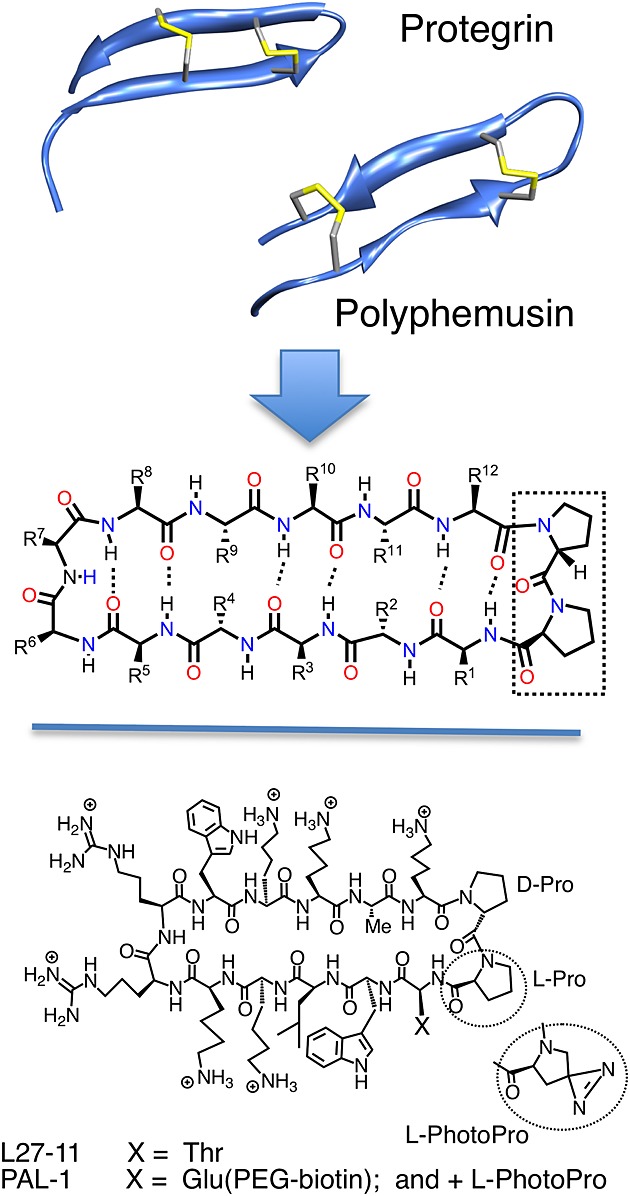
Naturally occurring β-hairpin-shaped CAPs provide a starting point for mimetic design. The mimetic L27-11 is a potent antibiotic acting selectively against Pseudomonas sp. [33]. The bacterial target of L27-11 was shown to be the OM protein LptD. The photoprobe PAL-1, which contains photoproline in place of l-proline and a biotin tag at position 1, photolabels LptD selectively.
Figure 4
Figure 4
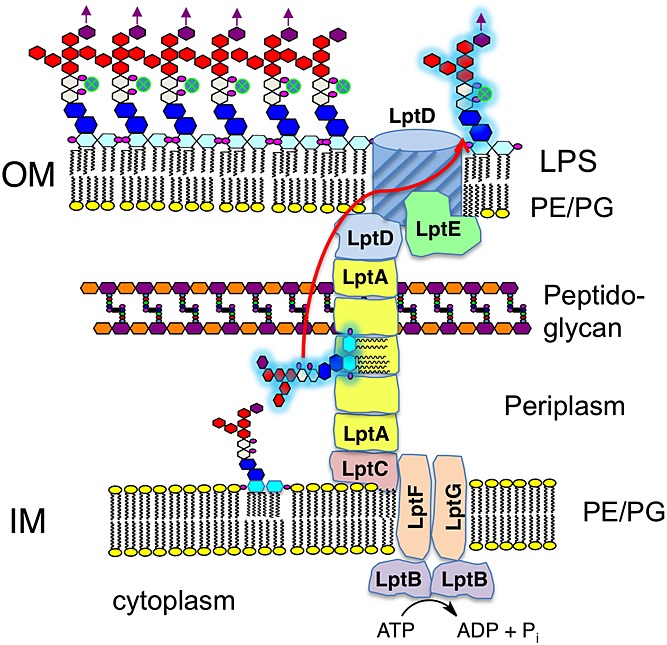
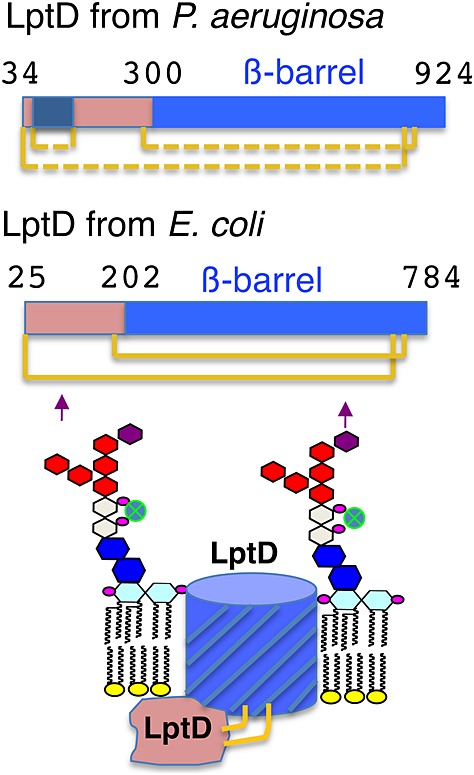
The OM protein LptD is the last component in the LPS transport pathway in Gram-negative bacteria [–48]. LptD translocates LPS from the periplasm into the outer leaflet of the asymmetric OM.
Figure 5
Figure 5
The LptD OM protein is essential in both P. aeruginosa (PA) and E. coli (EC), and the sequences share significant homology. The folded proteins lack the signal peptide (residues 1–33 in PA or residues 1–24 in EC), both contain a periplasmic domain and a C-terminal β-barrel domain. However, differences in sequence, length, and the number of disulfide bonds (proven in EC, full lines [59]; likely in PA, dotted lines) are seen between LptD in these organisms. These sequence differences may account for the selective action of the antibiotic L27-11 for Pseudomonas sp.
Figure 6
Figure 6
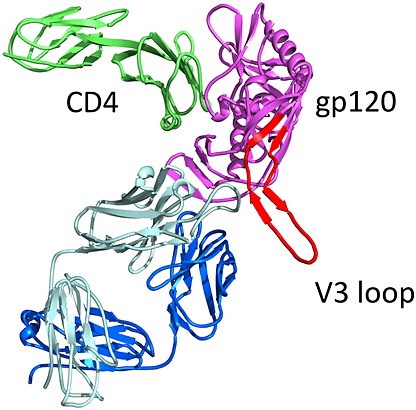
Crystal structure (Protein Data Bank 2B4C) of a complex formed by an engineered gp120 HIV-1 glycoprotein with domains from the cellular receptor CD4 and with a mAb Fab fragment [124]. The V3 loop of gp120 is in red.
Figure 7
Figure 7
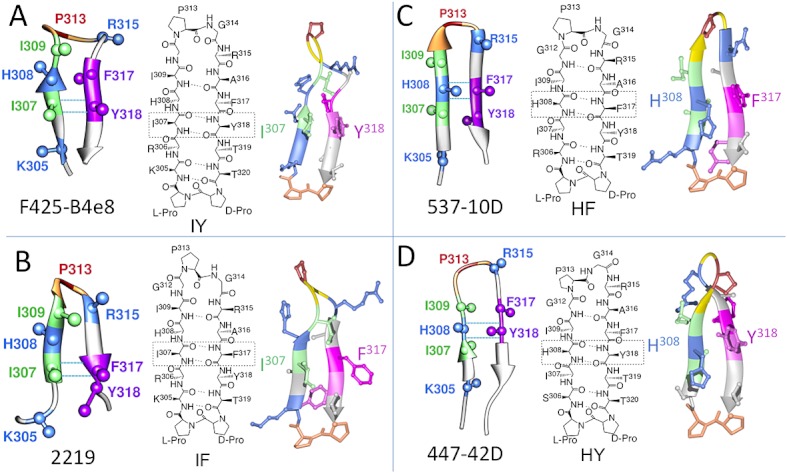
Design of four β-hairpin mimetics (called IY, IF, HF, and HY) based upon V3-derived peptides bound to four different neutralizing mAbs [163]. The hairpin loops have different hairpin registers in the four complexes. The hairpin registers are fixed after transfer to the d-Pro- l-Pro template. For each, the left side shows the bound V3 loop conformation taken from the Protein Data Bank file, and the right side shows one typical NMR structure of each mimetic. The template is shown in orange at the bottom of each structure.
Figure 8
Figure 8
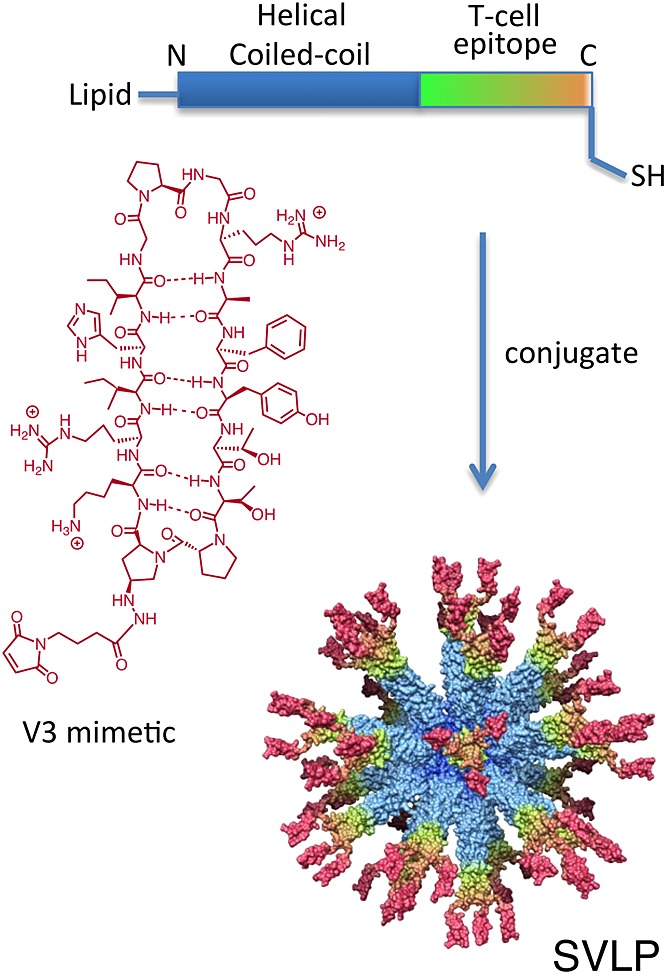
SVLPs are produced by spontaneous self-assembly from lipopeptide building blocks, in which the peptide sequence includes a coiled coil linked to a T-cell epitope. Epitope mimetics can be linked to the lipopeptide, for example, the V3 mimetic shown can be linked to a C-terminal Cys residue. The model of the resulting SVLP nanoparticle is based upon extensive biophysical characterization [,–121].

References

    1. Yin H, Hamilton AD. Strategies for targeting protein–protein interactions with synthetic agents. Angew. Chem. Int. Ed. 2005;44:4130–4163. - PubMed
    1. Dormitzer PR, Grandi G, Rappuoli R. Structural vaccinology starts to deliver. Nat. Rev. Microbiol. 2012;10:807–813. - PubMed
    1. Clackson T, Wells JA. A hot spot of binding energy in a hormone–receptor interface. Science. 1995;267:383–386. - PubMed
    1. DeLano WL. Unraveling hot spots in binding interfaces: progress and challenges. Curr. Opin. Struct. Biol. 2002;12:14–20. - PubMed
    1. Keskin O, Ma B, Nussinov R. Hot regions in protein–protein interactions: the organization and contribution of structurally conserved hot spot residues. J. Mol. Biol. 2005;345:1281–1294. - PubMed