doi: 10.1371/journal.ppat.1003088.
Epub 2013 Jan 17.
Make it, take it, or leave it: heme metabolism of parasites
Affiliations
- PMID: 23349629
- PMCID: PMC3547853
- DOI: 10.1371/journal.ppat.1003088
Item in Clipboard
Make it, take it, or leave it: heme metabolism of parasites
PLoS Pathog.
2013 Jan.
No abstract available
Conflict of interest statement
The authors have declared that no competing interests exist.
Figures
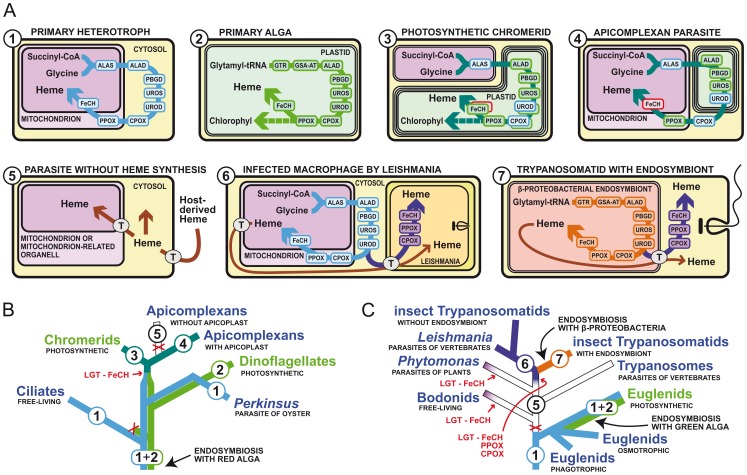
(A) Intracellular localizations of heme synthesis enzymes and heme trafficking in various parasites. The colors and numbers of the phylogenetic lineages in (B) and (C) correspond to the colors of the pathways and numbers in the schematics in (A). The blue line (no. 1) represents the original pathway of the primary heterotroph and is similar to the well characterized C4 pathways of animals and fungi. The green line (no. 2) represents the plastidial C5 pathway of the endosymbiotic alga and is present in most phototrophs. In the ancestral lineages of alveolates, both of these pathways co-existed as in extant photosynthetic euglenids. The lines no. 3 and 4 represent the hybrid pathways of photosynthetic chromerids and apicomplexan parasites, which resulted from the combination of the original pathway of the host (no. 1) and the plastidial pathway from the algal endosymbiont (no. 2). FeCH in a red box was acquired via lateral gene transfer (LGT) from a γ-proteobacterium. The purple line (no. 6) represents the partial pathway of the trypanosomatid flagellates, which consists of the last three steps encoded by enzymes of γ-proteobacterial origin. The orange line (no. 7) is the heme synthesis pathway of the β-proteobacterial endosymbionts of one group of trypanosomatids. T stands for porphyrin transporters. (B) Evolution of the heme biosynthesis in Alveolata leading to the unique pathway of apicomplexan parasites. (C) Evolution of the heme synthesis in Euglenozoa leading to the loss of the pathway in ancestral kinetoplastids and its partial rescue by bacterial genes for the last three steps and full rescue by bacterial endosymbionts in trypanosomatids. The abbreviated enzyme names are: ALAS, ALA-synthase; GTR, glutamyl-tRNA reductase; GSA-AT, glutamate 1-semialdehyde aminotransferase; ALAD, ALA-dehydratase; PBGD, porphobilinogen deaminase; UROS, uroporphyrinogen synthase; UROD, uroporphyrinogen decarboxylase; CPOX, coproporphyrinogen oxidase; PPOX, protoporphyrinogen oxidase; FeCH, ferrochelatase.
References
-
- Panek H, O'Brian MR (2002) A whole genome view of prokaryotic haem biosynthesis. Microbiology 148: 2273–2282. - PubMed
-
- Roth JR, Lawrence JG, Bobik TA (1996) Cobalamin (coenzyme B12): synthesis and biological significance. Annu Rev Microbiol 50: 137–181. - PubMed
-
- Poole RK, Hughes MN (2000) New functions for the ancient globin family: bacterial responses to nitric oxide and nitrosative stress. Mol Microbiol 36: 775–783. - PubMed
-
- Rafferty S, Luu B, March RE, Yee J (2010) Giardia lamblia encodes a functional flavohemoglobin. Biochem Biophys Res Commun 399: 347–351. - PubMed
-
- Schenkman JB, Jansson I (2003) The many roles of cytochrome b5. Pharmacol Ther 97: 139–152. - PubMed
Publication types
MeSH terms
Substances
LinkOut - more resources
Full Text Sources
Other Literature Sources
Medical