. 2013;8(1):e54263.
doi: 10.1371/journal.pone.0054263. Epub 2013 Jan 21.

Immunogenicity and cross protective ability of the central VP2 amino acids of infectious pancreatic necrosis virus in Atlantic salmon (Salmo salar L.)

Affiliations

Immunogenicity and cross protective ability of the central VP2 amino acids of infectious pancreatic necrosis virus in Atlantic salmon (Salmo salar L.)

Hetron M Munang'andu et al. PLoS One. 2013.

Abstract

Infectious pancreatic necrosis virus (IPNV) is a member of the family Birnaviridae that has been linked to high mortalities in juvenile salmonids and postsmolt stages of Atlantic salmon (Salmo salar L.) after transfer to seawater. IPN vaccines have been available for a long time but their efficacy has been variable. The reason for the varying immune response to these vaccines has not well defined and studies on the importance of using vaccine trains homologous to the virulent field strain has not been conclusive. In this study we prepared one vaccine identical to the virulent Norwegian Sp strain NVI-015 (NCBI: 379740) (T(217)A(221)T(247) of VP2) and three other vaccine strains developed using the same genomic backbone altered by reverse genetics at three residues yielding variants, T(217)T(221)T(247), P(217)A(221)A(247), P(217)T(221)A(247). These 4 strains, differing in these three positions only, were used as inactivated, oil-adjuvanted vaccines while two strains, T(217)A(221)T(247) and P(217)T(221)A(247), were used as live vaccines. The results show that these three residues of the VP2 capsid play a key role for immunogenicity of IPNV vaccines. The virulent strain for inactivated vaccines elicited the highest level of virus neutralization (VN) titers and ELISA antibodies. Interestingly, differences in immunogenicity were not reflected in differences in post challenge survival percentages (PCSP) for oil-adjuvanted, inactivated vaccines but clearly so for live vaccines (TAT and PTA). Further post challenge viral carrier state correlated inversely with VN titers at challenge for inactivated vaccines and prevalence of pathology in target organs inversely correlated with protection for live vaccines. Overall, our findings show that a few residues localized on the VP2-capsid are important for immunogenicity of IPNV vaccines.


Conflict of interest statement

Competing Interests: The authors have read the journal's policy and have the following conflicts. Ane Sandtrø and Bjørn Brudeseth are employed in PHARMAQ AS. Nina Santi is employed in AquaGen AS. Dr. Evensen received funding from the Research Council of Norway. Dr. Evensen has been acting as expert witness and as consultant for PHARMAQ. This does not alter the authors' adherence to all the PLOS ONE policies on sharing data and materials, apart from the AGK cell line which is used under licence by Norwegian School of Veterinary Science and is the exclusive ownership of SBC Biotech, Taiwan, ROC.

Figures

Figure 1
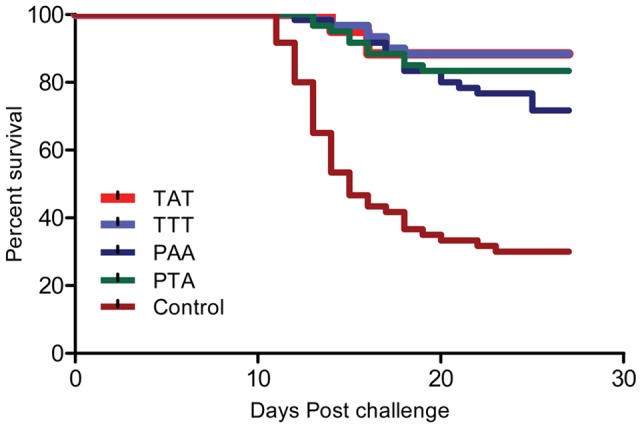
Figure 1. Post challenge survival plots for inactivated vaccines.
Kaplan Meyer's (KM) post challenge survival percentages (PCSPs) of fish vaccinated with inactivated, water-in-oil adjuvanted vaccines made from the TAT, TTT, PAA and PTA strains, challenged at 10 weeks post vaccination with the virulent TAT strain. Mortality started on day 11 post challenge and stopped on day 27 when fish stopped dying and the PCSP curves plateaued. The challenge study was stopped on day 31. TAT and TTT groups overlap while there was a reduced survival in the PTA and PAA groups with significantly lower PCSP for the latter (p = 0.042).
Figure 2
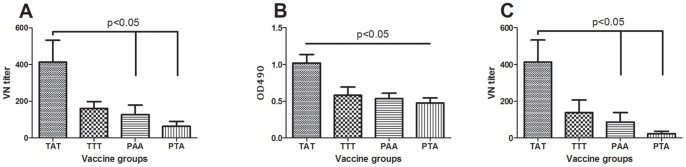
Figure 2. Virus neutralization titers and ELISA antibodies for inactivated vaccines.
A) Virus neutralization (VN) titers generated from TAT, TTT, PAA and PTA inactivated vaccines against the TAT challenge strain at 10 wpv shows significantly higher VN titer for TAT over PAA and PTA groups (p<0.05). The TTT group was not different from any other group. N = 12; ±SEM. B) Antibody response by ELISA at 10 wpv against TAT antigen coat for the TAT, TTT, PAA and PTA vaccines. TAT is different from all other groups. N = 12; ±SEM. C) VN titers of serum from fish vaccinated with different vaccines at 10 wpv. Each group of vaccine was tested against the corresponding vaccine antigen. As can be seen the trend is similar to what is seen in B) but with lower antibody levels against corresponding antigen. N = 12; ±SEM.
Figure 3
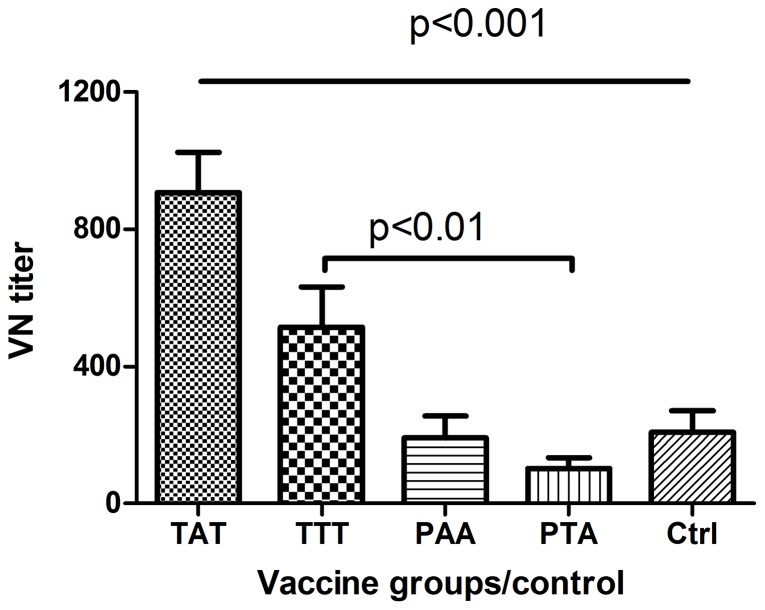
Figure 3. Virus neutralization titers post challenge.
A) VN titers at 4 weeks post challenge (wpc) show that the TAT vaccinated fish are significantly higher than all other vaccine groups while the TTT group is higher than the PTA fish. Surviving control fish (Ctrl) also show VN titers at 4 wpc and is not significantly different from the TTT, PAA and PTA groups. There is significant increase in the TAT and TTT groups. N = 12; ±SEM. * = p<0.05.
Figure 4
Figure 4. Post challenge survival plots for live vaccines.
Kaplan Meyer's (KM) post challenge survival percentages (PCSPs) of fish vaccinated with the TAT- and PTA-live vaccines. TAT-live Ctrl and PTA-live Ctrl are non-vaccinated controls cohabiting with the respective vaccine groups, while the mortality controls (Ctrl) are the reference mortalities in the tanks not including vaccinated fish (cf. Fig. S2). Mortality started on day 21 post challenge and lasted until day 55, and the experiment was stopped 57 days post challenge. PCSP for the PTA-live was significantly lower than for the TAT-live group (p<0.0001).
Figure 5
Figure 5. Virus neutralization titers in live vaccine groups.
A) VN titers against TAT strain for the TAT- and PTA-live vaccinated fish increased markedly from 4 to 8 weeks post vaccination (wpv). B) VN titer against the PTA strain was also examined and showed that the homologous titer for the PTA vaccinated fish were equal to their cross-reactivity to the TAT variant. C) VN titers at 8 and 17 weeks post challenge (wpc) were examined and while the TAT-live show no increase from time of challenge (A) there is an increase for the PTA-live group. Control fish cohabiting with the vaccinated fish also show an increase. By 17 wpc there is a marked increase in all groups. N = 12; ±SEM.
Figure 6
Figure 6. Immunohistochemistry (IHC) of infected tissues.
Detection of viral antigens in infected tissues by IHC is depicted as red stain. A) shows extensive distribution of viral antigens in exocrine pancreas. B) Viral antigens in liver parenchyma of multifocal appearance. C) Rounding (R) of individual liver cells and also with vacuolation (V) concomitant with positive staining for virus (red). D) Viral positive cells scattered in spleen tissue.

References

    1. Evensen O, Santi N (2008) Infectious pancreatic necrosis virus. In: Mahy BWJ and van Regenmortel MVH(eds), editors. In encyclopedia of virology, 3rd virology edn. Elsevier: Oxford. pp. 83–89.
    1. Dobos P, Roberts TE (1983) The molecular biology of infectious pancreatic necrosis virus – A review. Can J Microbiol 29: 377–384. - PubMed
    1. Dobos P (1976) Size and structure of genome of infectious pancreatic necrosis virus. Nucleic Acids Res 3: 1903–1924. - PMC - PubMed
    1. Dobos P, Rowe D (1977) Peptide map comparison of infectious pancreatic necrosis virus-specific polypeptides. J Virol 24: 805–820. - PMC - PubMed
    1. Heppell J, Tarrab E, Lecomte J, Berthiaume L, Arella M (1995) Strain variability and localization of important epitopes on the major structuralprotein (VP2) of infectious pancreatic necrosis virus. Virology 214: 40–49. - PubMed

Publication types

MeSH terms