


Terrestrial pesticide exposure of amphibians: an underestimated cause of global decline?
- PMID: 23350038
- PMCID: PMC3553602
- DOI: 10.1038/srep01135
Terrestrial pesticide exposure of amphibians: an underestimated cause of global decline?
Abstract
Amphibians, a class of animals in global decline, are present in agricultural landscapes characterized by agrochemical inputs. Effects of pesticides on terrestrial life stages of amphibians such as juvenile and adult frogs, toads and newts are little understood and a specific risk assessment for pesticide exposure, mandatory for other vertebrate groups, is currently not conducted. We studied the effects of seven pesticide products on juvenile European common frogs (Rana temporaria) in an agricultural overspray scenario. Mortality ranged from 100% after one hour to 40% after seven days at the recommended label rate of currently registered products. The demonstrated toxicity is alarming and a large-scale negative effect of terrestrial pesticide exposure on amphibian populations seems likely. Terrestrial pesticide exposure might be underestimated as a driver of their decline calling for more attention in conservation efforts and the risk assessment procedures in place do not protect this vanishing animal group.
Figures
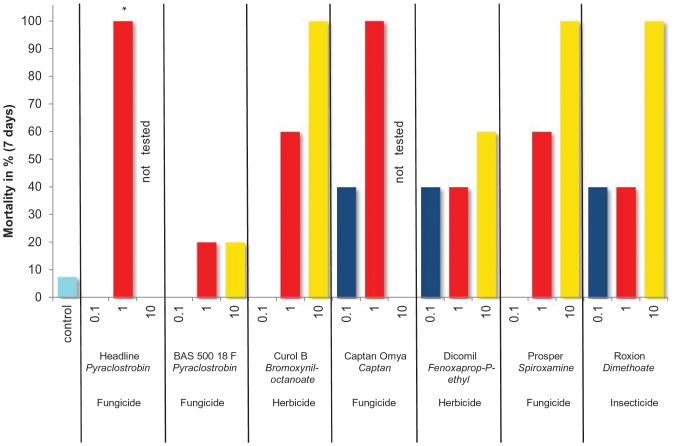
 0.1× label rate,
  label rate,
  10× label rate.
References
-
- Stuart S. N. et al. Status and trends of amphibian declines and extinctions worldwide. Science 306, 1783–1786 (2004). - PubMed
-
- Pounds J. A. et al. Widespread amphibian extinctions from epidemic disease driven by global warming. Nature 439, 161–167 (2006). - PubMed
-
- Collins J. P. & Storfer A. Global amphibian declines: sorting the hypotheses. Divers. Distrib. 9, 89–98 (2003).
-
- Blaustein A. R., Wake D. B. & Sousa W. P. Amphibian declines - Judging stability, persistence and susceptibility of populations to local and global extinctions. Conserv. Biol. 8, 60–71 (1994).
-
- Becker C. G., Fonseca C. R., Haddad C. F. B., Batista R. F. & Prado P. I. Habitat Split and the Global Decline of Amphibians. Science 318, 1775–1777 (2007). - PubMed
Publication types
MeSH terms
Substances
LinkOut - more resources
Full Text Sources
Other Literature Sources
Medical
