


Antihypertensive therapy and cerebral hemodynamics in executive mild cognitive impairment: results of a pilot randomized clinical trial
- PMID: 23350899
- PMCID: PMC3608194
- DOI: 10.1111/jgs.12100
Antihypertensive therapy and cerebral hemodynamics in executive mild cognitive impairment: results of a pilot randomized clinical trial
Abstract
Objectives: To compare the effects of three antihypertensive medications on cerebral hemodynamic and cognitive function in hypertensive individuals with executive dysfunction.
Design: Double-blind randomized clinical trial.
Setting: Community.
Participants: Fifty-three individuals aged 60 and older with hypertension and executive dysfunction.
Intervention: Lisinopril, candesartan, or hydrochlorothiazide for 1 year.
Measurements: Cerebral blood flow velocity (BFV; transcranial Doppler ultrasonography during rest, sitting, standing, hypercapnia, and hypocapnia), cognition, and blood pressure were measured at baseline and after 6 and 12 months. Linear mixed models were used to compare the three groups.
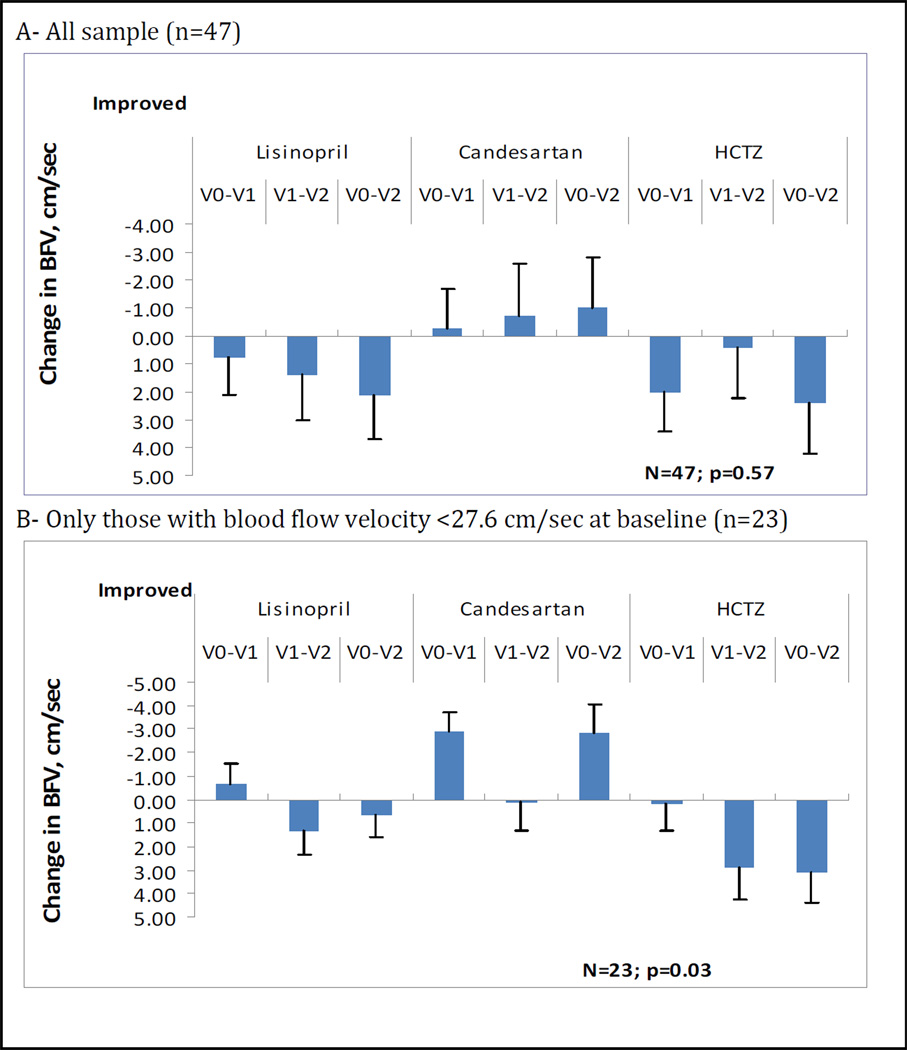
Results: Of the 53 participants, 47 had successful insonation (mean age 72; 70% white; 57% women). There was a tendency toward an increase in BFV in the candesartan group and a decrease in the lisinopril and hydrochlorothiazide groups (between-group P = .57) that was significant in those with low BFV at baseline (<median 27.6 cm/s, between-group P = .03). The candesartan group also had the greatest improvement in executive function (Trail Making Test Part B improved by 17.1 seconds, vs hydrochlorothiazide improved by 4.2 seconds and lisinopril worsened by 14.4 seconds, P = .008). Carbon dioxide vasoreactivity and vasomotor range declined significantly in the lisinopril (within-group P = .001 for vasoreactivity and .02 for vasomotor range) and hydrochlorothiazide groups (within-group P = .10 and .009, respectively) but not in the candesartan group (within-group P = .25 and .38, respectively; between-group P = .30 and .46, respectively).
Conclusion: Angiotensin receptor blockers may preferentially preserve cerebral hemodynamics and executive function in individuals with executive dysfunction. These findings warrant further investigation in a larger trial.
Trial registration: ClinicalTrials.gov NCT00605072.
© 2013, Copyright the Authors Journal compilation © 2013, The American Geriatrics Society.
Conflict of interest statement
Figures
Comment in
-
Unappreciated side effects of antihypertensive therapy.J Am Geriatr Soc. 2013 Oct;61(10):1848. doi: 10.1111/jgs.12486. J Am Geriatr Soc. 2013. PMID: 24117316 No abstract available.
References
-
- Grigsby J, Kaye K, Shetterly SM, Baxter J, Morgenstern NE, Hamman RF. Prevalence of disorders of executive cognitive functioning among the elderly: findings from the San Luis Valley Health and Aging Study. Neuroepidemiology. 2002 Sep-Oct;21(5):213–220. - PubMed
-
- Royall DR, Espino DV, Polk MJ, Palmer RF, Markides KS. Prevalence and patterns of executive impairment in community dwelling Mexican Americans: results from the Hispanic EPESE Study. International journal of geriatric psychiatry. 2004 Oct;19(10):926–934. - PubMed
-
- Rockwood K, Wentzel C, Hachinski V, Hogan DB, MacKnight C, McDowell I. Prevalence and outcomes of vascular cognitive impairment. Vascular Cognitive Impairment Investigators of the Canadian Study of Health and Aging. Neurology. 2000 Jan 25;54(2):447–451. - PubMed
Publication types
MeSH terms
Substances
Associated data
Grants and funding
LinkOut - more resources
Full Text Sources
Other Literature Sources
Medical
