


Prevalence of low back pain in children and adolescents: a meta-analysis
- PMID: 23351394
- PMCID: PMC3571904
- DOI: 10.1186/1471-2431-13-14
Prevalence of low back pain in children and adolescents: a meta-analysis
Abstract
Background: Low back pain (LBP) is common in children and adolescents, and it is becoming a public health concern. In recent years there has been a considerable increase in research studies that examine the prevalence of LBP in this population, but studies exhibit great variability in the prevalence rates reported. The purpose of this research was to examine, by means of a meta-analytic investigation, the prevalence rates of LBP in children and adolescents.
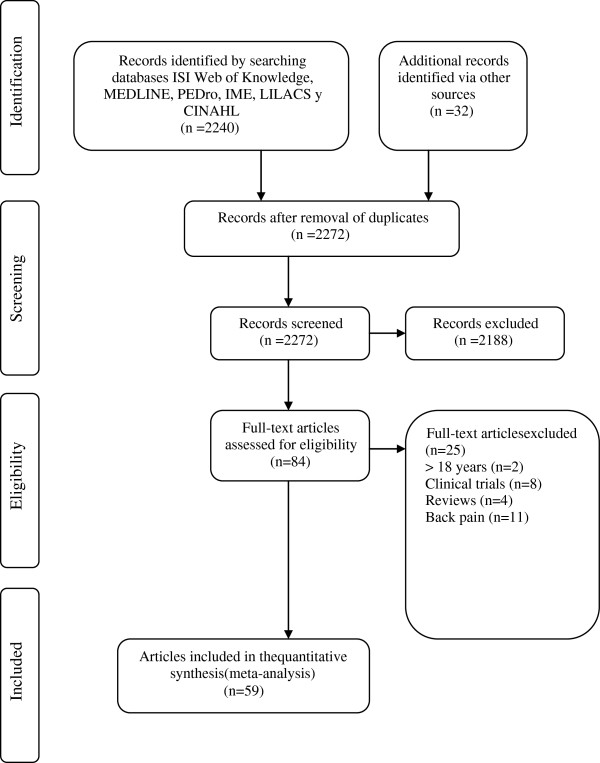
Methods: Studies were located from computerized databases (ISI Web of Knowledge, MedLine, PEDro, IME, LILACS, and CINAHL) and other sources. The search period extended to April 2011. To be included in the meta-analysis, studies had to report a prevalence rate (whether point, period or lifetime prevalence) of LBP in children and/or adolescents (≤ 18 years old). Two independent researchers coded the moderator variables of the studies, and extracted the prevalence rates. Separate meta-analyses were carried out for the different types of prevalence in order to avoid dependence problems. In each meta-analysis, a random-effects model was assumed to carry out the statistical analyses.
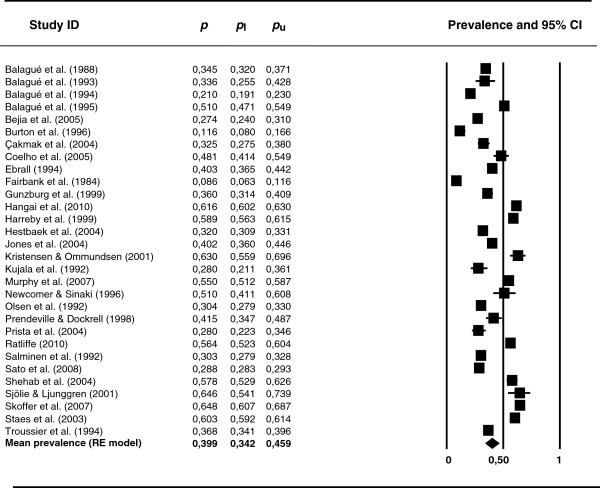
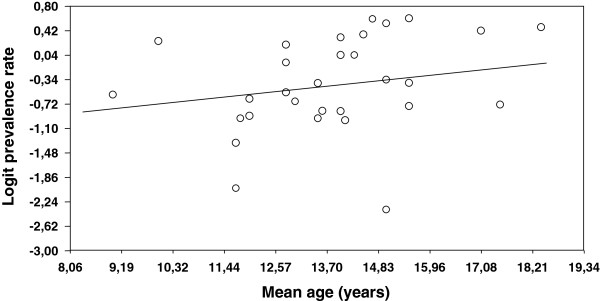
Results: A total of 59 articles fulfilled the selection criteria. The mean point prevalence obtained from 10 studies was 0.120 (95% CI: 0.09 and 0.159). The mean period prevalence at 12 months obtained from 13 studies was 0.336 (95% CI: 0.269 and 0.410), whereas the mean period prevalence at one week obtained from six studies was 0.177 (95% CI: 0.124 and 0.247). The mean lifetime prevalence obtained from 30 studies was 0.399 (95% CI: 0.342 and 0.459). Lifetime prevalence exhibited a positive, statistically significant relationship with the mean age of the participants in the samples and with the publication year of the studies.
Conclusions: The most recent studies showed higher prevalence rates than the oldest ones, and studies with a better methodology exhibited higher lifetime prevalence rates than studies that were methodologically poor. Future studies should report more information regarding the definition of LBP and there is a need to improve the methodological quality of studies.
Figures
References
-
- Anderson L. Educational approaches to management of low back pain. Orthop Nurs. 1989;8:43–46. - PubMed
Publication types
MeSH terms
LinkOut - more resources
Full Text Sources
Other Literature Sources
Miscellaneous
